-
Bryn Athyn, PA and Urban Legends
Until I was 12, our family lived at the edge of Willow Grove, in Upper Moreland Township. We were a short walk from a forested area of the township along Edge Hill Road, abutting Huntington Valley and Lower Moreland Township. Not far from our house was a wooded area with a ravine that was known as Fox’s Den. We never saw any foxes there, but we had fun playing war there.
Even today, the area down around the intersection of Edge Hill and Huntington Roads is still fairly rural, especially south of the Abington Hospital’s June Fete fairgrounds. I have a vivid memory of driving down Huntington Rd. past several fieldstone houses with my father and grandfather. My father wanted to show us the 19th-century stone bridge that crossed the Pennypack Creek and then the now defunct Reading Railroad Fox Chase-Newtown line near the site of the deadliest train accident in the history of the Reading Railroad in 1921 that resulted in 26 deaths. I recall the three of us walking to the creek side and admiring the bridge, now sadly gone, and the deep woods beyond when a PA state trooper approached us and suggested that we might want to leave since there were some “bad people” in the area.
A few years later, my next-door neighbor Ricky McNamara and I were playing one evening when his older sister Linda’s boyfriend, Larry, suggested that we join them for a little ride. To my horror, Larry drove down to the same stone bridge and told us about the Hookman, an urban legend that is widely retold all around the country.
In Larry’s telling, the Hookman was the son of prominent Swedenborgians from Bryn Athyn, a somewhat insular community beyond the Pennypack Creek known for its stunning cathedral and the palatial residences of the Pitcairn family, the Swedenborgian Church’s benefactors. The Pitcairn fortune derived from their ownership of PPG Industries.
The son had been committed to the notorious Byberry State Mental Institution, a Dickensian complex that was the site of ghastly surgeries and misery. It was closed down in 1990 and razed later. During his stay there, he lost his right hand in an accident and was fitted with a stainless steel hook. According to Larry, he escaped and was living in the woods, perhaps receiving covert assistance from his family. While many readers are familiar with the legend, in this version high school students (I recall from Bishop McDevitt) used to drive over the stone bridge and the railroad tracks to a Lover’s Lane in the woods. The couple in the legend were making out in the car when the AM radio disc jockey interrupted the program to warn teenagers that an escaped Byberry patient had been spotted in the Pennypack Woods. The girl suggested that they leave the woods immediately, but her boyfriend protested that it was probably a hoax. A few minutes later they heard trampling noises near the car whereupon the teens finally pulled out of the woods and raced home. When the girl opened the door, she was horrified to find a hook caught in the door handle.
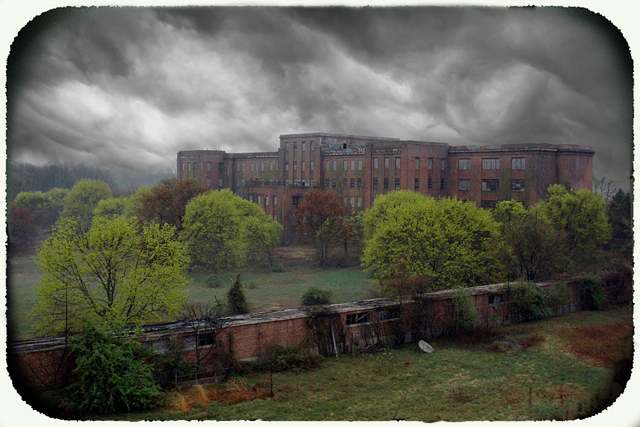
Abandoned Byberry 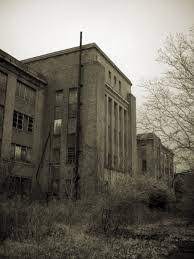
Bayberry ruins 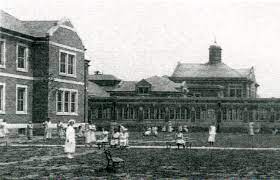
Old photo of patients 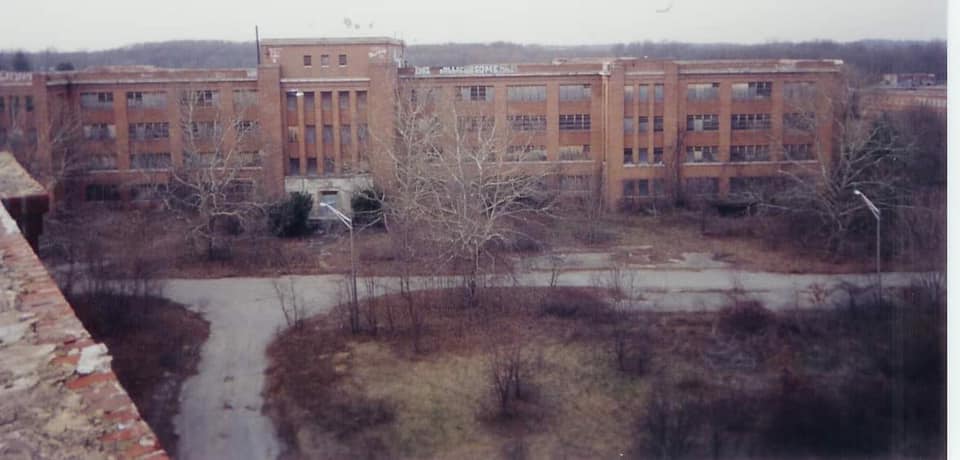
Dystopia I’ve retained a morbid curiosity about this area, still secluded and rural despite its proximity to the Philadelphia city line. Now the area has been converted to a superb conservancy, with miles of trails and preserved farmland.


The village of Bryn Athyn is particularly intriguing. It is the Vatican of the Swedenborgians, followers of the Swedish theologian Emmanuel Swedenborg, whose gravesite I happened upon when visiting Stockholm’s Old Town in 2002. The denomination is officially the General Church of the New Jerusalem. As a child, I was fascinated to see the Gothic tower in the distance, looming above the woods.
The cathedral was built in the English Gothic style in the early 20th century, with Norman and Romanesque accents. Glencairn, the original Pitcairn mansion next door, is now the church’s Glencairn Museum. The village also is the site of a college and private day school associated with the church.


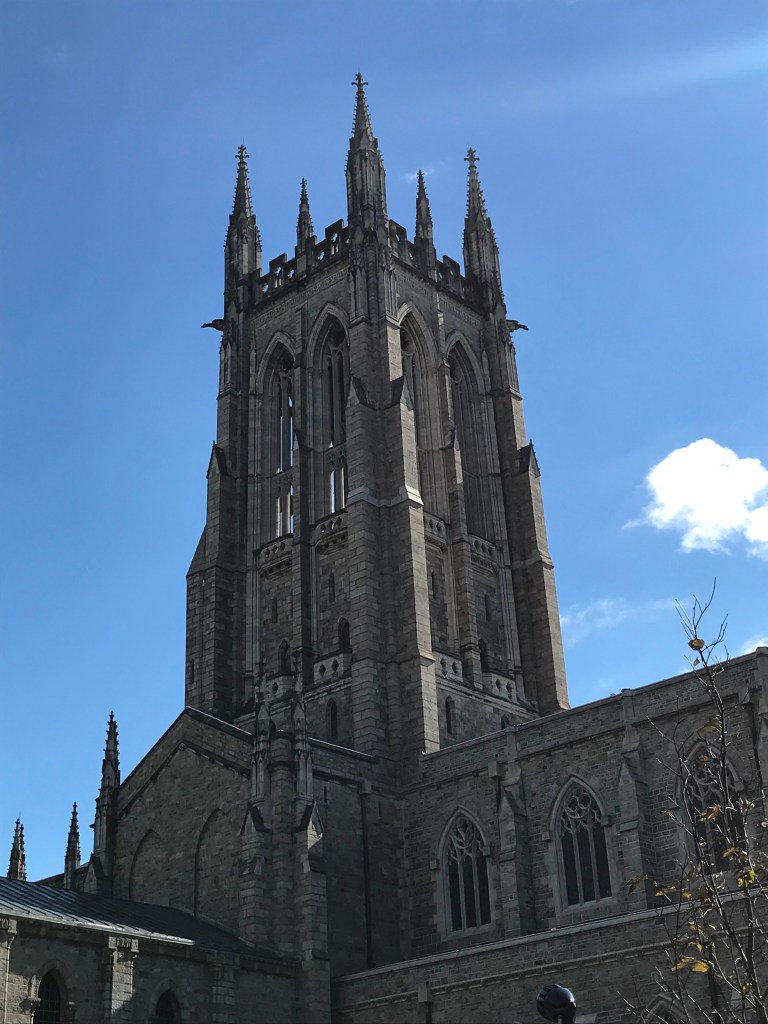


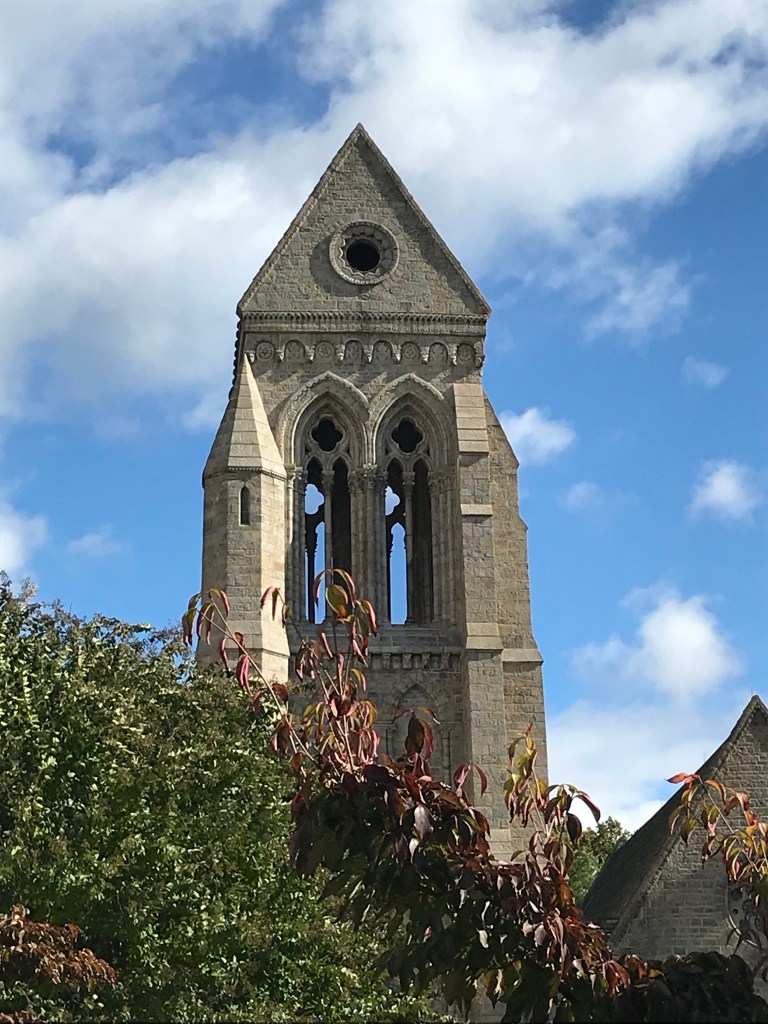


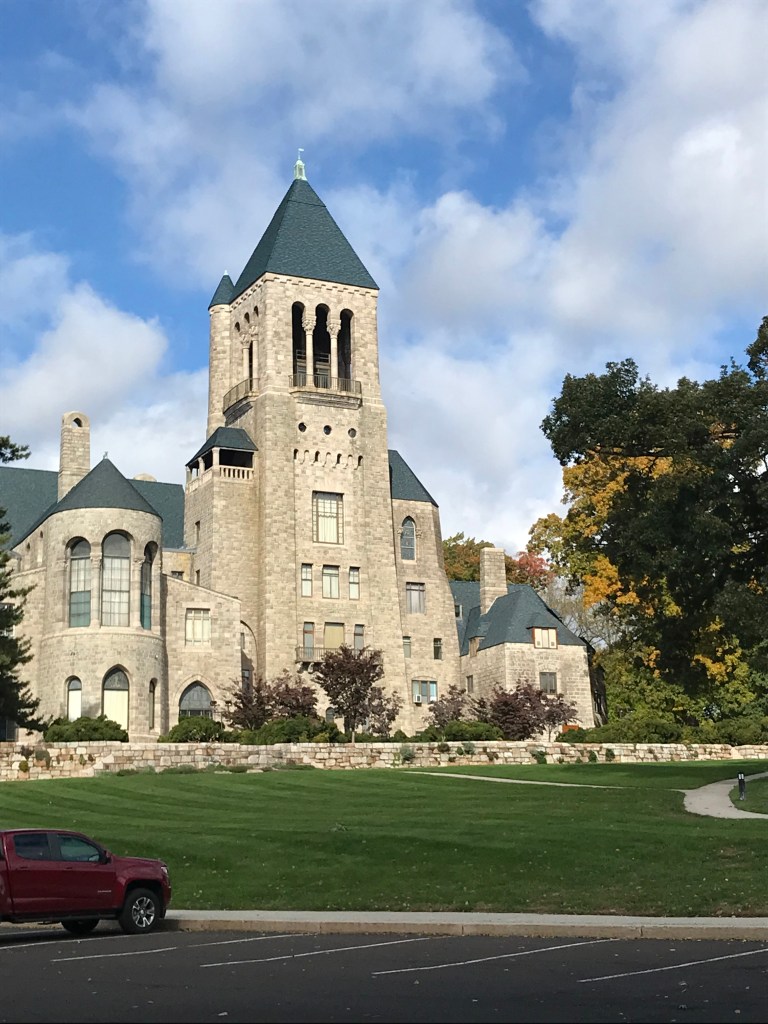


Bryn Athyn Cathedral, Glencairn and surrounding Pennsylvania countryside The Asplundhs are a well-known Swedenborgian family. They own a national landscaping and tree maintenance company. One of my high school classmates married into the family.
The exquisite residential neighborhoods of the village feature trophy assets. My sister stated that it’s difficult to buy a house in Bryn Athyn since many of the sales are private “pocket” listings.
During the same week in late 2018 I also did a 50-mile round trip on the Perkiomen Trail and connected to the northbound Schuylkill River Trail at Valley Forge. For years, I’ve enjoyed hiking along the trail to its starting point in Green Lane Park. Like the Pennypack Trail, it runs along a long-abandoned Reading Railroad line. At the halfway point, I saw a hulking abandoned factory looming above the trail on the Chester County side of the Schuylkill River, just above the old industrial town of Spring City. After researching the site, I discovered that it was the old power plant for the Pennhurst State School and Hospital, another notorious state institution originally called the Eastern Pennsylvania State Institution for the Feeble-Minded and Epileptic. As in the case with Byberry, media investigations of the horrors visited upon the largely teen and preteen inmates at Pennhurst led to its closing in 1987. Reportedly, some parents committed their unwanted children there. It’s said to be haunted and the abandoned institution has been used as a Halloween horror house in recent years. Seeing the abandoned power plant on an overcast November afternoon was spooky enough. The three images below are from photo archives.


Schuylkill River Trail mile marker near Pennhurst 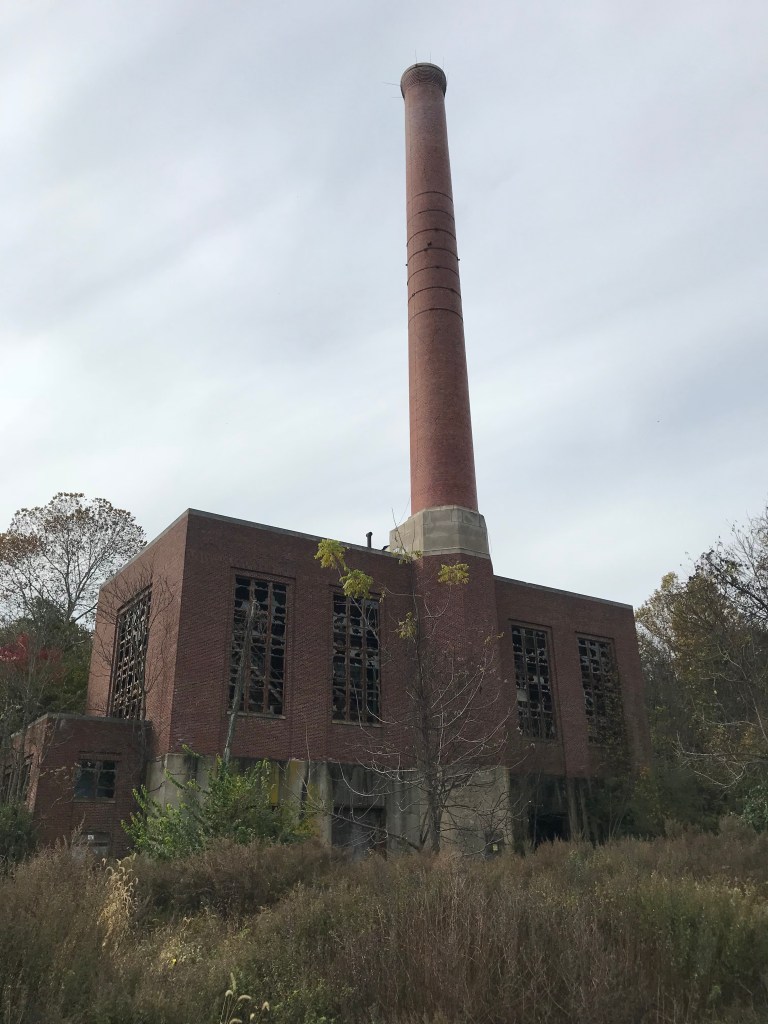
Abandoned Pennhurst power plant -
Program Knowledge
When I was a kid, we used to visit my grandmother’s cottage in Deer Lake, PA. One day my cousins were visiting and one of them asked my father about the inscription on his lighter. He asked “what does zero defects mean”. My father replied that it referred to a high level of quality control in manufacturing. Years later I coined the phrase “zero defects program” to describe a rigorous physical fitness regime paired with clean food and no alcohol.
You will notice that we added the word “program” to the quality control description. My use of the word program has entertained and amused friends and acquaintances for years and their subsequent adoption of it has always pleased me. I must admit that the usage was borrowed from an executive of a wholesale distributor in Minneapolis with whom I worked in my mid-20’s. We were preparing for a company meeting and planned to address the lack of product knowledge among a group of newly-hired sales and customer service employees. The executive decided that we should focus on “program knowledge” to remedy that deficiency and to equip them with the knowledge they needed to drive revenues.Since then, I’ve used the word program in a number of ways. For example, when considering refreshments we speak of a “Bordeaux program”, or an “Amaro program”. Adding program to a noun underscores its prominence and adds a humorous touch. There’s a high-end men’s store that we refer to as a “Haymakers program”. When exercising, we describe a “gravel biking program” or a “hiking program”. Why simply enjoy cheese and salami when you could be indulging in a “charcuterie program”? Program is truly a marvelous modifier and possessing “program knowledge” gives any enthusiast a certain edge.
-
An Easter Week 2019 Visit to Mexico City
One of my close friends suggested that I join him and his father on a visit to Mexico City to celebrate his father’s 80th birthday. I found a large three-bedroom, three-bath Airbnb located in the desirable Art Deco Condesa neighborhood of CDMX (Ciudad de México). We planned to meet at the Mexico City airport since we were arriving from different cities.
I hadn’t considered a visit to CDMX before, but looked forward to visiting the largest city in the Western Hemisphere. As we descended into the megalopolis, I was stunned by the sheer size of this high-altitude city surrounded by smog-obscured volcanic peaks.
I arrived an hour before my friends, so I walked around the woefully undersized Benito Juárez International Airport a bit. The previous PRI (Partido Revolucionario Institucional) government had started construction on a massive $13 billion airport only 3 miles from the existing one that would’ve accommodated 68 million passengers annually. However, the new populist government of Andrés Manuel Lopéz Labrador, known as AMLO, conducted a referendum that resulted in a majority vote against the new airport, even though construction had already begun. As of this writing, a second airport has opened at a former airbase, though it’s smaller than the existing one and serves cargo and low-cost carriers.
Once my friends arrived we walked outside to meet our Uber driver for the short and inexpensive ride to Condesa. My basic Spanish came in handy.
We checked into our Airbnb with its private elevator entrance. It appeared that all of the apartments were being rented by Americans.

Living room and balcony 
My luxurious bathroom 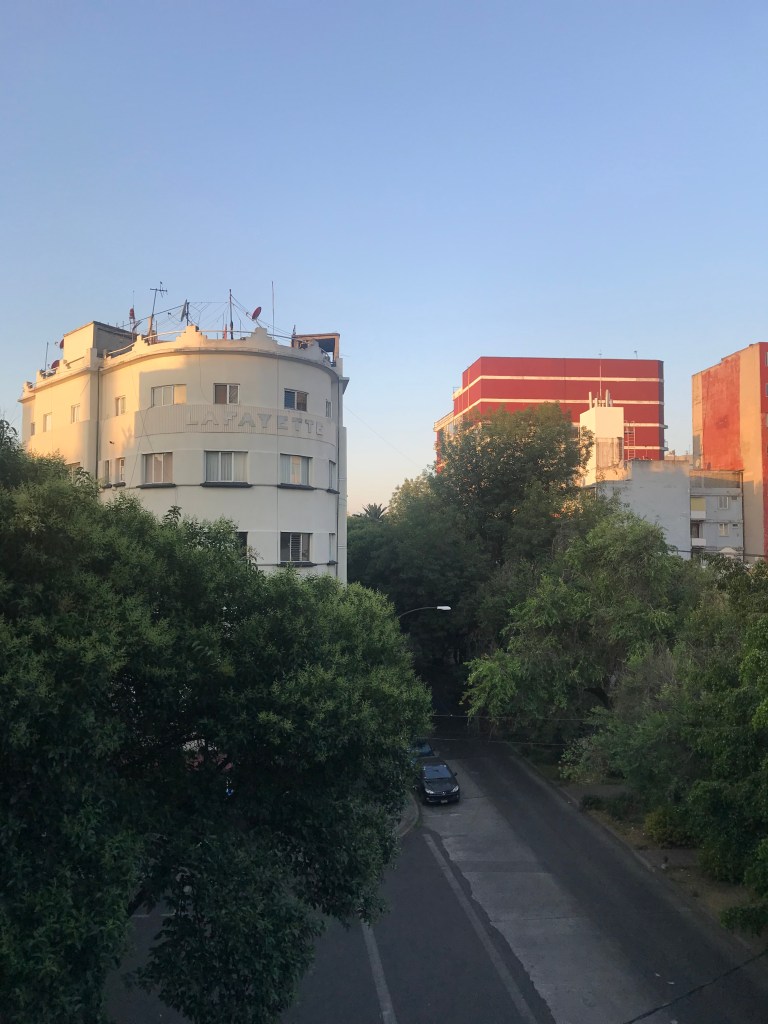
Balcony view My friend and I went to a grocery store to grab some supplies. We found that it was owned by Wal-Mart, which has a big presence in Mexico. While most of the groceries were mediocre, we were intrigued by the ingenious self-carbonating water bottles. There’s probably some EPA prohibition in the US on this excellent product. 90% of CDMX residents consume bottled water, the highest in the world, owing to widespread distrust of the municipal water supplies.
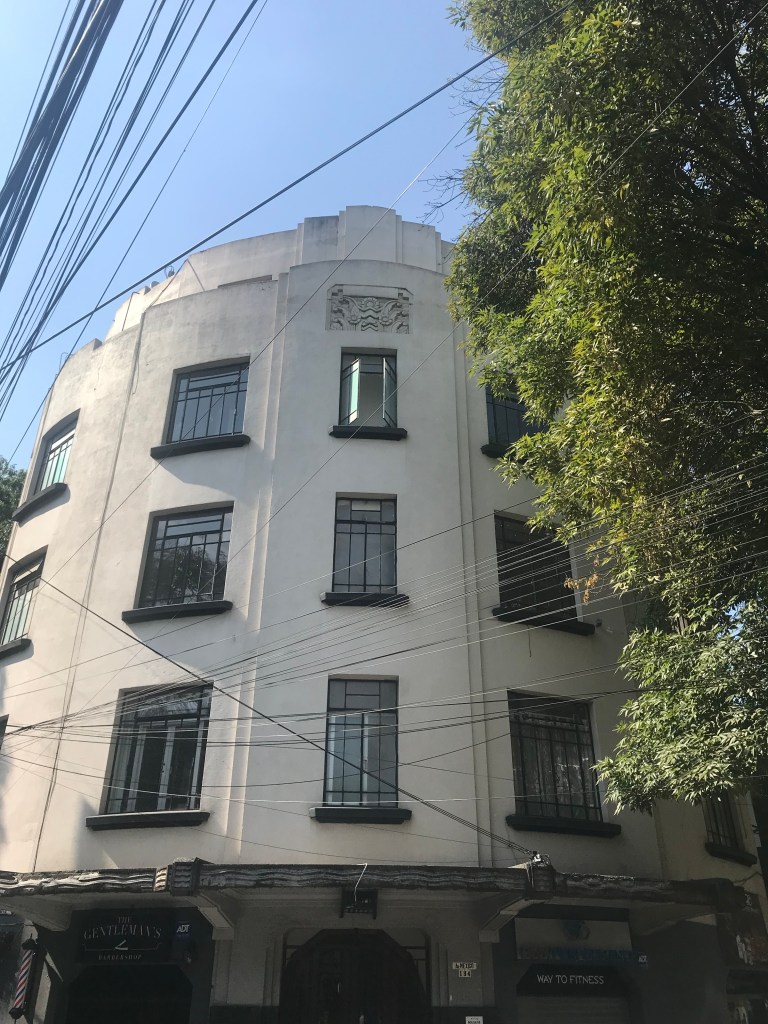
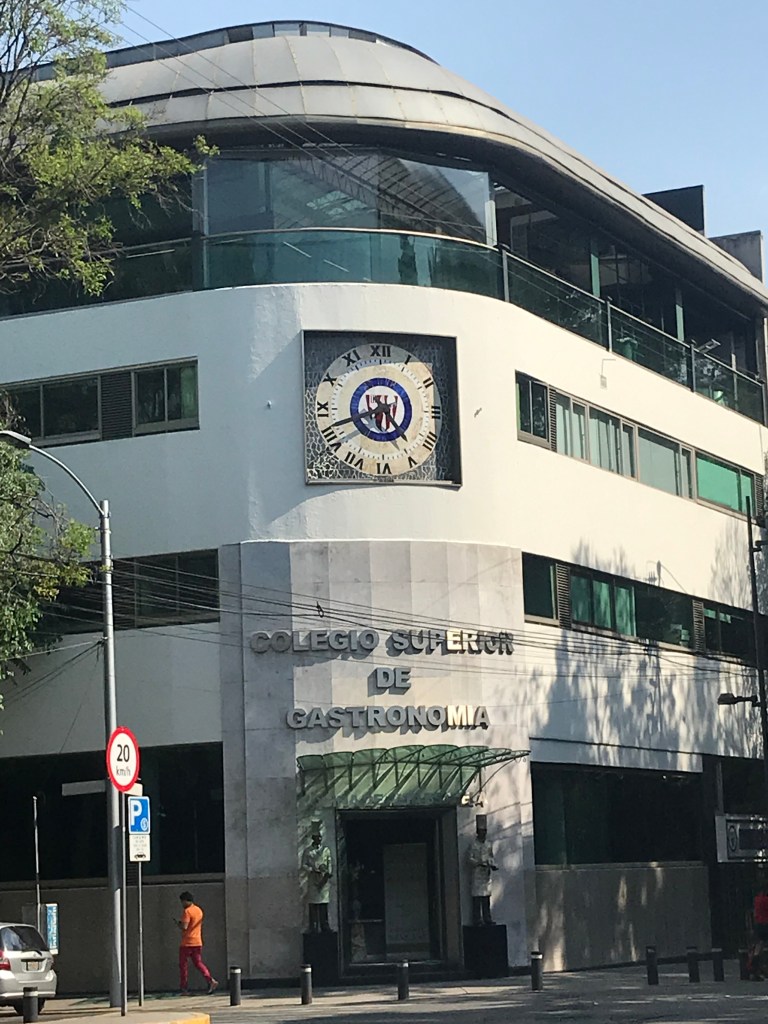
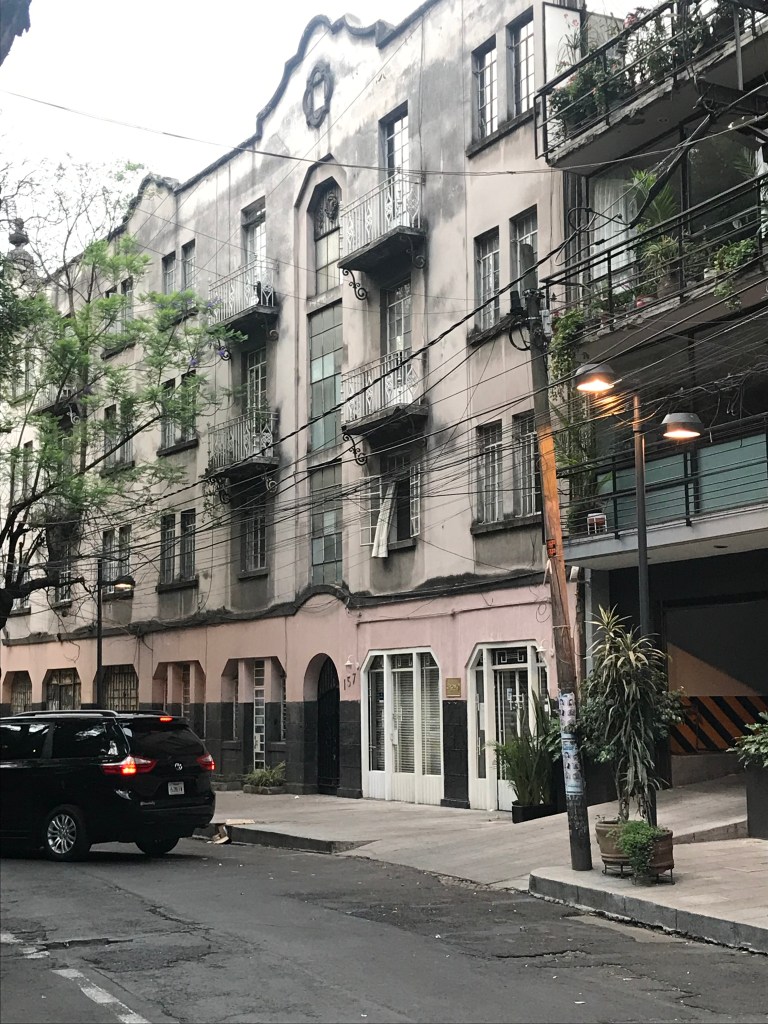
We made tequila cocktails in the apartment before walking over to El Tizoncito, a well-reviewed taco place nearby. On the way, we passed some exquisite Art Deco buildings constructed in the 1930’s and 1940’s when Condesa was an elegant inner suburb. Before that, it had been the Jewish quarter. Now the whole area is gentrified and upmarket.
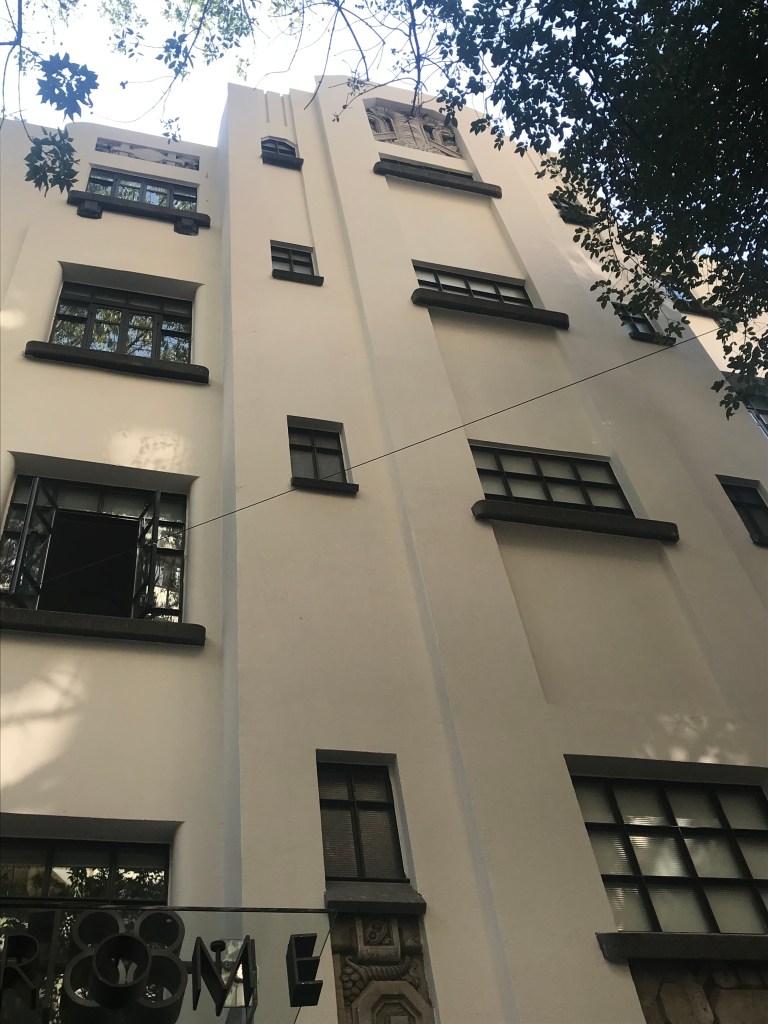

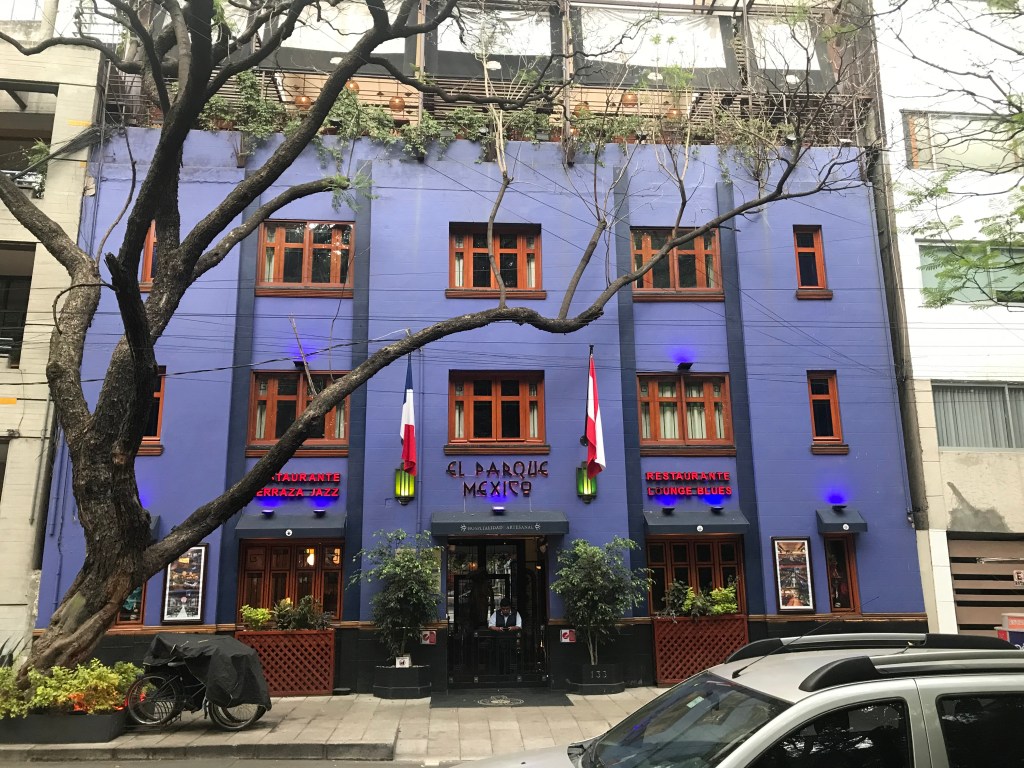

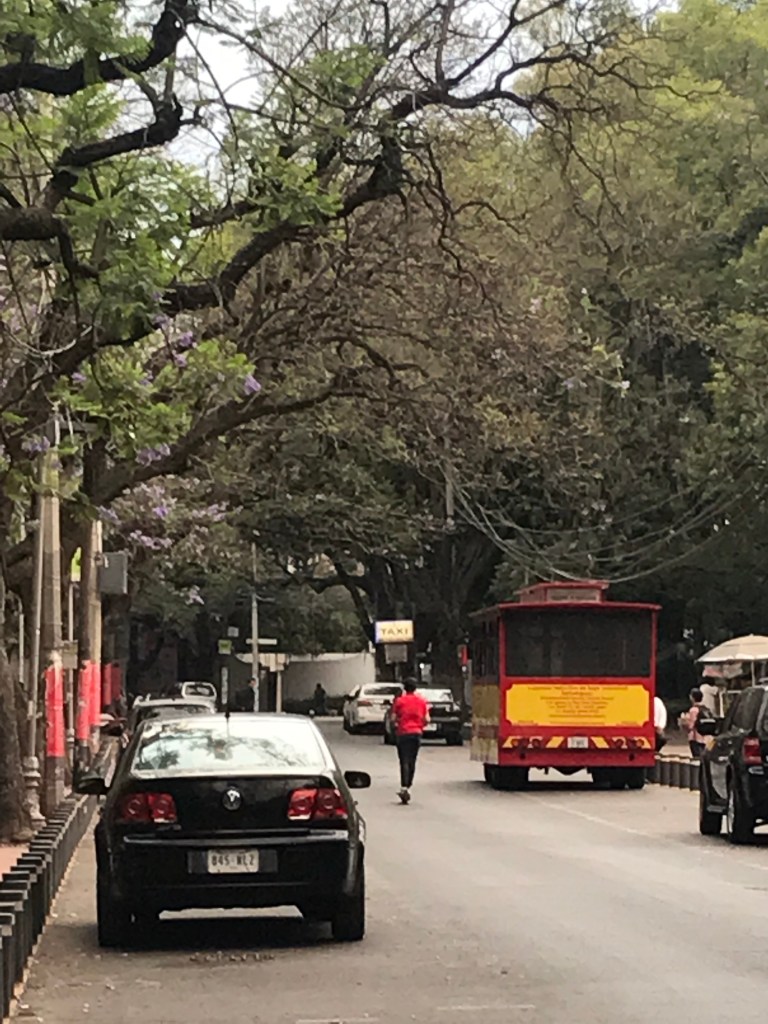
The taco place was excellent. We sat at an outside bar watching the attendant expertly carve the pork and toss pineapple slices in the air that landed perfectly on the freshly made corn tortillas. I could’ve eaten ten. The beer was cold and refreshing. While seated, we struck up a conversation with a nice Mexican couple and their charming daughter. The parents were both petroleum engineers with Pemex, the state-owned oil company, and traveled often to the US with their daughter for dance competitions. They lived nearby in one of the upscale historic barrios.
I woke early the next morning, Easter Sunday, and brewed some coffee and stood on the balcony enjoying the morning quiet. At 7,349 feet above sea level, CDMX is higher than any mountain east of the Rockies. Because of this high altitude, CDMX has an unparalleled mild climate, with lows around 60F and highs in the low 80’s year round and negligible humidity. Aside from the smog, the climate is enviable.
After my friends awoke and had coffee, we headed out by Uber to visit the house where Lev Trotsky, Lenin’s right-hand man, lived in exile and where he was murdered by Ramón Mercator, an NKVD agent. My friend’s father is somewhat of an expert on Trotsky and gave us a primer on his life before we set out. Although he was widely thought to be Lenin’s successor, the wily Stalin outmaneuvered him and stripped him of his party membership and deported him soon after Lenin’s death.
The Trotsky house is perfectly preserved and still contains his library and household goods. He ended up in Mexico as a guest of the state, after living in Turkey and Norway. He was friends with Frida Kahlo and Diego Rivera, two well-known Mexican artists, and received a steady flow of acolytes. When his savage criticism of Stalin became too much for the Soviet despot to ignore, Stalin’s secret police chief Beria began to plan his execution. Mercator insinuated himself into Trotsky’s inner circle and eventually had the opportunity to enter Trotsky’s study and murder him with an ice axe to the head. Trotsky died at 60 on August 21, 1940. His grave is located in the garden.

Bust of Trotsky 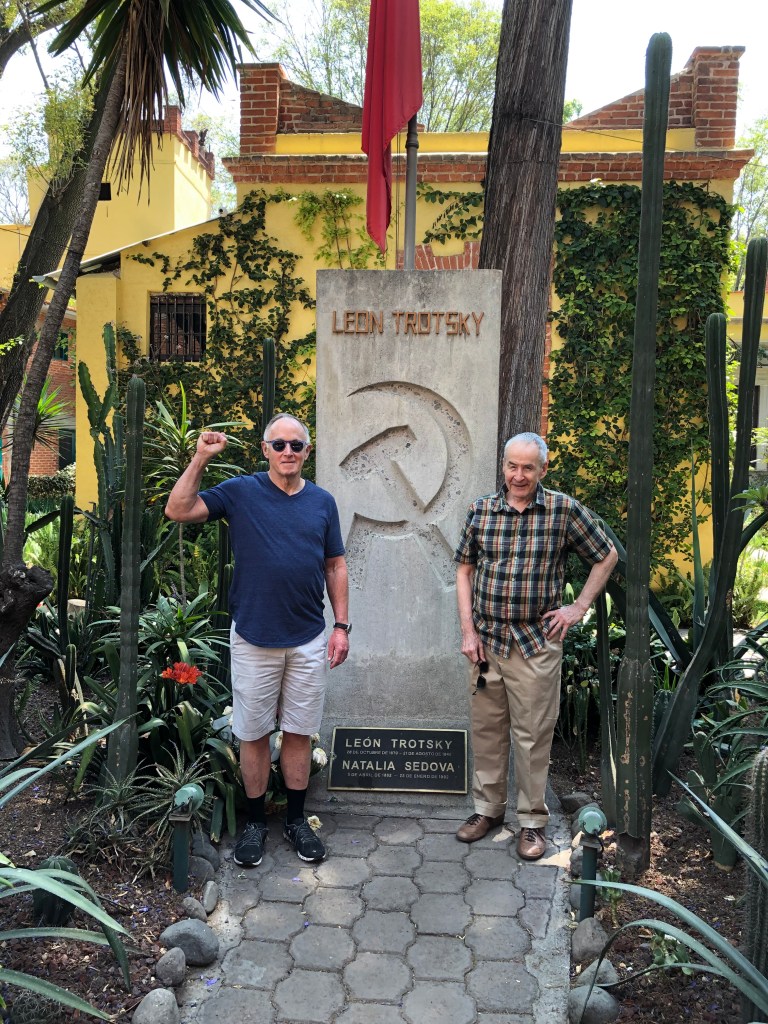
Trotsky’s grave with irreverent visitors After visiting the Trotsky house, we walked around the neighborhood and were surprised by the relatively empty churches on Easter Sunday. It may surprise visitors who assume that Mexico is a pious Roman Catholic country to find that the 1917 constitution is profoundly anti-clerical. The Church was stripped of its properties, religious orders were banned, foreign-born priests were deported and priests and religious lost the right to vote, proselytize or wear clerical garb in public. Under President Calles, even more rigorous measures were employed, which resulted in the Cristero War between the state and devout Catholics, which finally ended in 1929 through the intermediation of the US. In 1991, most of the anti-clerical statutes were repealed, but the urban population is largely indifferent to the Church, as evidenced by the empty churches on Easter.
After returning to the Airbnb, my friend’s father decided to rest up while my friend and I embarked on a long walk through Chapultepec Park to the fancy Polanco district. We had to cross several immense boulevards, including El Paseo de la Reforma, to enter the massive urban park. On the way, we passed by a military base surrounded by concertina wire, although we felt perfectly safe. We had to watch out step, though, since the frequent seismic activity had lifted up sidewalks, which lay unrepaired.
The park itself was filled with multi-generational families enjoying the balmy afternoon. I was struck by how few smokers there were and the absence of either obese or exceptionally fit people. The population appears to be right in the middle of the fitness bell curve. I also noticed an appealing lack of litter. The citizens are proud of their well-used park and keep it clean.
As we left the park, we crossed into the Polanco district, which was full of high-rise condos and apartments and towering hotels and offices buildings. All the luxury brands were represented. We popped into a cafe that sold cold-pressed juices and enjoyed one. The fruits and vegetables in CDMX are superior. On the way back, we commented on the rigorous security measures in place.
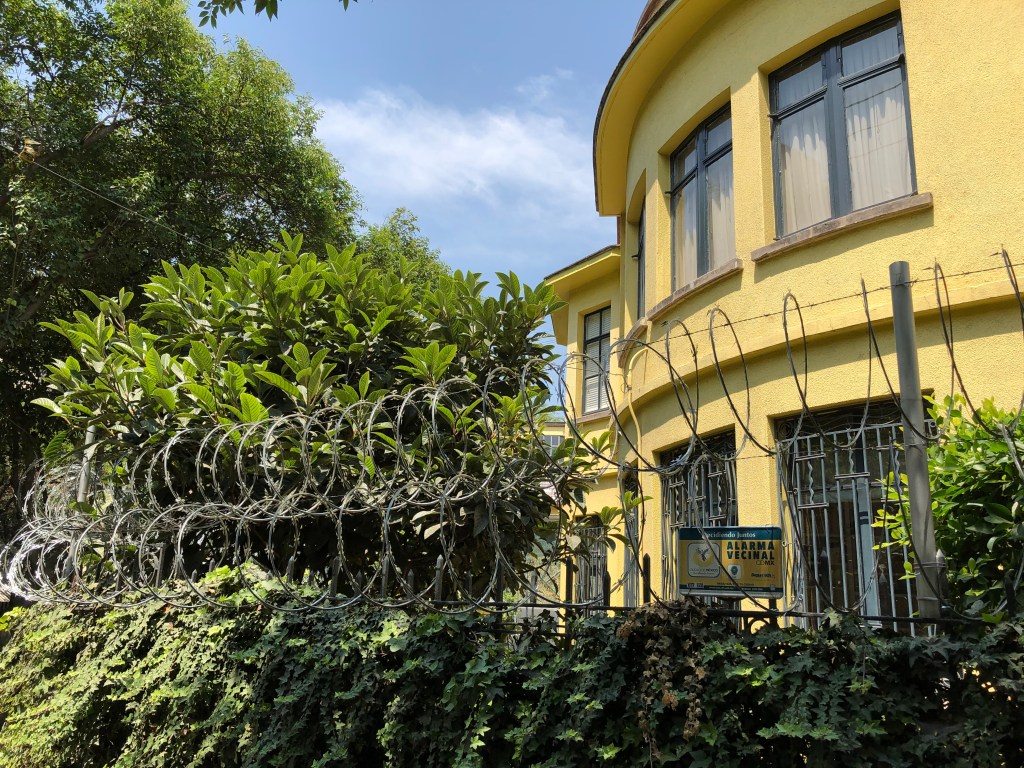
Concertina wire 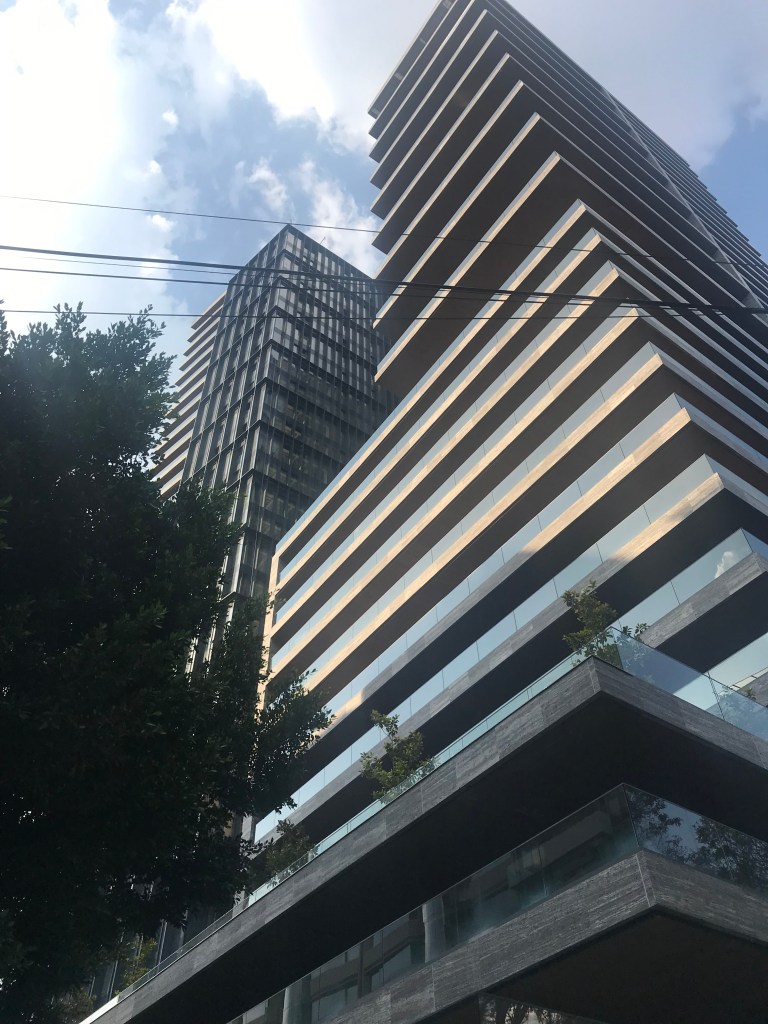
Polanco apartment towers 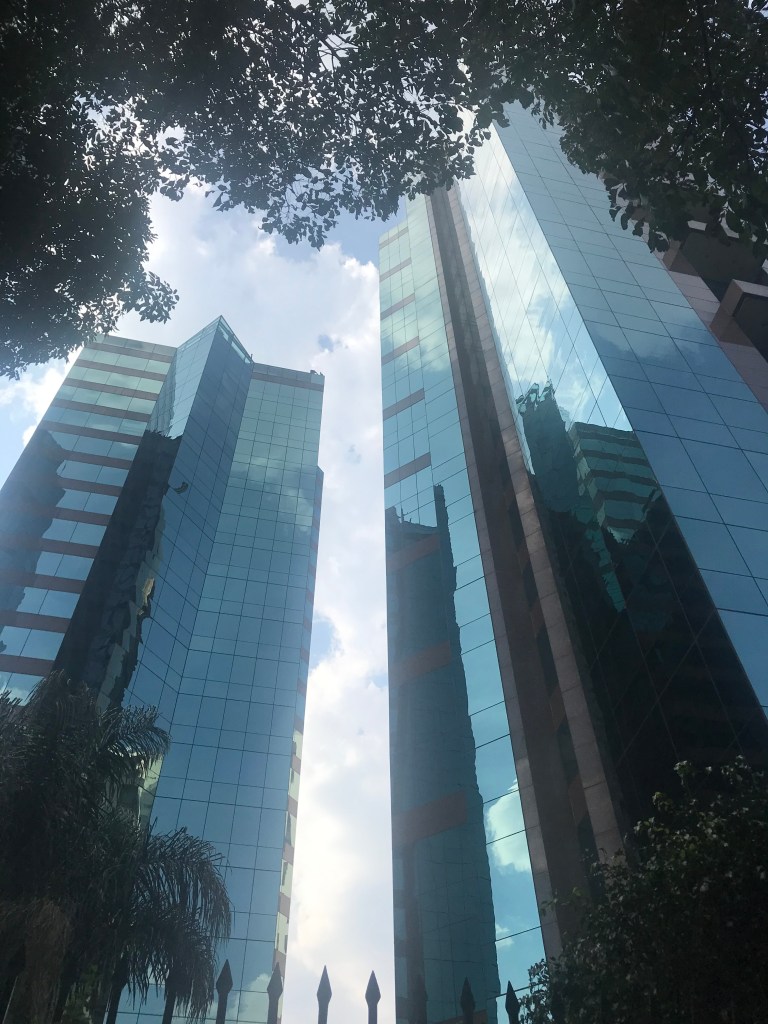
Polanco office towers The neighborhood was surprisingly quiet for Easter Sunday night, with numerous restaurant closures. We found an Argentinian steakhouse, La Vid Argentina. The owner, from Argentina, was our server and the meat and wine were very good.
After dinner, we walked my friend’s dad back to the Airbnb and then we took off to complete our planned 10-mile daily walk, with about a mile remaining. Several sights raised our awareness. The uneven sidewalks were, of course, a hazard; however, the silent police cars with flashing blue lights were a bit odd. We saw several very slowly moving around the neighborhood. As we walked down the broad Insurgentes around 10:00 pm we passed Tom’s Leather Bar and were amused by the furtively moving patrons as they headed to the main door. Apparently, it’s quite a tourist draw.
The next day we took an Uber downtown to El Centro Histórico to visit the Zócalo and the Palacio de Bellas Artes (Museum of Fine Arts). Sadly, the museum was closed on Monday, but we were able to view the entrance hall. We then walked over to the Sanborns department store since my friend’s father wanted to buy a pair of walking shorts. The store was a bit antiquated and looked like it would’ve been at home in the Soviet Union.
From Sanborns we made our way through the throngs of people to the Zócolo, which is the massive governmental center of the country. We were eager to tour the immense Gothic Metropolitan Cathedral, which dates from 1573, when construction started. The solid gold throughout the many chapels adjoining the towering nave speaks to the immense wealth of Spanish Mexico and the Church. As the centerpiece of the Zócalo, it is complemented by the neo-Gothic and Art Deco government buildings across from and adjacent to it. The Mexican flag in the plaza is the largest I’ve ever seen. The annual Independence Day military parades are staged on the Zócalo.
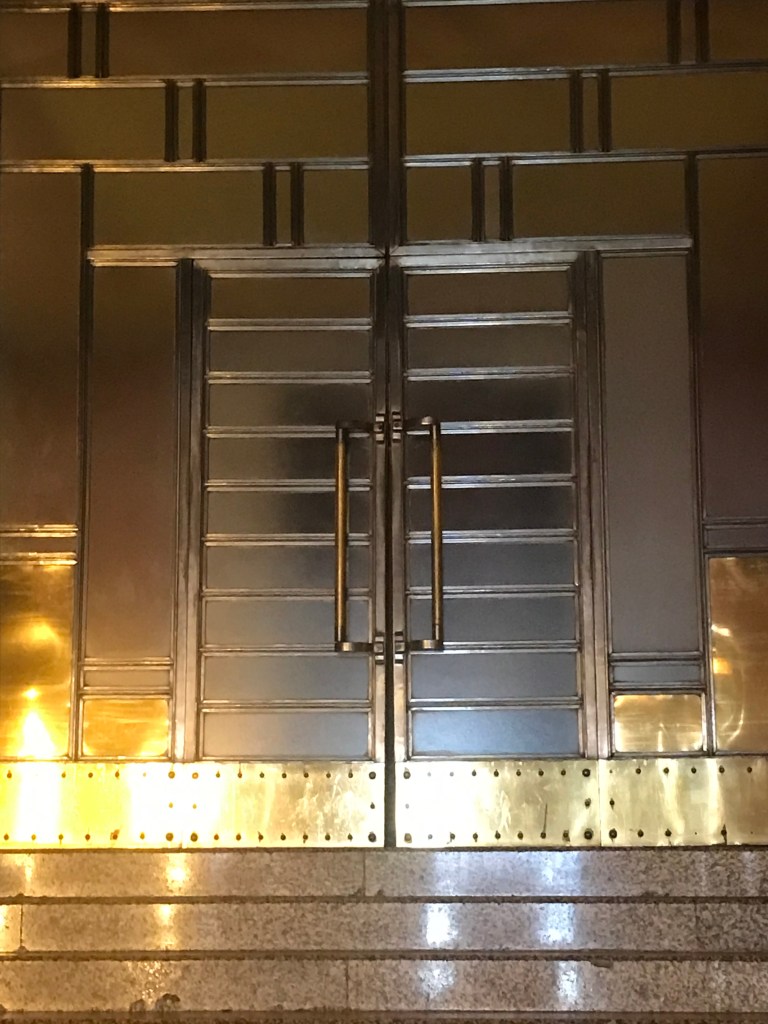
Massive Art Deco bronze doors at The Palace of Fine Arts 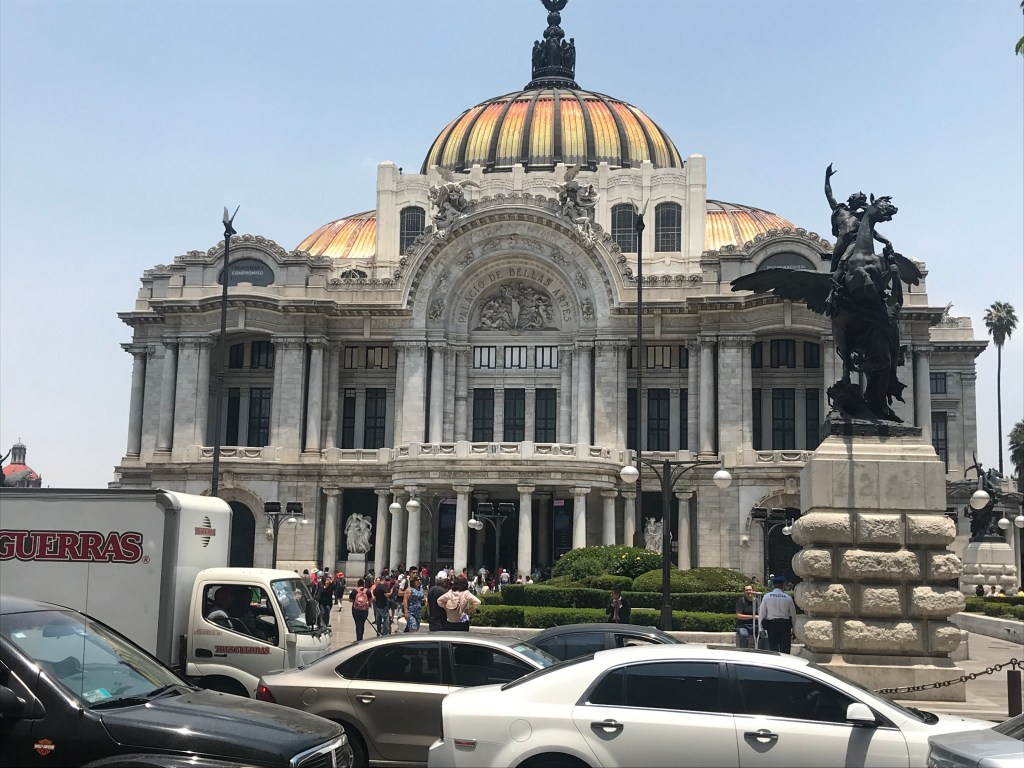
The Palace of Fine Arts 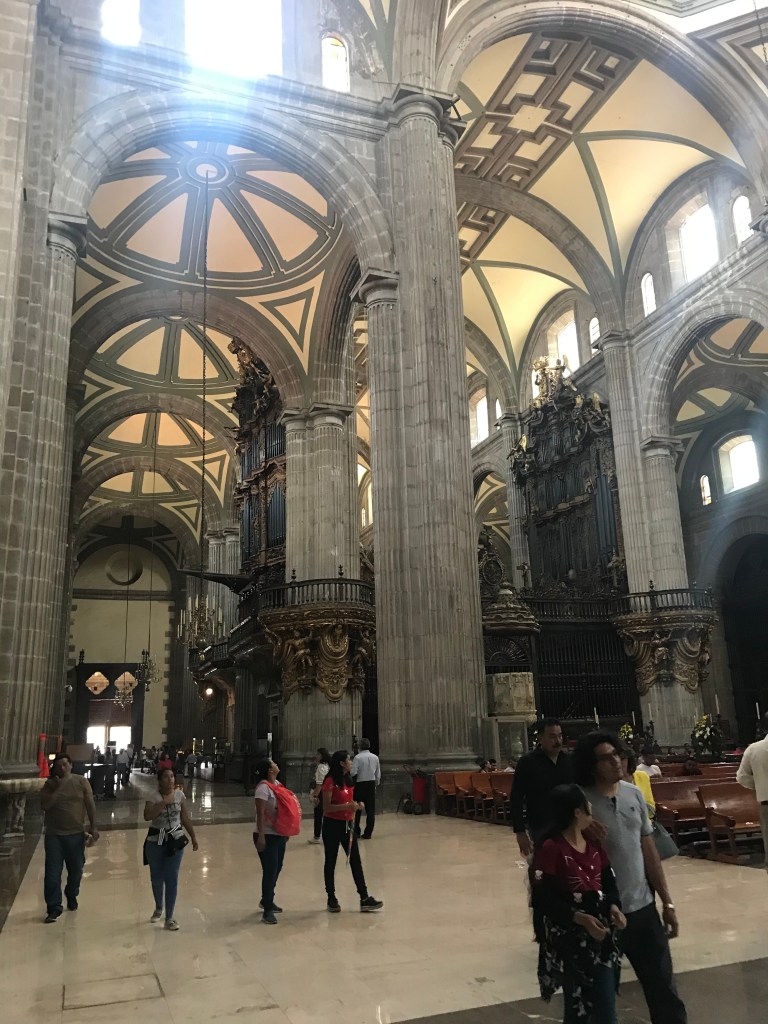
Art Deco museum foyer 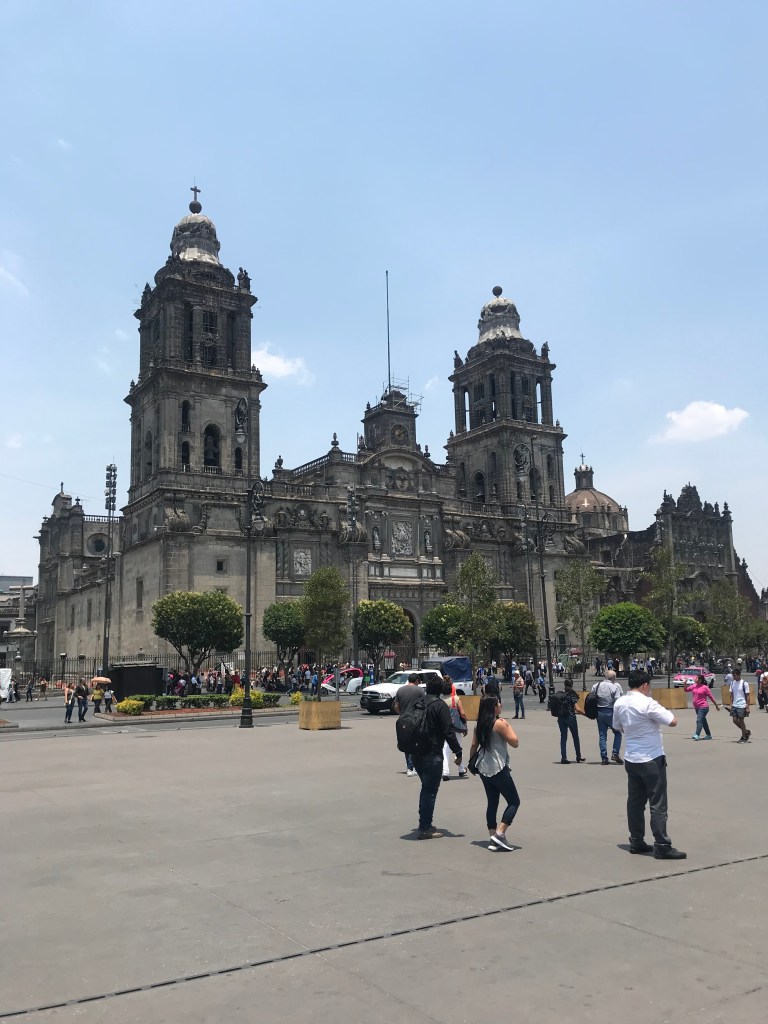
Metropolitan Cathedral 
Main altar 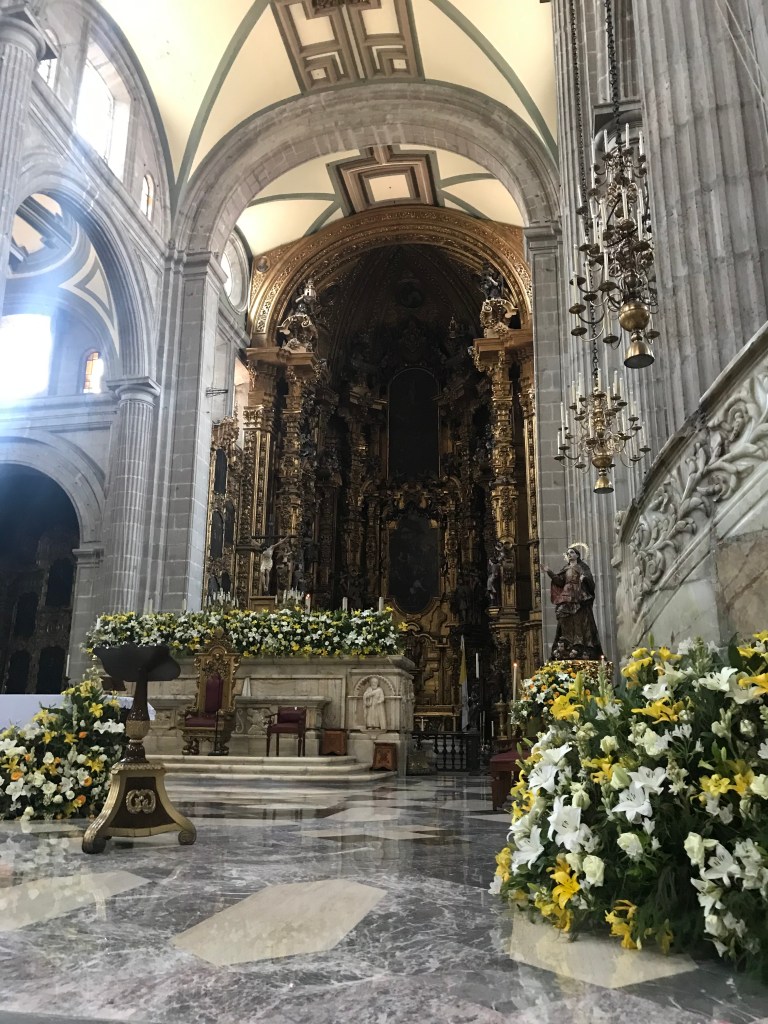
Chapel For dinner that night we chose Ultramar, a 20-minute walk from our Airbnb. The food was superb and the wines from the Valle de Guadalupe in northern Baja were quite fine. We made early reservations since they were closing at 7:30 that night. We had the impression that early closures might be surprisingly common in CDMX, but a recent online search indicated that the restaurant is normally open until 1:30 am.
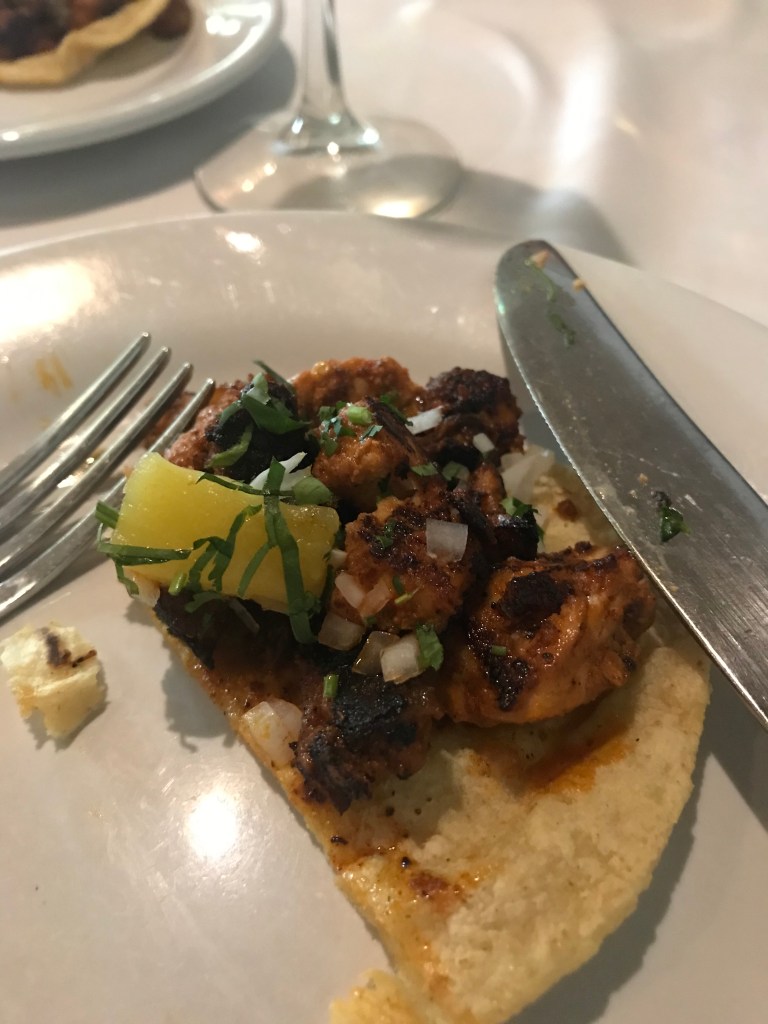
Seafood taco 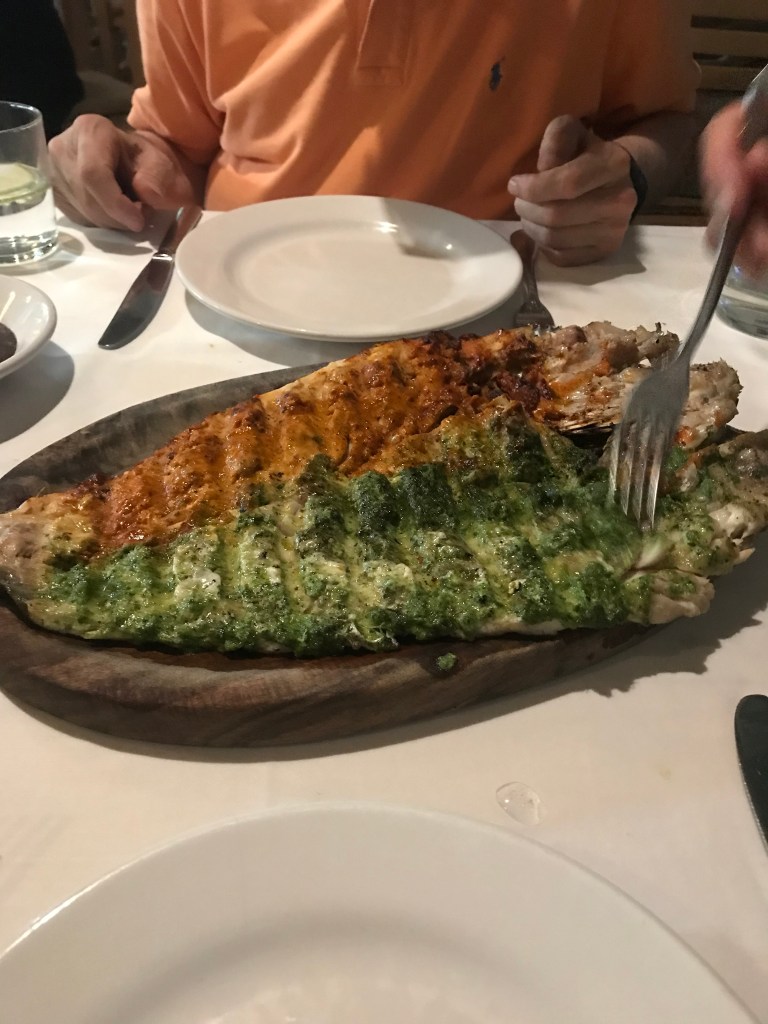
Butterflied sea bass with two sauces 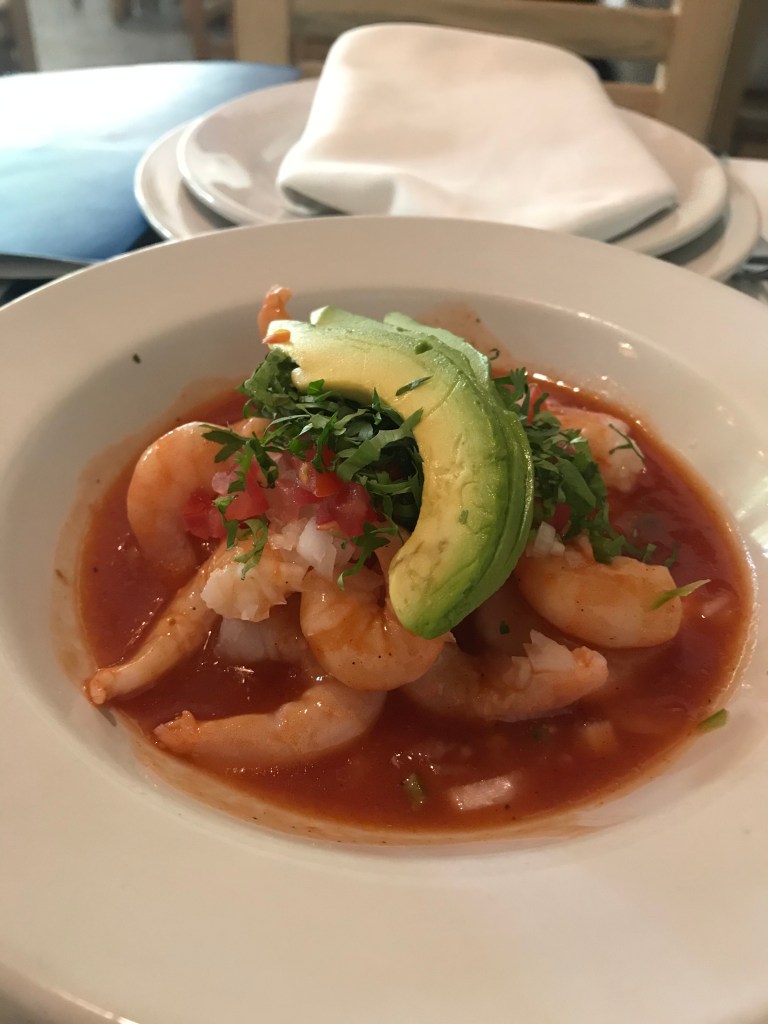
Shrimp cocktail 
Ultramar interior on Easter Monday After dinner, we took a stroll through the Condesa neighborhood to enjoy the parks and architecture. On our walk, we dropped by a lovely bakery and bought some attractive pastries from the saleswoman, dressed in a crisp white smock-very traditional. When we got back, we were dismayed that the pastries were tasteless, with the consistency of sawdust. I refer to this as the Latin American “pastry deception” since I had an identical experience in Santiago de Chile many years earlier.

Panaderia 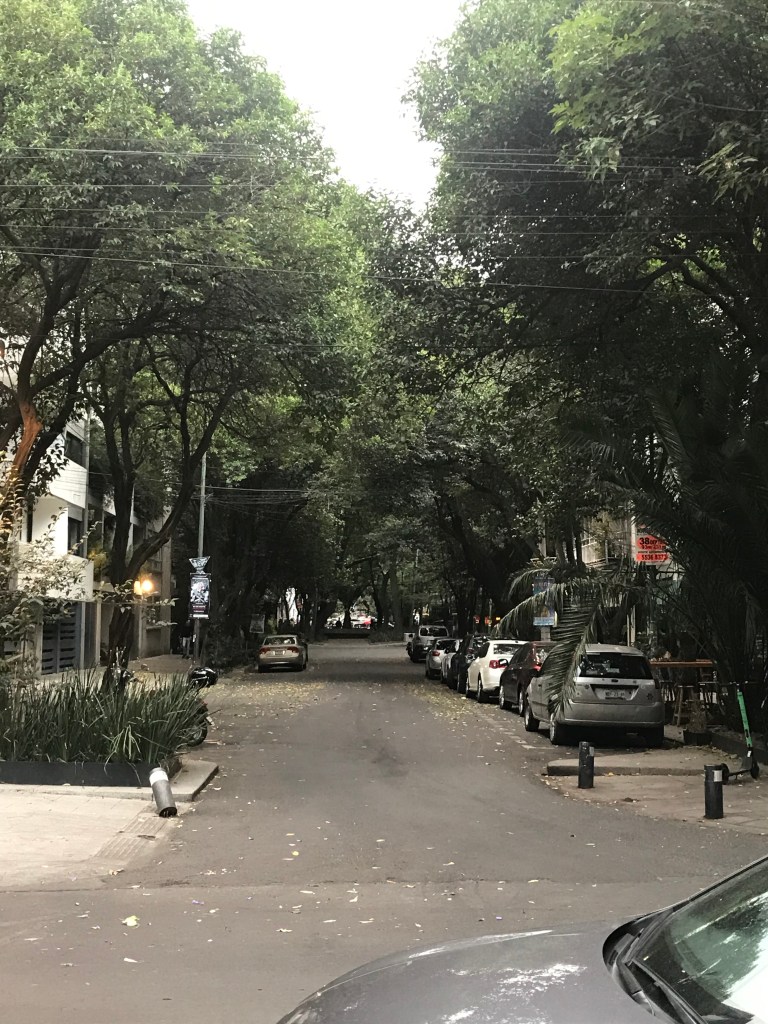
Condesa street 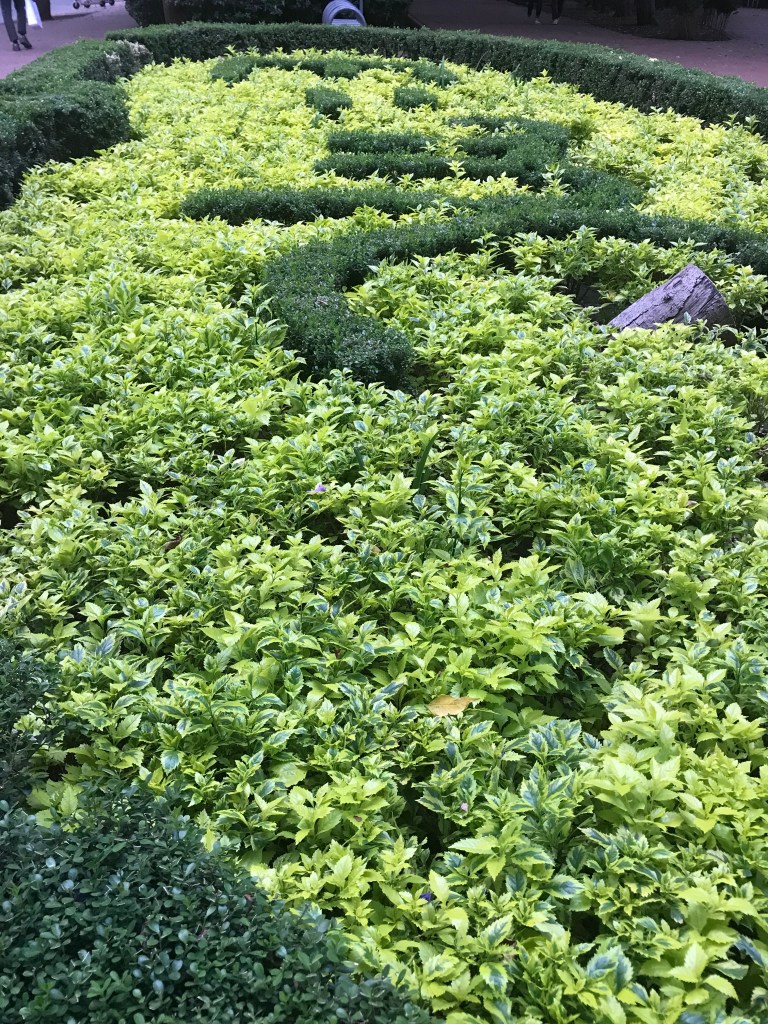
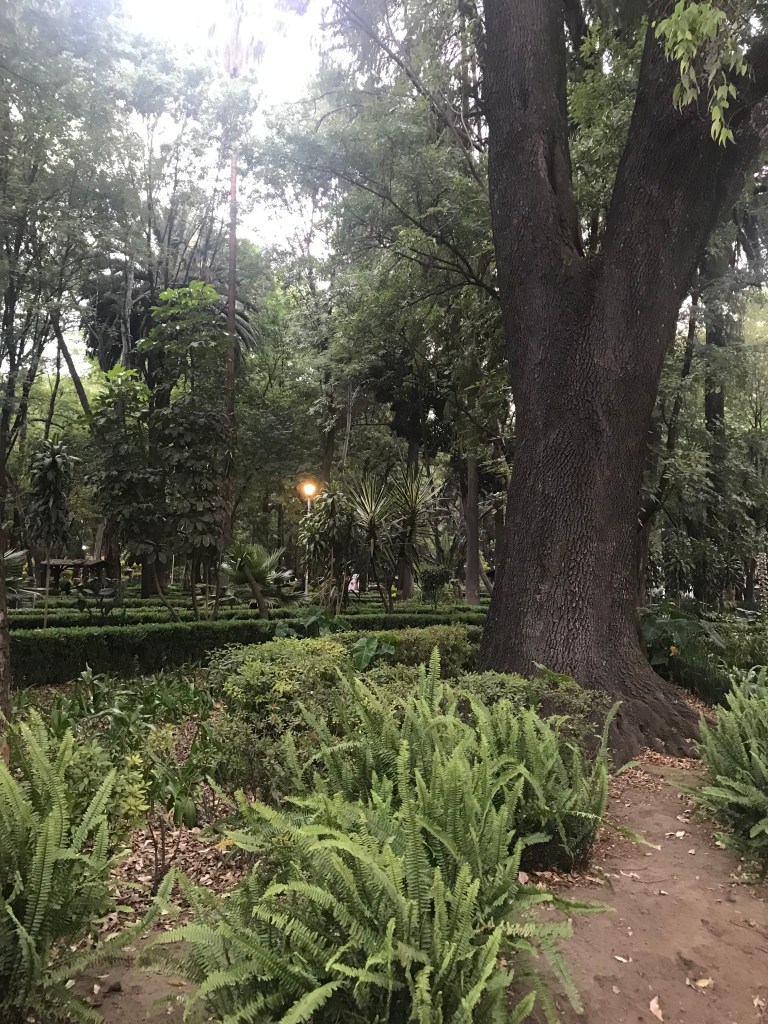
Parque México 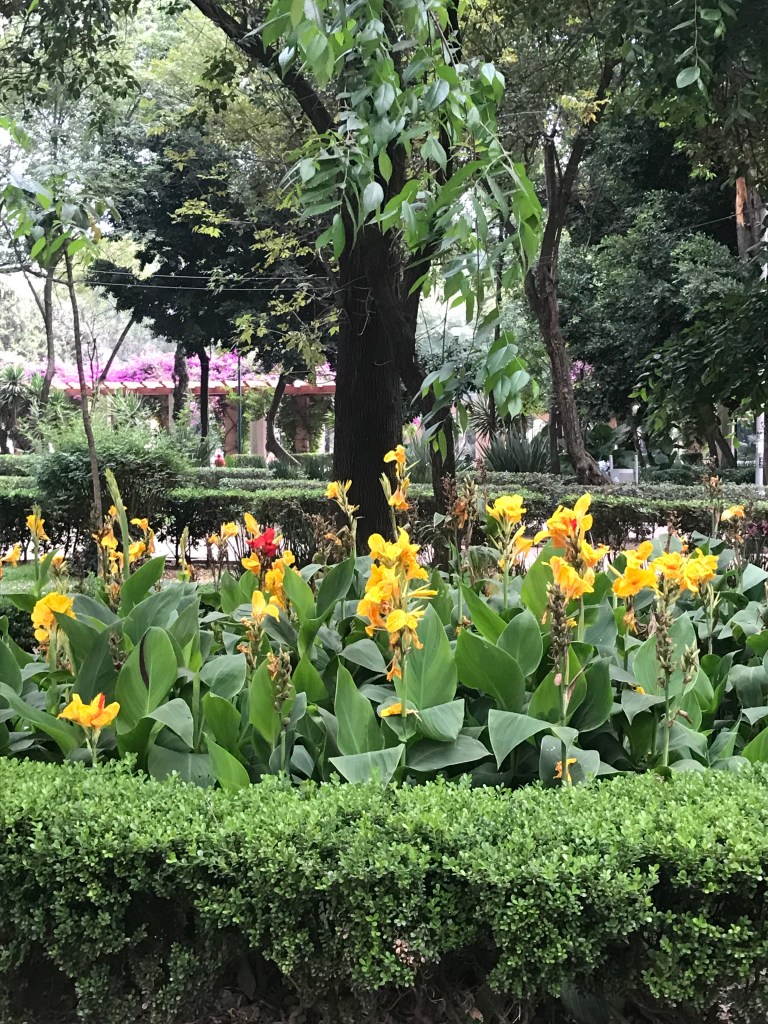
Parque España 
Parque México That evening we took our private elevator to the rooftop patio to watch a passing thunderstorm and enjoy the smog-free evening. We could see the towers of the Santa Fé financial district and the local neighborhood from our perch.
Rooftop terrace 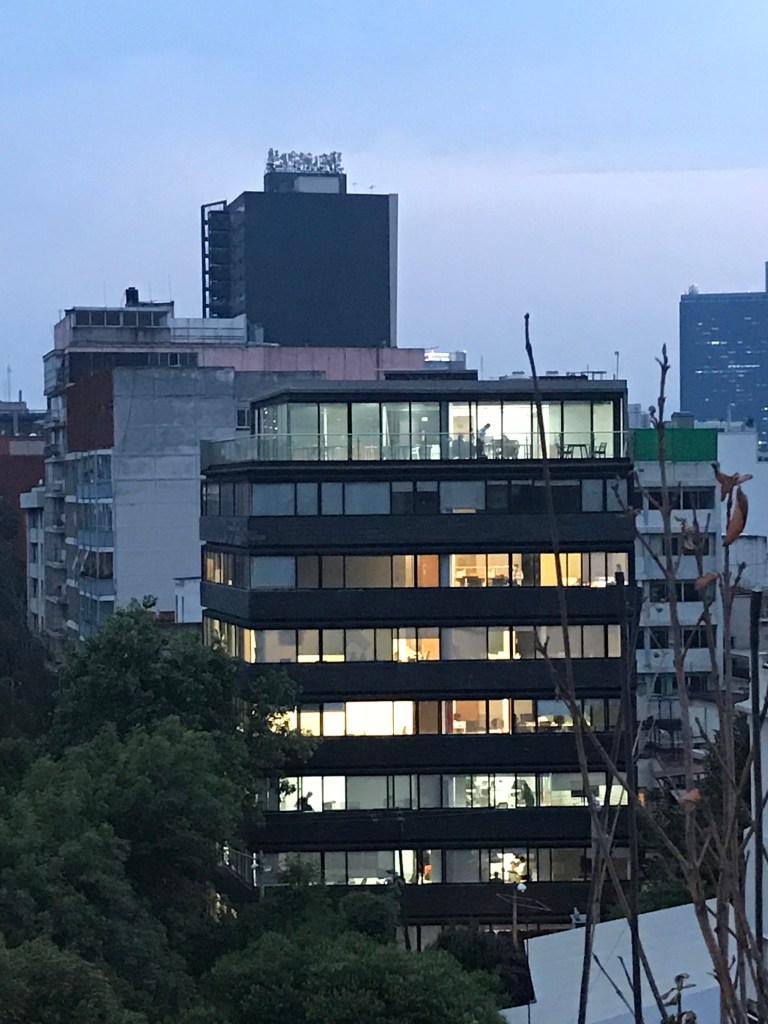
Condesa condos 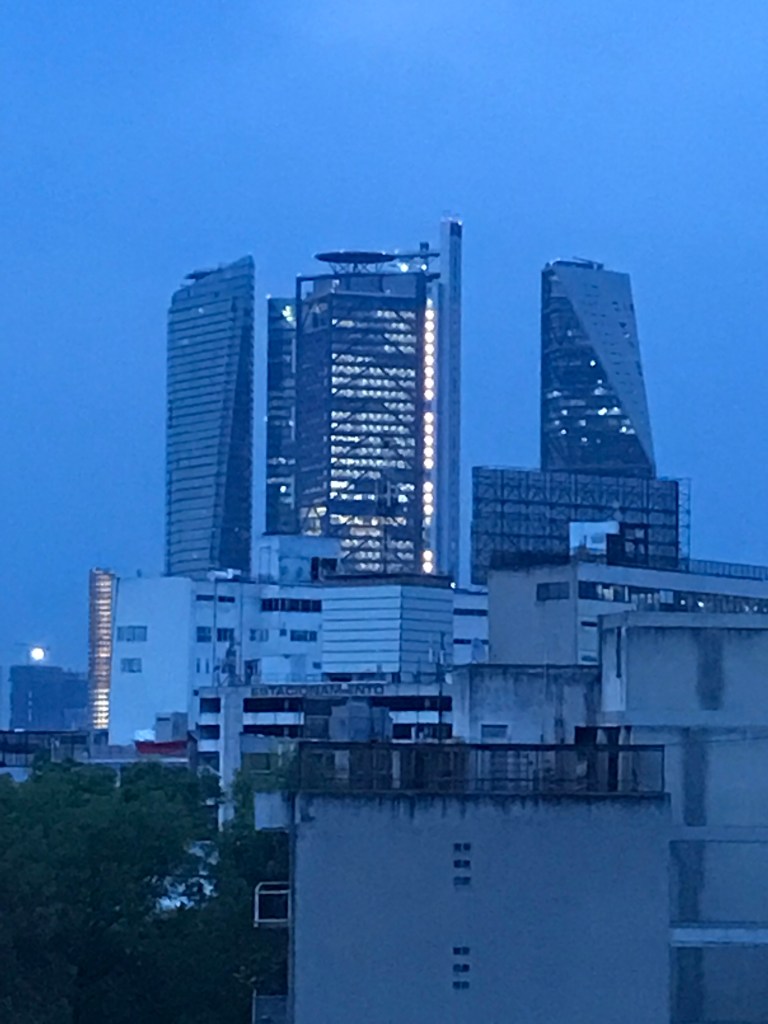
Office towers My friend’s father enjoyed CDMX so much that he decided to stay for a few days on his own, so his son made reservations nearby at another Airbnb. I flew back the next morning. I’m pleased that I joined this pleasant excursion to CDMX. It’s become such a popular destination for American expats that the local population is beginning to lightly resent them. Covid provided an opportunity for remote workers to decamp in a lower-cost city while still enjoying the amenities that such a megalopolis provides. This immense city is certainly worth a visit, especially since it’s a decidedly foreign capital within a few hours’ flight from most of the US.
My next set of posts will focus on my 2019 return trip to Ukraine, with the addition of Belarus and the Baltic states.
-
Warsaw: September 3-5
My Airbnb wasn’t quite ready, so I had coffee and a pastry at a little cafe around the corner. My flat was quite nice, within 5 minutes of the completely reconstructed Old Town, which was razed to the ground after the 1944 uprising by the Armia Krajowa AK, the Polish Home Army, which remained loyal to the London-based Polish government-in-exile and anti-communist. The AK was much larger and more effective than the French Resistance, but is not well known in the West. During the Warsaw Uprising beginning in August 1944, the AK recaptured much of Warsaw from the Wehrmacht in the hopes that the Soviet Army just across the Vistula would intervene to decisively defeat the Germans. Stalin cynically did nothing, and the Germans proceeded to crush the rebellion, reclaiming control in late September. Stalin sat by so that the Germans could defeat the AK, which Stalin saw as an armed impediment to his plan to install a post-war Soviet puppet state. The Germans eventually destroyed almost 85% of the city, including 100% of the historic center.
As in Gdánsk, the meticulous rebuilding of Warsaw was remarkable. Many of the pre-war buildings appeared as if they’d never been destroyed.
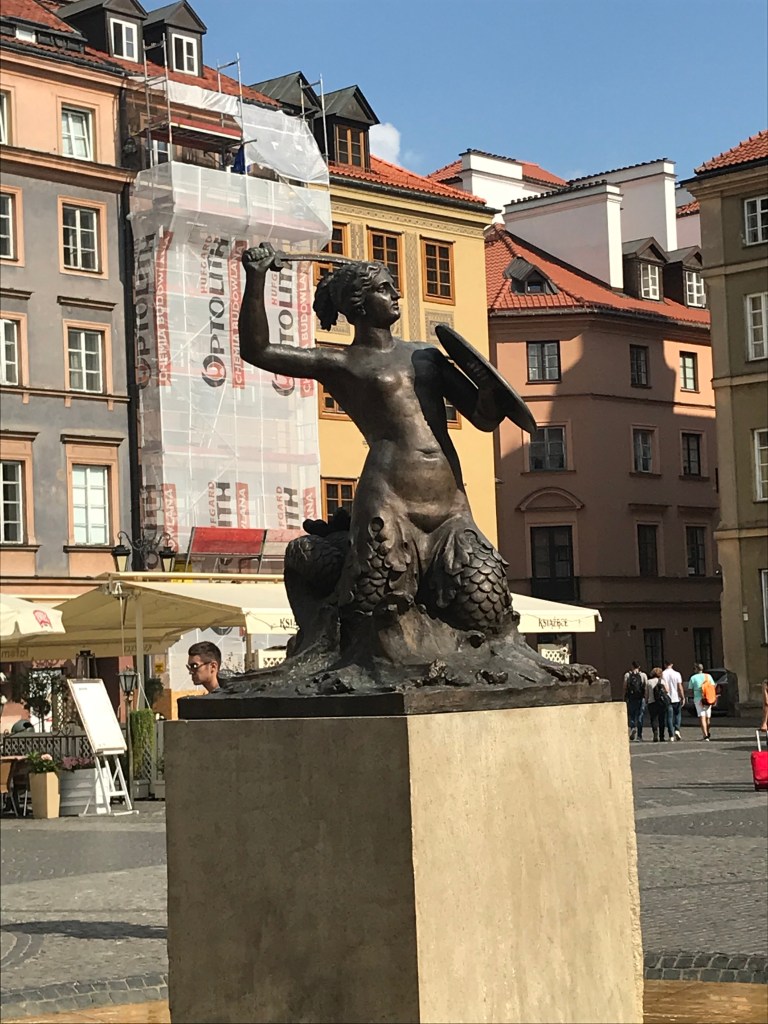
Syrenka mermaid in Old Town Square 
Royal Castle 1619 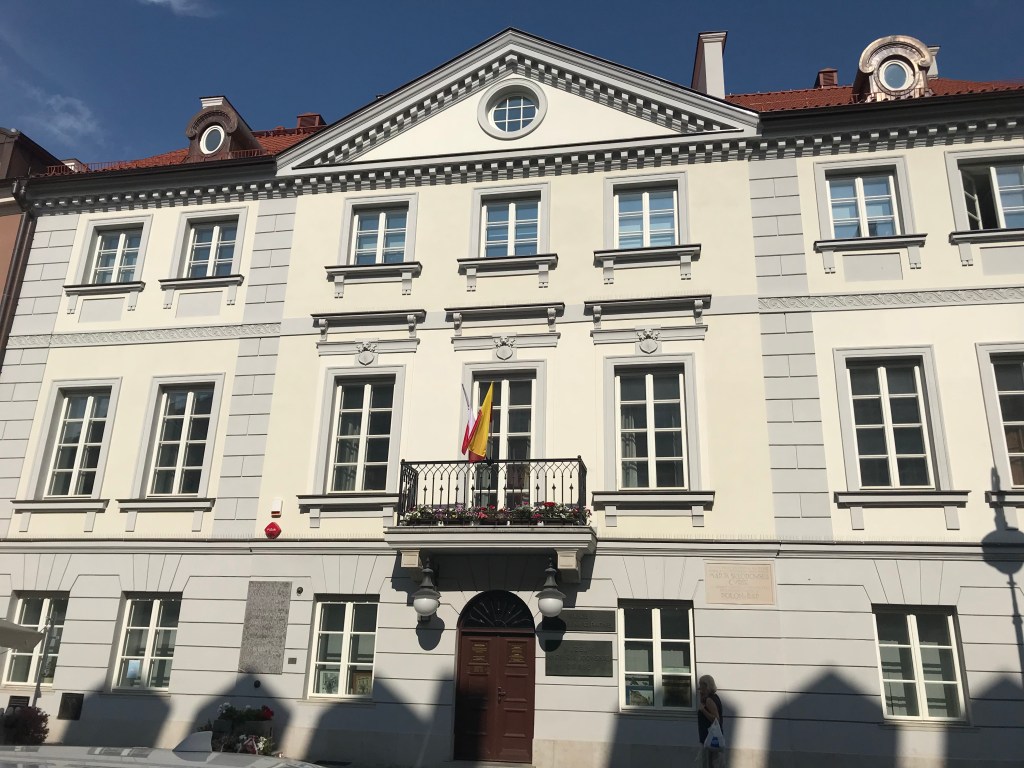
Madame Curie house 
Warsaw Ghetto line 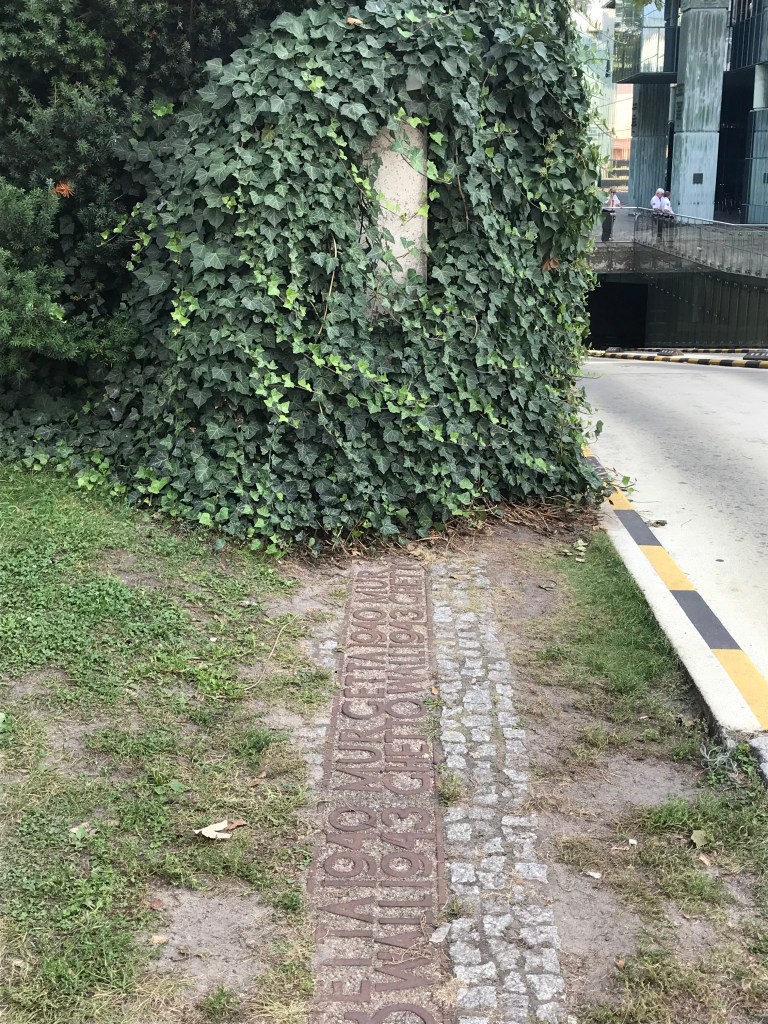
Part of ghetto wall 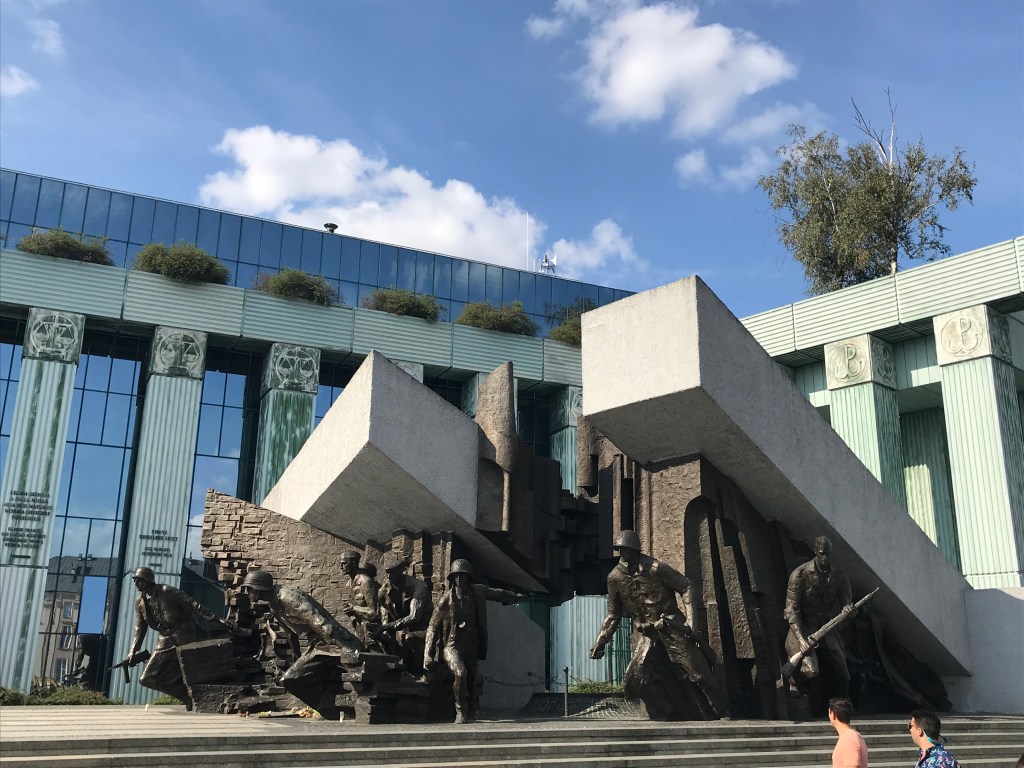
Warsaw Uprising Monument We viewed a number of the key sites on the Old Town walking tour, which began at the King Sigismund Column. There is little remaining of the Warsaw Ghetto, which was utterly destroyed by SS General Jürgen Stroop, who was executed by the Poles after the war. Only a few ruins of the wall remain. The nearby monumental memorial of The Warsaw Uprising commemorates the millions of Poles who perished between 1939 and 1945, estimated at six million, including three million Polish Jews. Several hundred thousand Poles were also deported by Stalin to Siberia and Kazakhstan during this period with few reported returnees. I recommend Bloodlands by Yale professor Timothy Snyder for a well-documented history of the millions who perished under both Hitler and Stalin.
After the tour, I had a nice lunch just outside the Old Town and made my way into central Warsaw. I wanted to see the British Prudential building that had been Warsaw’s tallest pre-war building.
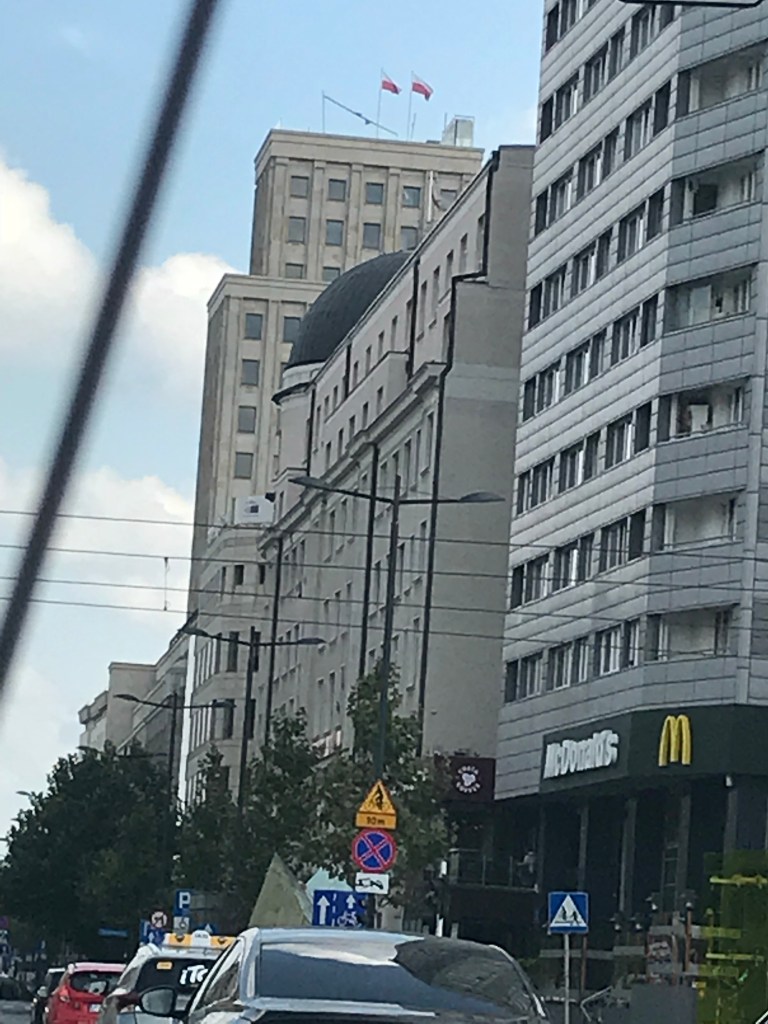
The rebuilt Prudential building 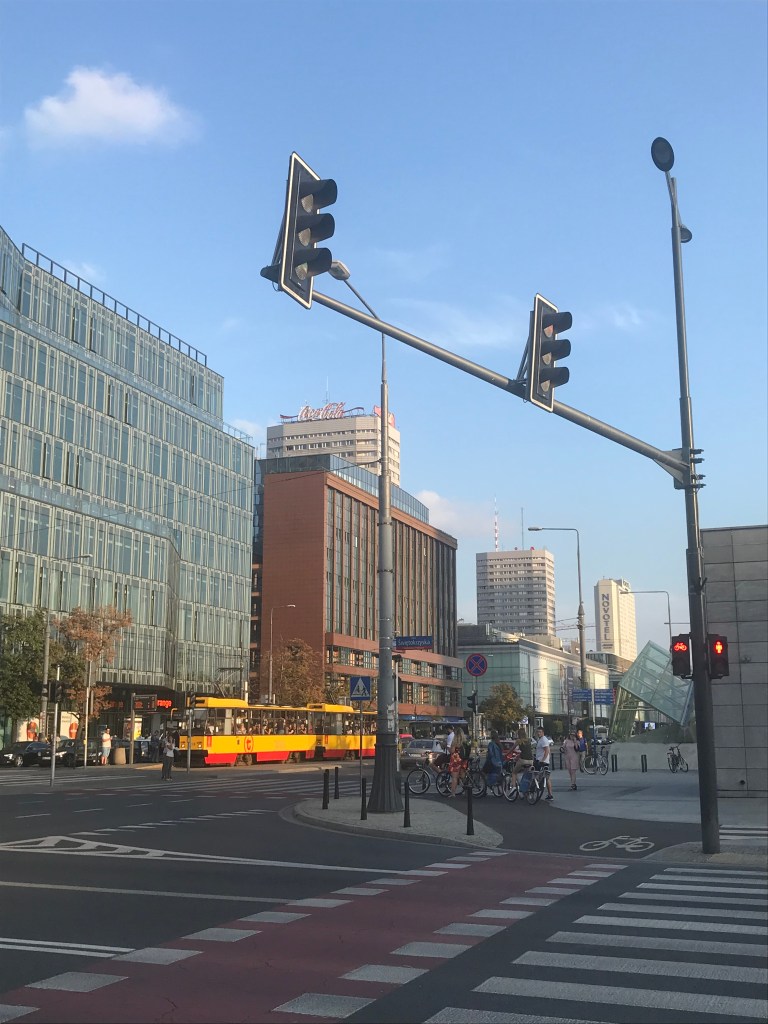
Central Warsaw 
Newer Warsaw skyscrapers Central Warsaw is filled with modern towers and government buildings, including some from the communist era. Like other Eastern European cities, the streets were litter-free and there were no signs of homeless people.
I took a long route back to Old Town where I had a light dinner before heading back to the apartment. I noticed that the weather is Warsaw was warmer than in Kraków or Gdánsk. It must be caused by its interior location.
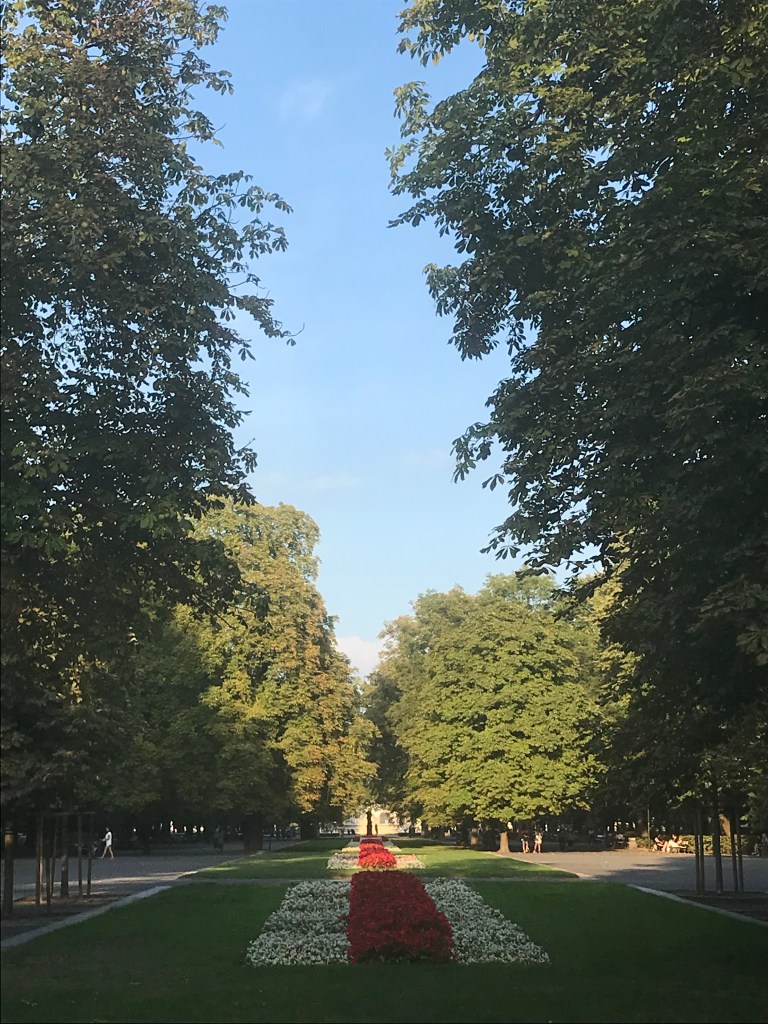
An urban park with the national colors 
Memorial plaza on the site of the Warsaw Ghetto 
The floodlit Royal Palace The next morning I booked a private “Communism Tour” in a restored Soviet-made Lada. My guide not only showed me sites related to the communist era; he also showed me some areas that were untouched by the war. After we visited the Field Cathedral of the Polish Army, a military church with a wing dedicated to the Katyń Massacre, he told me the story of the murder of pro-Solidarity priest Jerzy Popieluszko. He was kidnapped in 1984 by a branch of the SB secret police known as the “Shadow People”. He was beaten to death and hurled into a reservoir. His murder galvanized the anti-communist opposition and played a role in the dictatorship’s ultimate collapse.
More on the Katyń Massacre mentioned above—on September 17, 1939 the Red Army invaded Poland as part of the deal with Hitler and took thousands of Polish Army soldiers as prisoners. Many of the enlisted men were eventually released, but the officers were taken to a prison camp outside of Smolensk, in the Katyń Forest. After six months, Stalin and his NKVD secret police commissar, Beria, ordered the 22,000 officers liquidated, fearing that they could form the nucleus of a bourgeois opposition after the war. They were executed in the NKVD manner, with a bullet in the occipital nerve and then dumped into massive trenches, where their remains were bulldozed over. In 1943, advancing German units overran Smolensk and discovered the mass graves. They invited Polish officials and the Red Cross to view the site, but the Soviets lied and claimed that the Polish officers had been murdered by the Germans. The Western Allies reluctantly accepted Stalin’s lies until the truth was admitted in 1991. The Poles always knew that the Russians were responsible and have never forgiven them. Andrzej Wajda’s 2007 film Katyń is highly recommended viewing on regarding this atrocity.
One of the highlights of the tour was visiting the infamous 778’ tall Palace of Science and Culture, completed in 1955 in the Stalinist Social Realism style and proclaimed as a brotherly gift to their Polish comrades from the peace-loving peoples of the USSR! It was the backdrop for the stunning Polish Millennium military parade in 1966 that celebrated 1,000 years of Polish statehood and which was remarkably free of any communist regalia or symbolism. It’s worth a watch. https://www.youtube.com/watch?v=9c9IejeNxjU
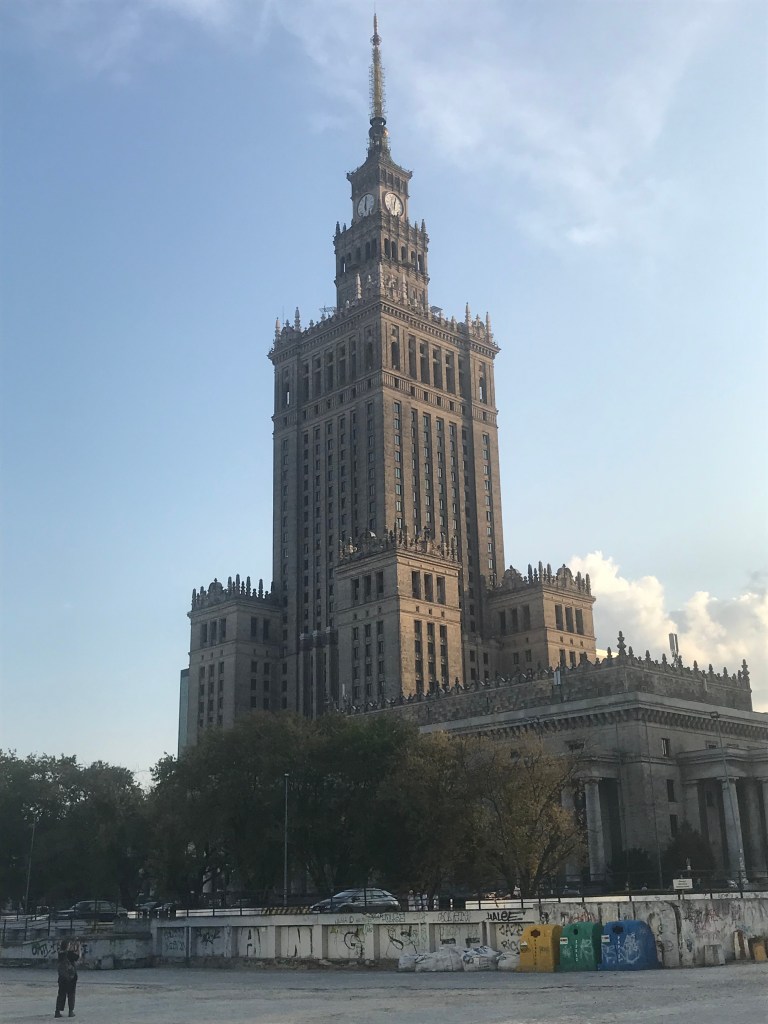
Palace of Science and Culture 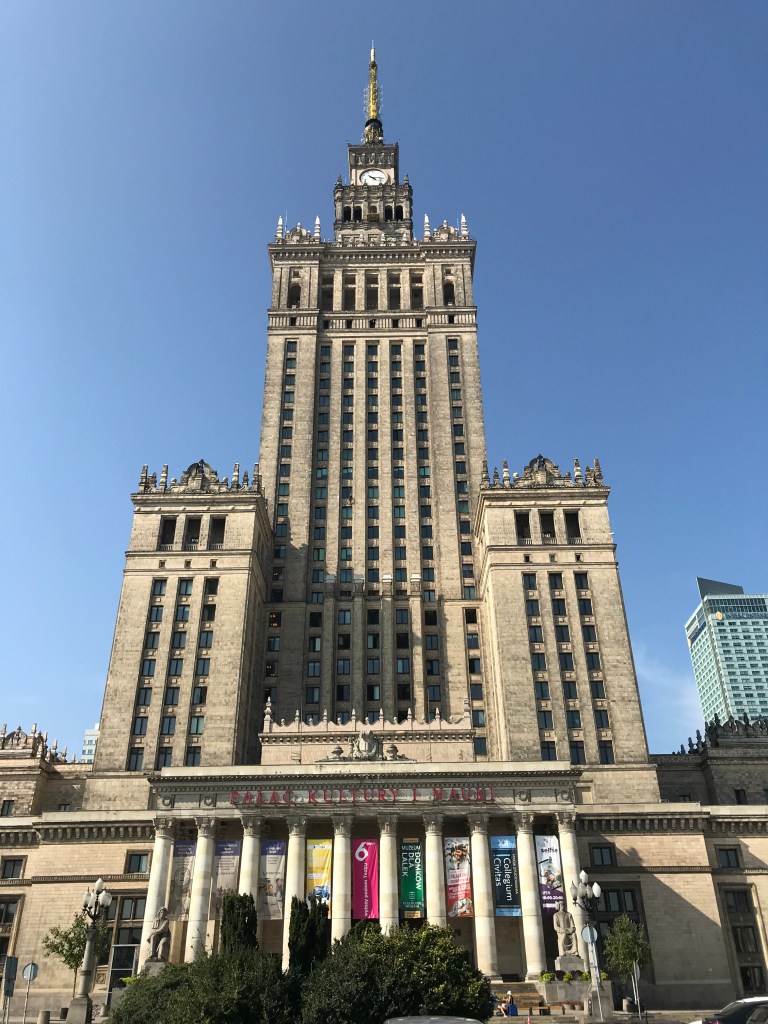
Palace entrance 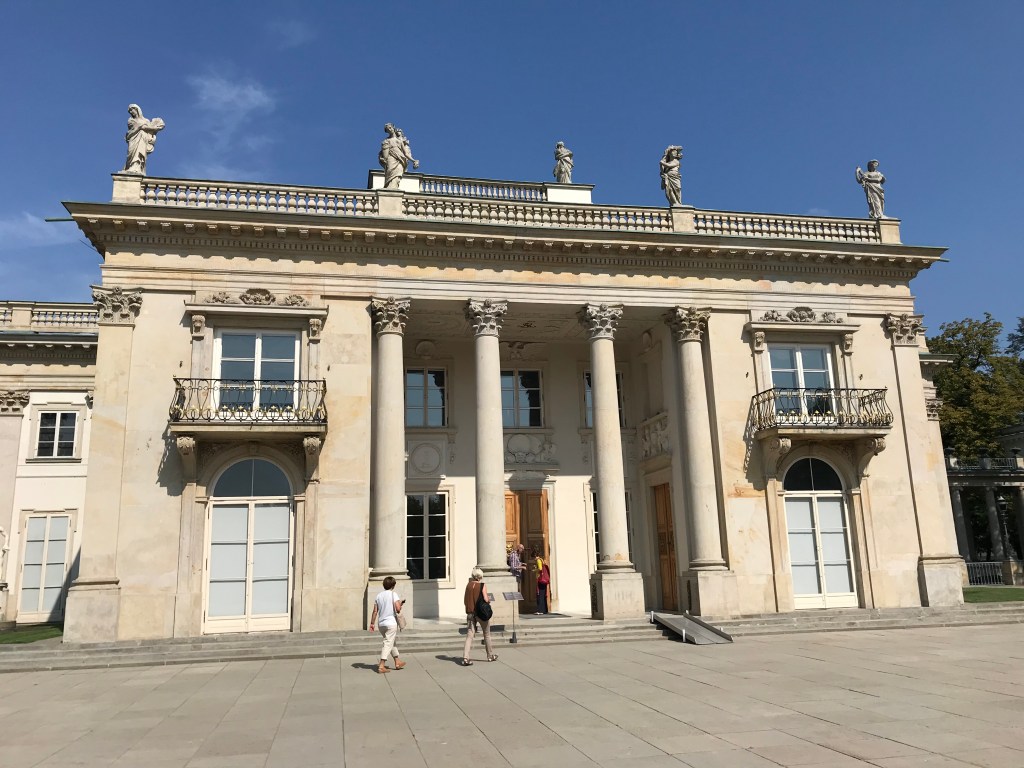
Lazienki Palace 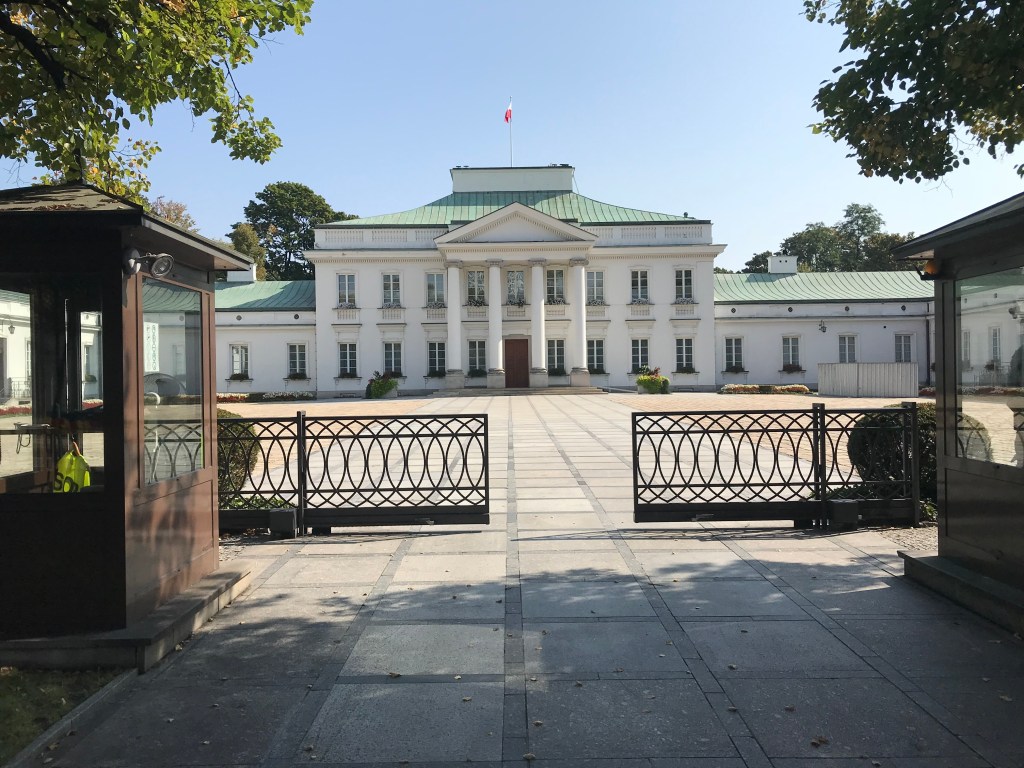
Royal Theater in Lazienki Park 
Orangerie in Lazienki Park 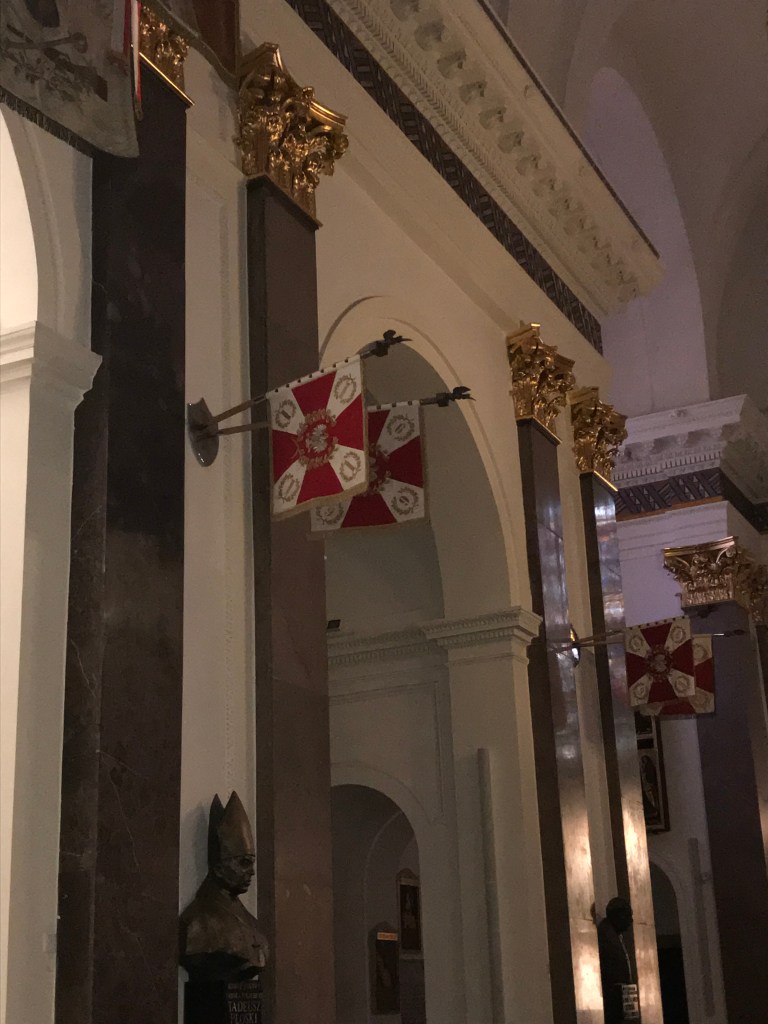
Interior of the Field Cathedral 
Katyń plaques 
More Katyń plaques 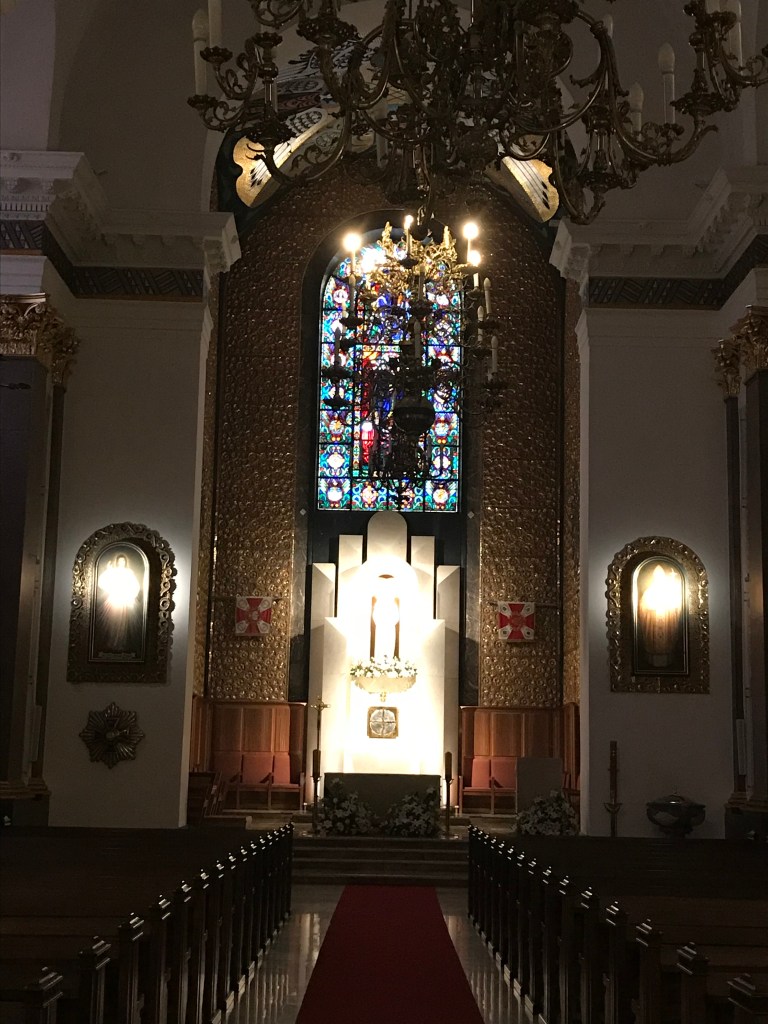
Nave of garrison church The stately Lazienki Park features a number of neo-classical buildings, including an orangerie. The park was largely built during the reign of the last Polish king before the first partition of Poland in 1772, Stanisław August Poniatowski, who was also a lover of Catherine the Great of Russia. Lazienki Park was thankfully untouched by the war.
We ended the tour with a drive through the working-class Praga district on the right bank of the Vistula. Praga was the only section of Warsaw untouched by the war, besides Lazienki Park. Now it’s becoming a hipster area given its relatively low rents.
Since I had an early flight back to Seattle via Amsterdam the next morning, I stayed at the Marriott by the airport. I was happy to have an early dinner with an old friend from Orange County who, with his Polish wife and two daughters, had relocated to Warsaw. Even though he was born in Poland, he expressed frustration with the bureaucracy and suggested that they might return to the US.
And so ended my six-week journey through the Balkans, Ukraine and Poland, the longest foreign trip of my life. I’ll write up my 2019 trips to Mexico City and Eastern Europe next, with occasional forays into a series of essays which friends are urging me to post. I hope you’ve enjoyed the blog so far and I look forward to sharing more of my adventures and essays with you.
-
Gdánsk: August 31 to September 3, 2018
My spacious and airy Airbnb was centrally located in an old apartment building. After completing my self check-in, I trudged up 3 flights of stairs to my apartment just behind a German couple returning to their unit. They invited me in for drinks and suggested several restaurants. I enjoyed their company and was disappointed that they were leaving the following day.
The next morning, September 1st, was the 79th anniversary of the beginning of World War II. At the time Gdánsk was the German Free State of Danzig, an ancient member of the Hanseatic League. German overland access to Danzig was one of Hitler’s demands to Poland. Later that day, I would come across a memorial service marking the invasion of Poland.
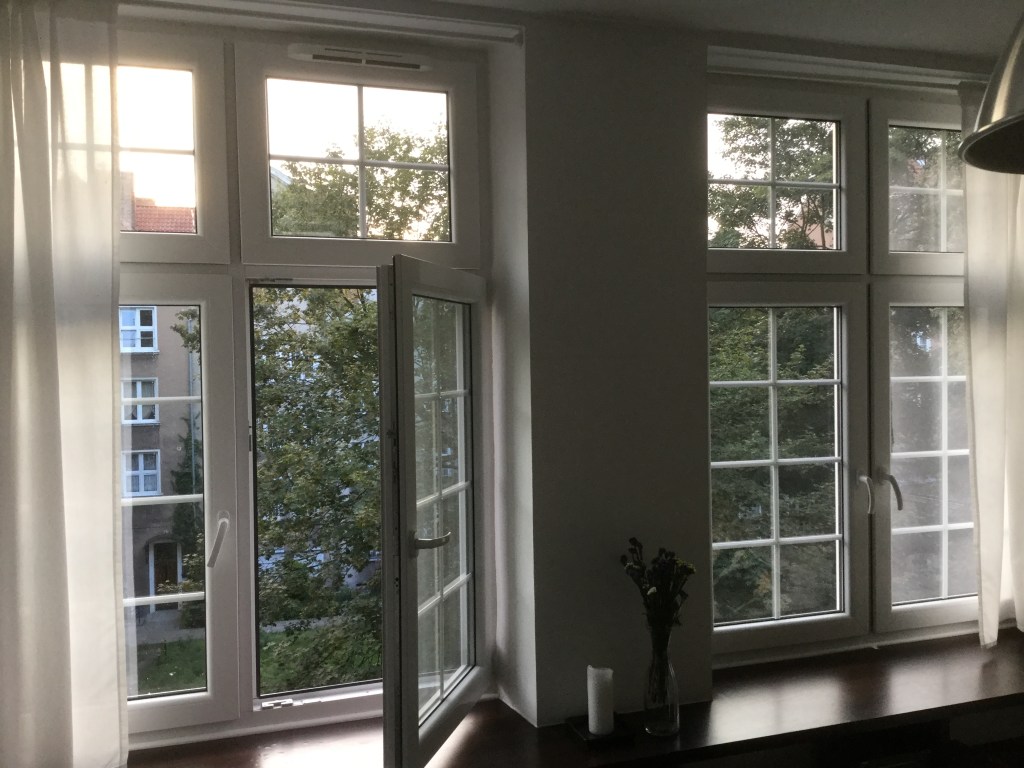
My spacious apartment 
St Mary’s Basilica from my window 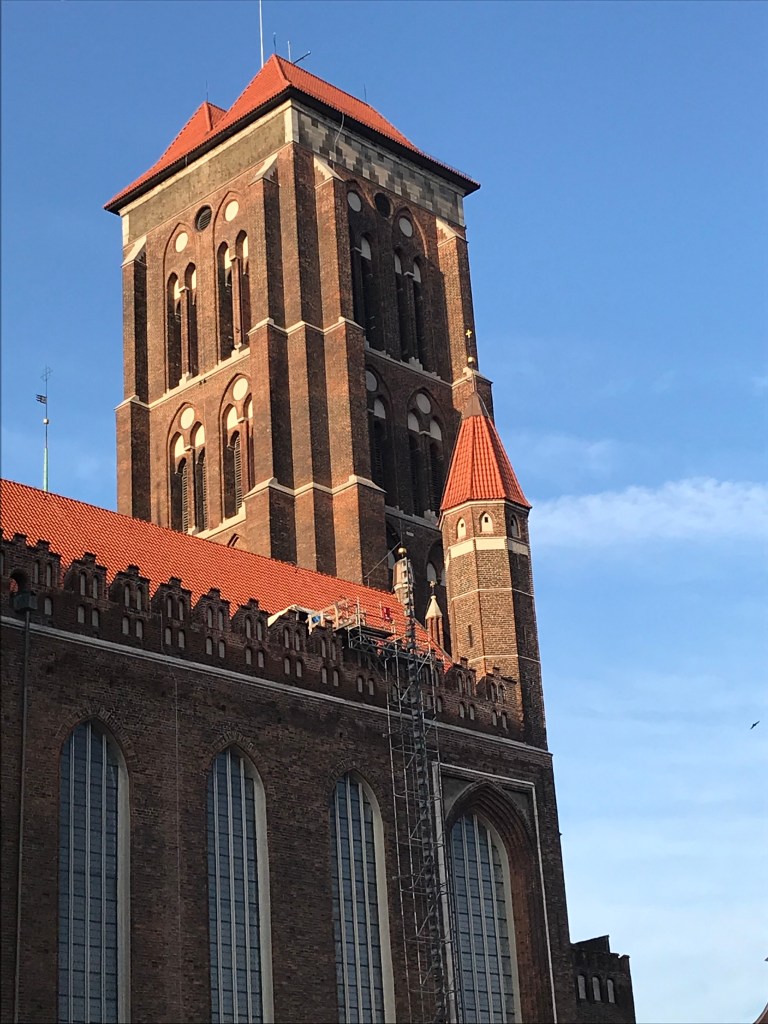
St Mary’s Basilica 14th c. 
Leafy side street 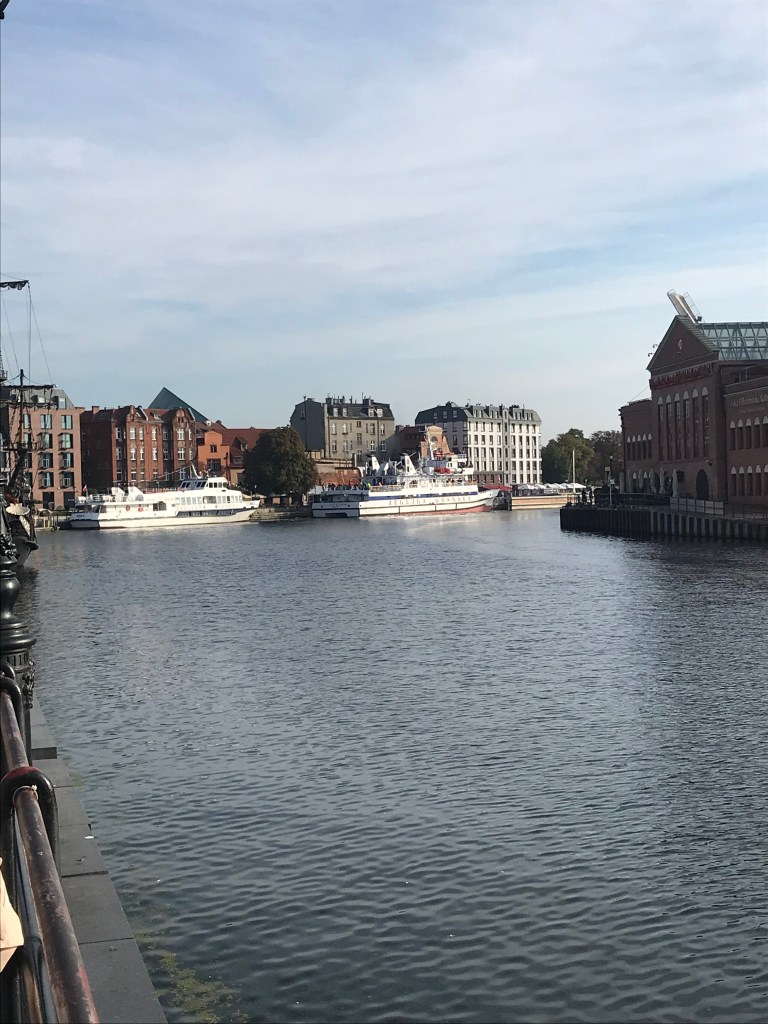
Harbor view 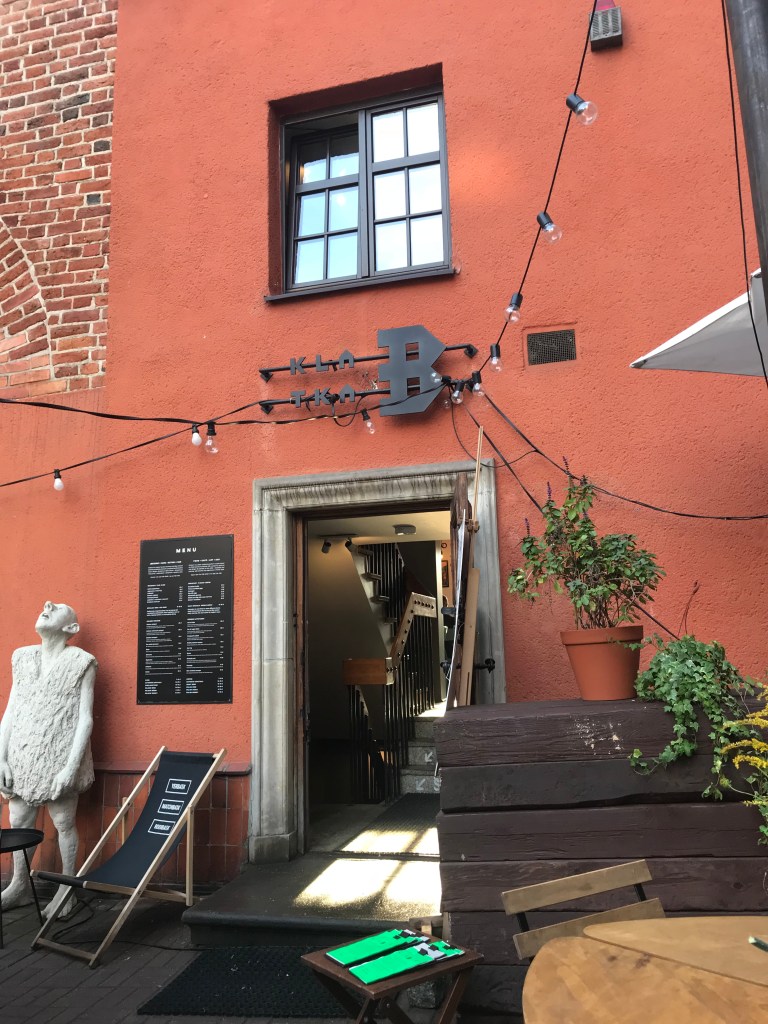
Klatka-great breakfast spot I enjoyed the outdoor breakfast so much at Klatka that I returned every morning. After breakfast I strolled around the harbor area and walked into St. Mary’s Basilica. It’s important to understand that the Red Army nearly razed Gdánsk to the ground after capturing it from the Germans in March 1945 before handing it over to the Poles. The Poles painstakingly rebuilt the entire historic core based on old architectural drawings and photographs. The majestic churches, therefore, have no stained glass windows and much of the interiors were lost. Considering how relatively poor Poland was under 40 years of communist rule, the restoration is remarkable.
Around noon, I joined a walking tour of the old town with our enthusiastic guide, who was clearly in love with his city. Walking around the old town was wonderful. One can see how prosperous this old port city was in the past. There were also several shops selling amber, for which this part of Poland is famous. The Polish word for amber is bursztyn, or “burning stone”. I realized then that many surnames in the US, like Burstyn and Bernstein, derive from the name of this gemstone of fossilized tree resin.

16th c. Upland Gate, main entrance to Old Town 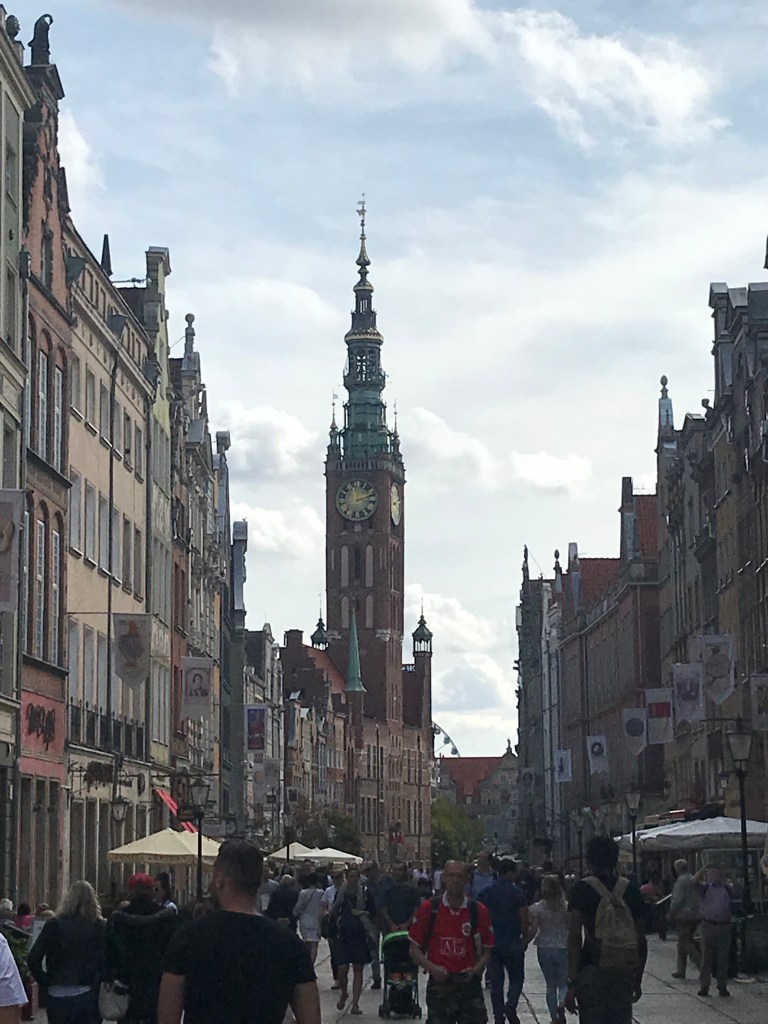
The town hall in the distance 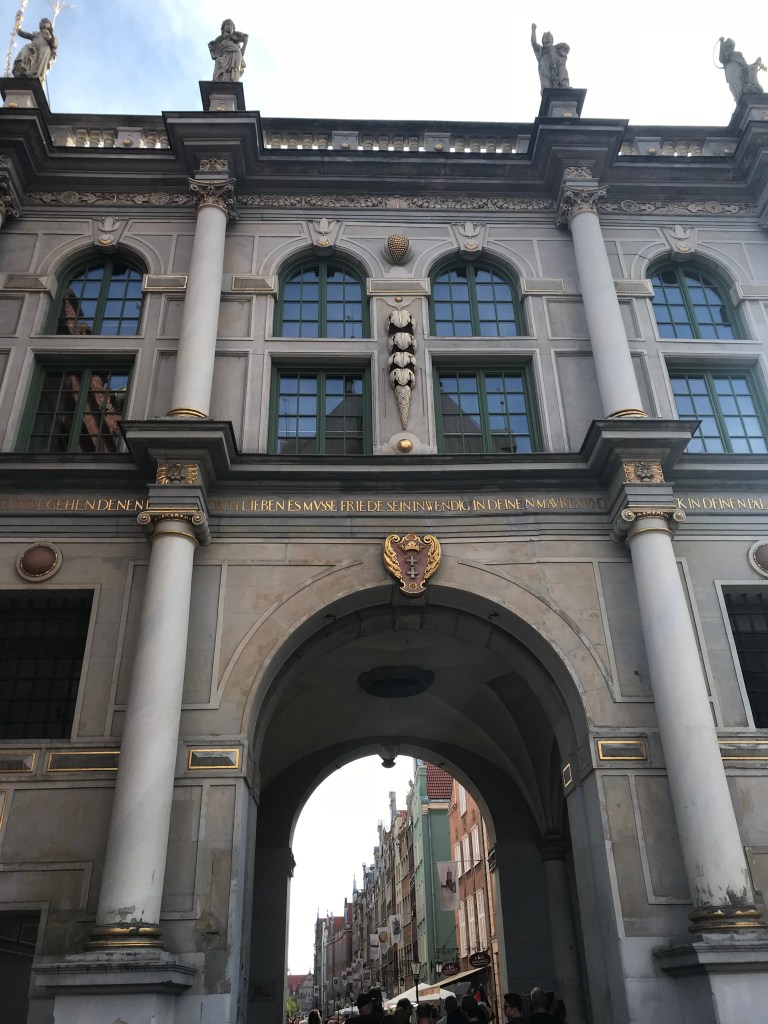
The Golden Gate (Złota Brama) 
A rear view of the basilica 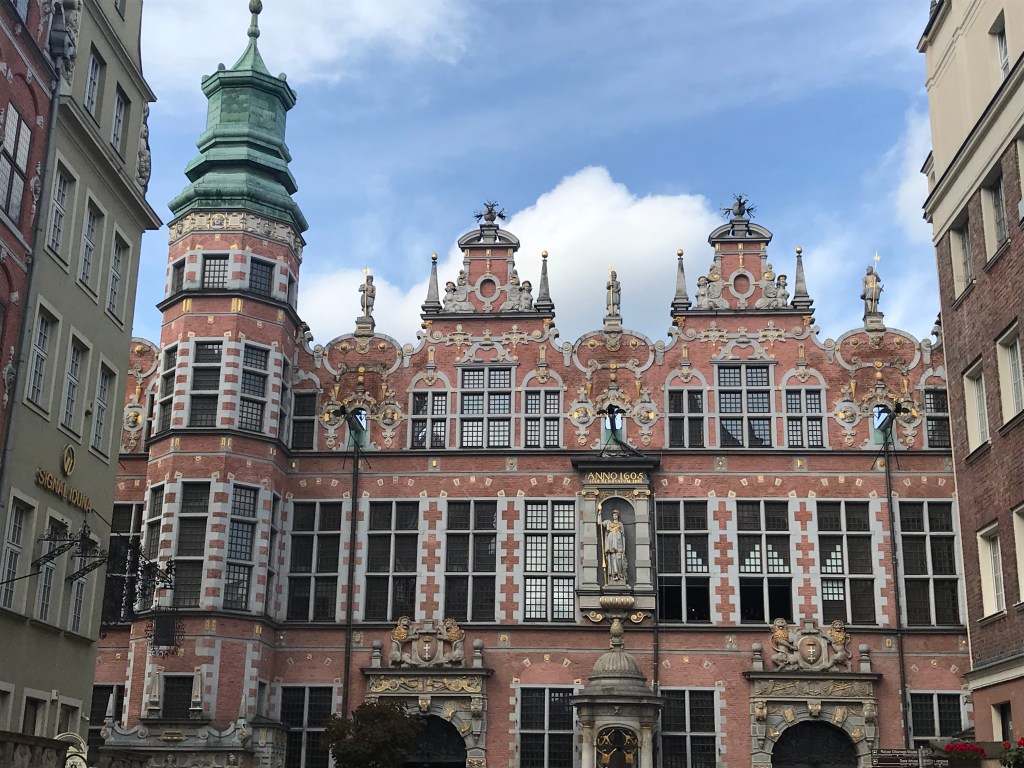
Baroque municipal office 
The town hall The walking tour ended at the Post Office, where our guide pointed out the bullet holes in the wall surrounding the garden behind the post office. Although Danzig was a German Free State, the Versailles Treaty gave Poland control of the post office and customs. The war came to Gdánsk when the German battle cruiser Schleswig-Holstein opened fire on the Polish base at Westerplatte. Shortly afterwards, a German militia group attacked the post office and executed a number of postal workers in the garden.
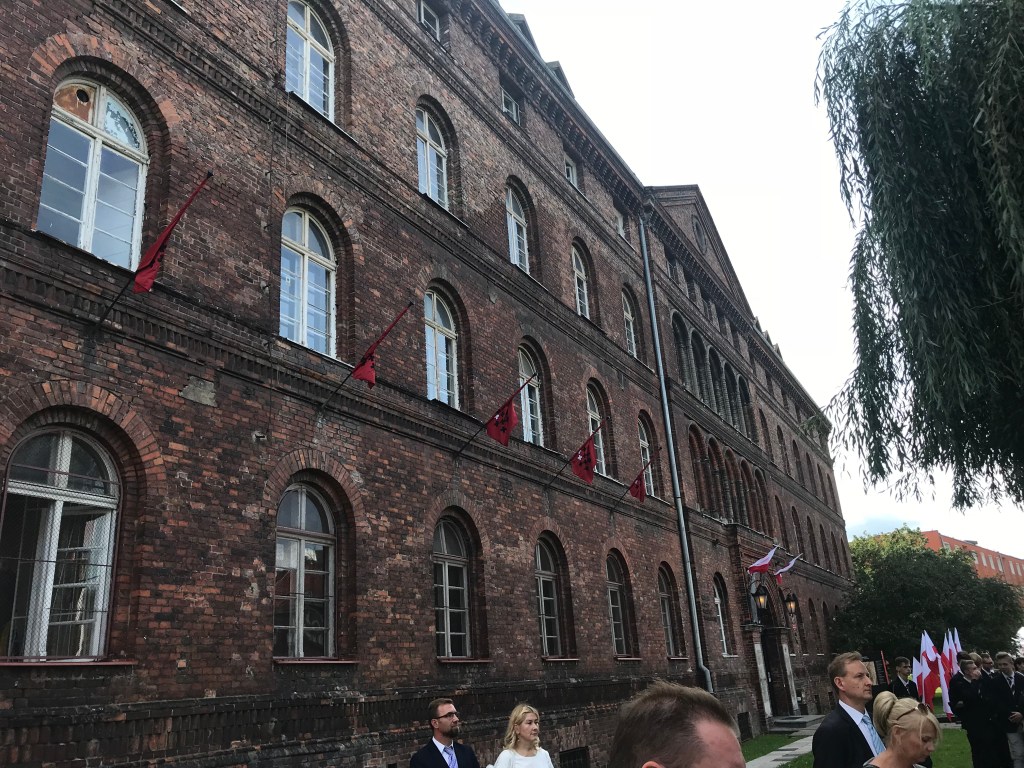
The Post Office 
Execution site outside 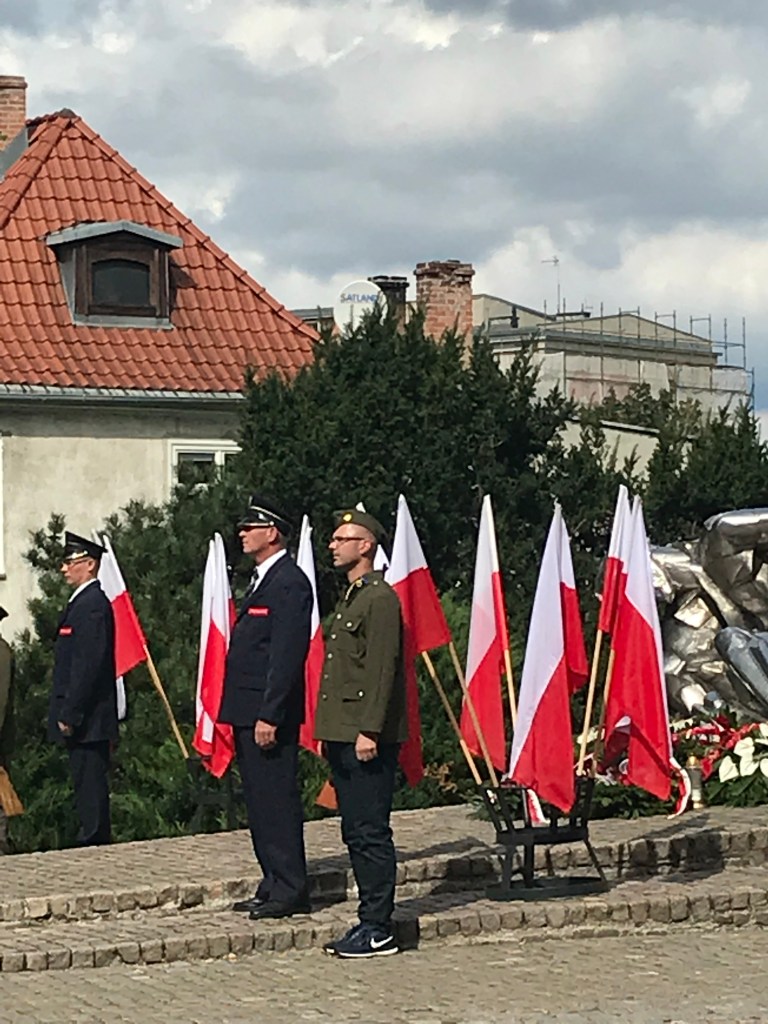
Memorial service at the Post Office 
Young Poles dressed in period uniforms at the memorial service After watching part of the solemn commemoration, I walked over to the highly-recommended World War II museum and spent several hours wandering through the remarkable galleries. There was a large collection of Soviet and Fascist poster art, which I found fascinating.
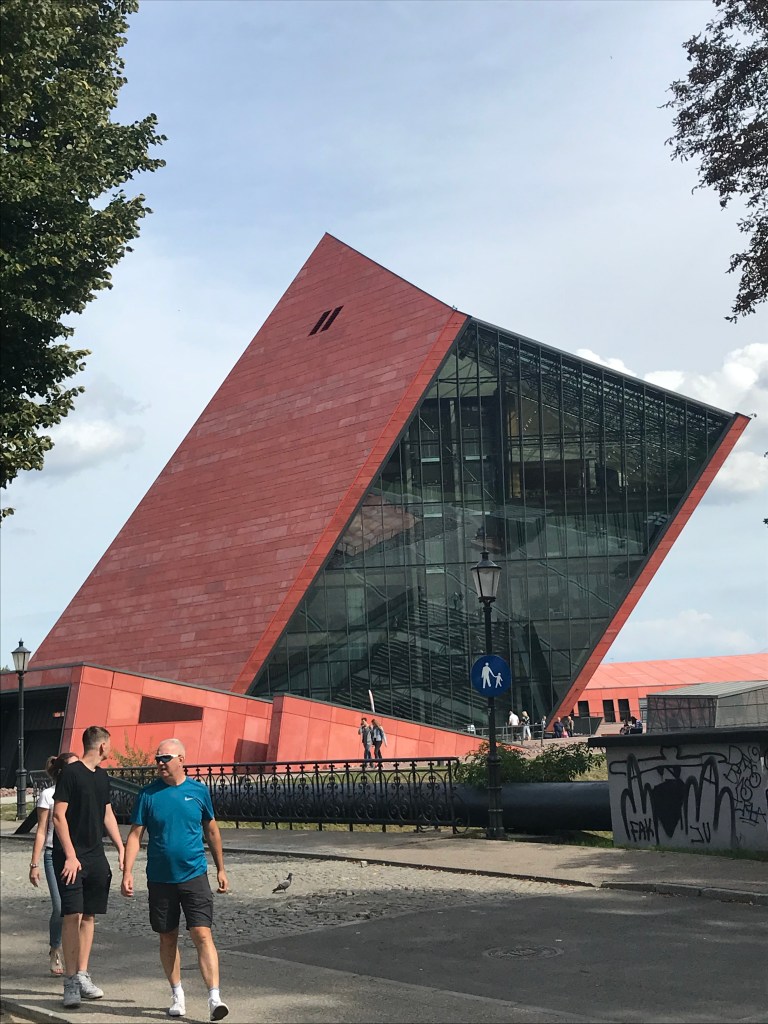
The WW2 Museum 
Deportations 
Katyn memories 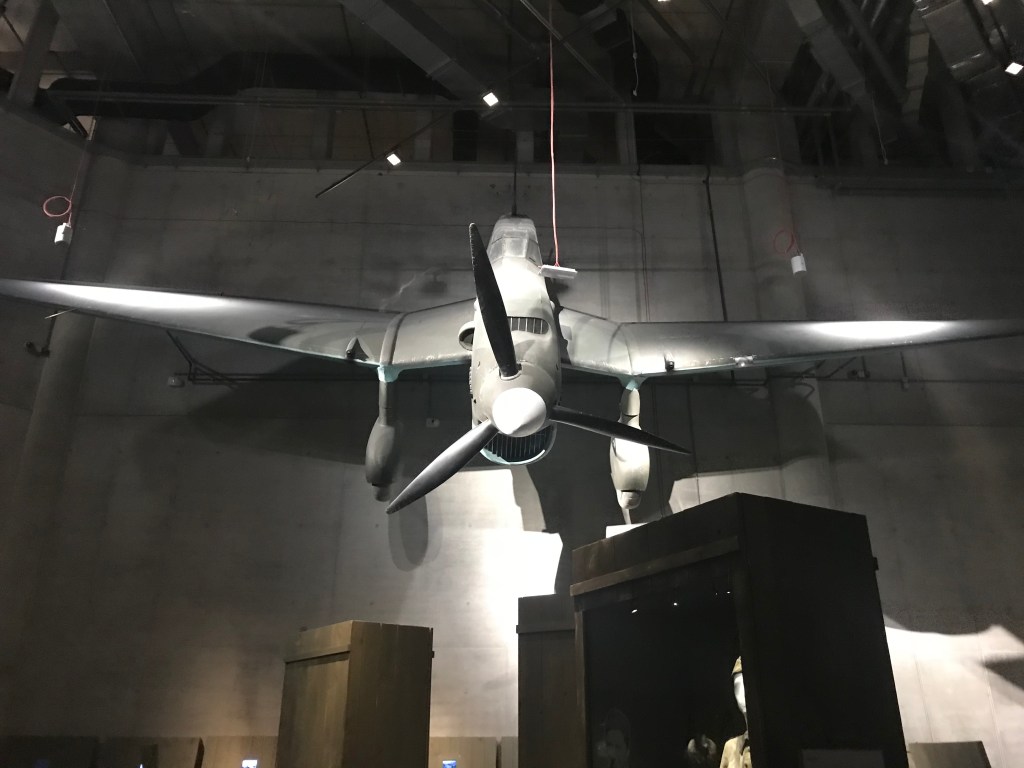
Stuka of the Luftwaffe 
Italian Fascist poster 
Late 30’s VW ad 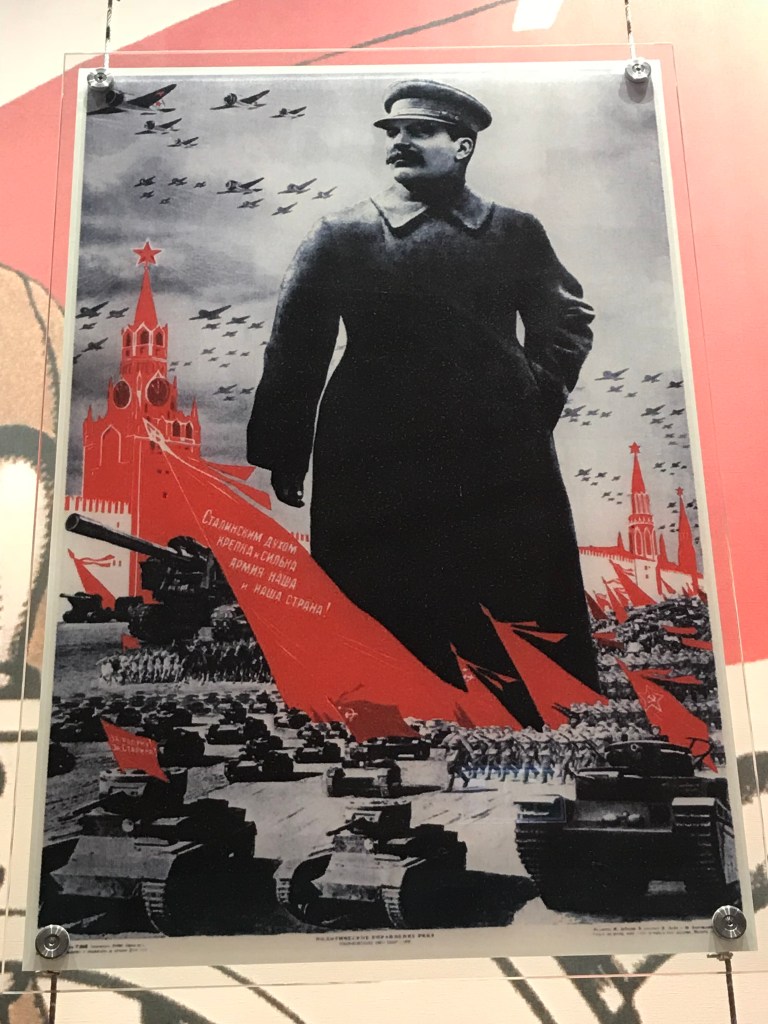
The Red Tsar Stalin 
Soviet propaganda 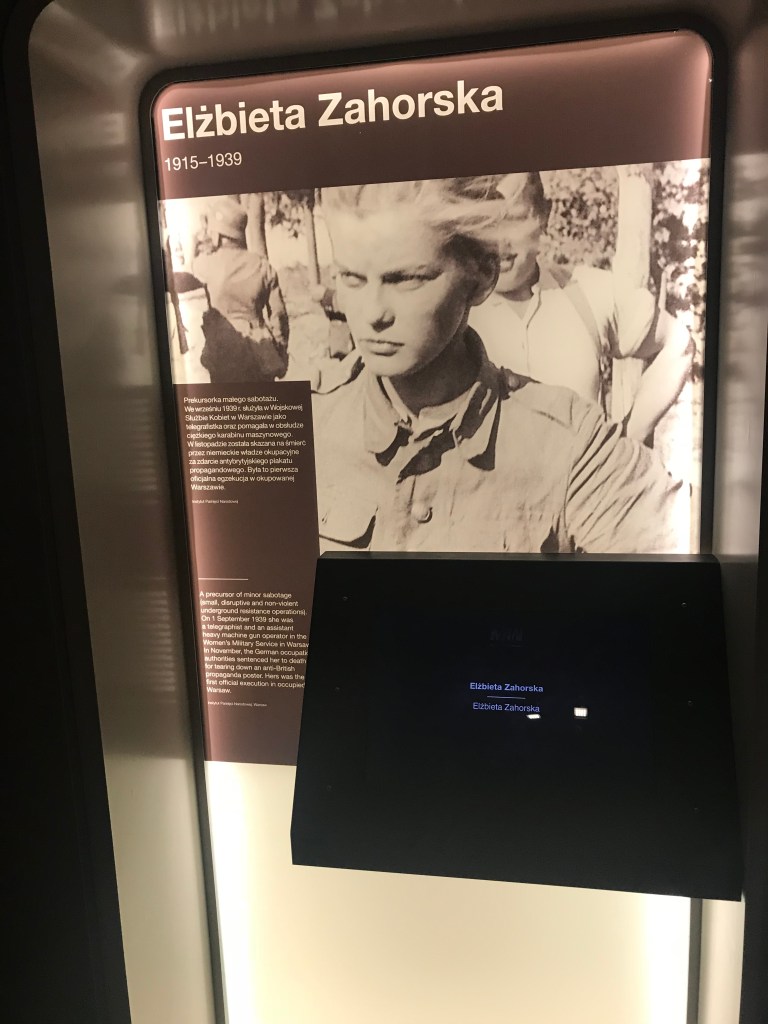
Polish woman in the AK Home Army executed by the SS From the museum, I walked a kilometer to the site of the famous Lenin Shipyards, where iron worker Lech Wałesa launched his mass Solidarność (Solidarity) movement in opposition to the communist dictatorship. After nine hard years, Solidarity finally prevailed when the communist state collapsed in early 1989. Wałesa was then elected the first president of free Poland.
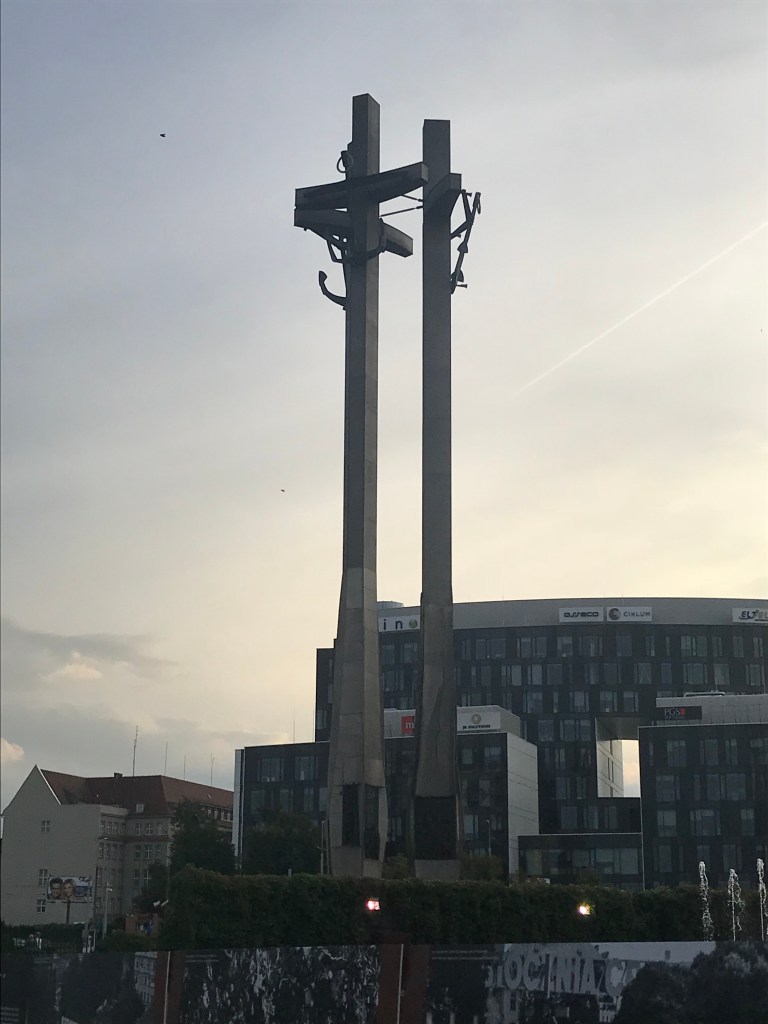
Solidarność Memorial 
Memorial close-up 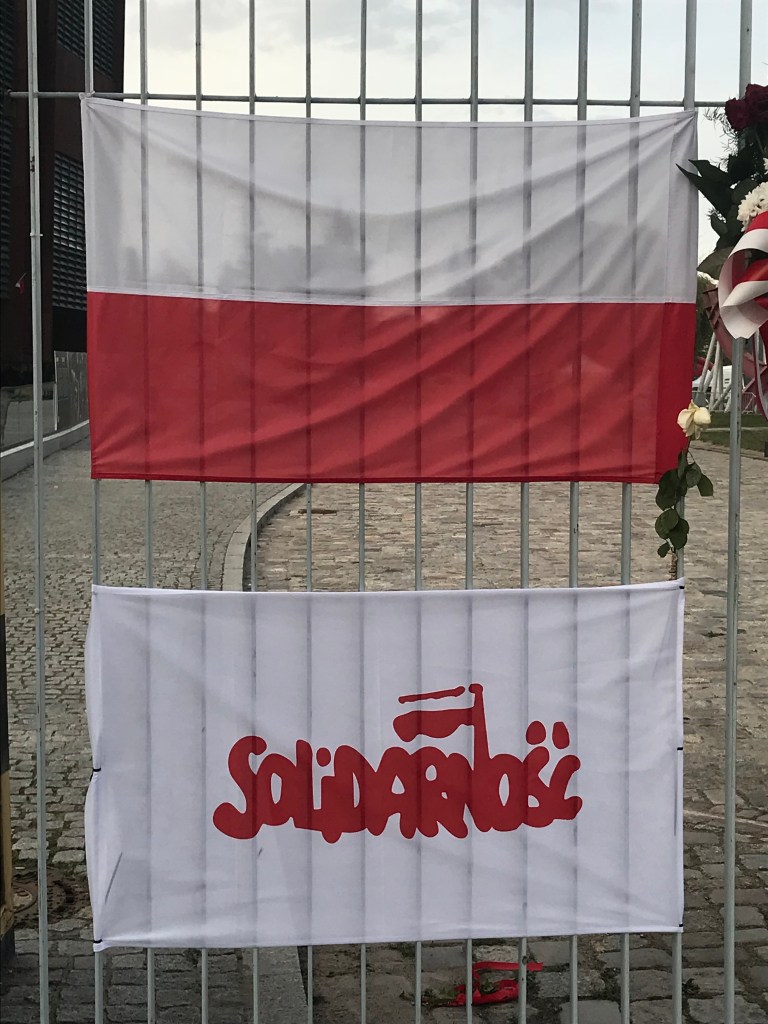
Entrance to former Lenin Shipyard That evening I went to an “underground” cocktail lounge recommended by our tour guide. It wasn’t too crowded and I enjoyed a few drinks and charcuterie with some locals, who suggested I rent a bike and ride out to the Baltic Sea resort of Sopot the next day, which was predicted to be sunny and mild.
It was a bit of a hassle renting the bike by the main train station. The owner showed up after I waited for a half hour; but finally I was on my way to Sopot.
The route northwest to Sopot wound through some impressive city parks and broad boulevards and took about 45 minutes. Sopot has been a getaway for centuries and was a famous spa in the 19th and first half of the 20th century before going into a slumber during the communist period. It was Germanicized after the partition of Poland in the 18th century and remained so until the end of WW2. It has the longest boardwalk in Europe, a number of restored spas and villas, and beautiful white sand beaches, surrounded by conifer forests.
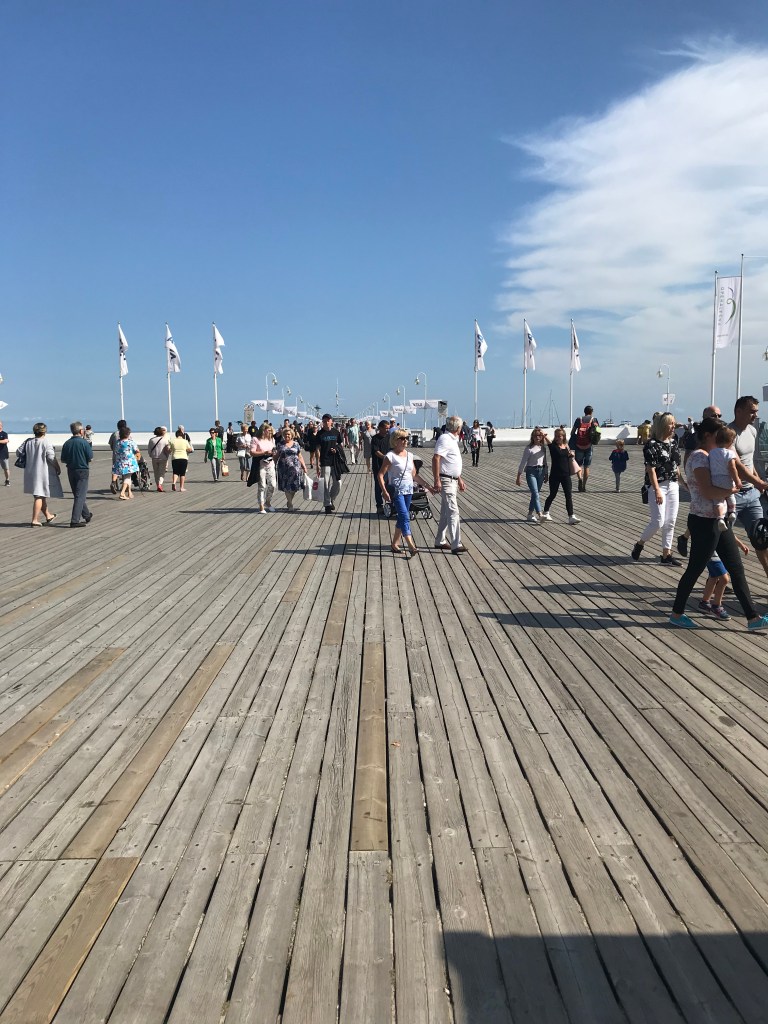
Sopot boardwalk 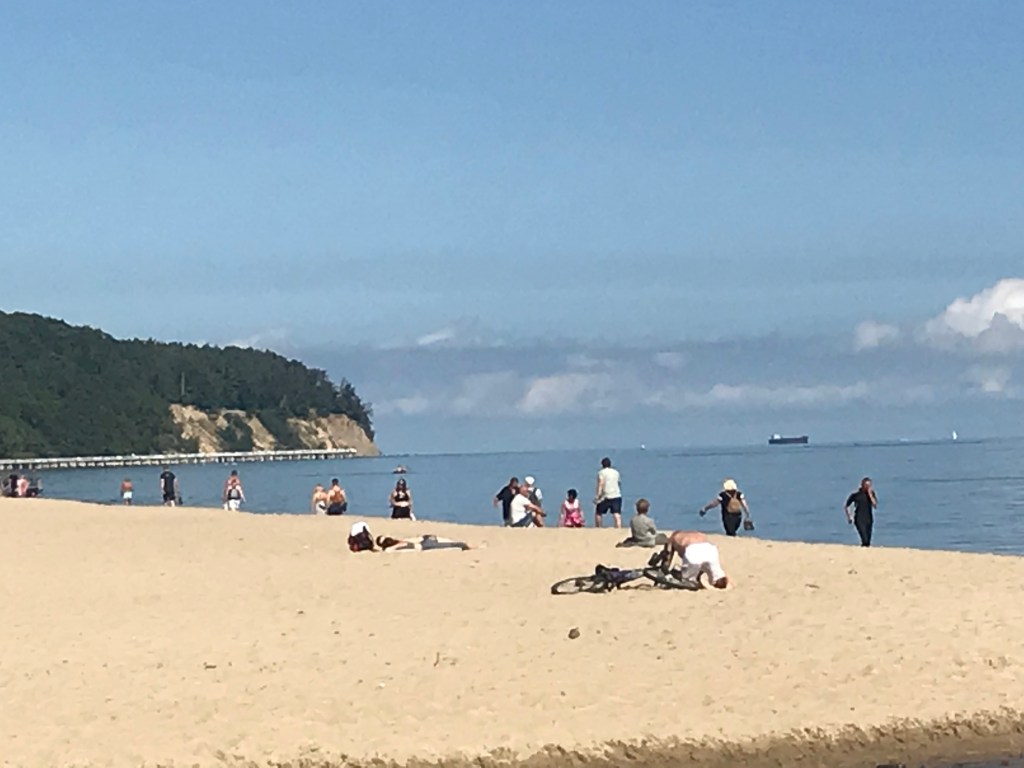
Beach on the Baltic Sea 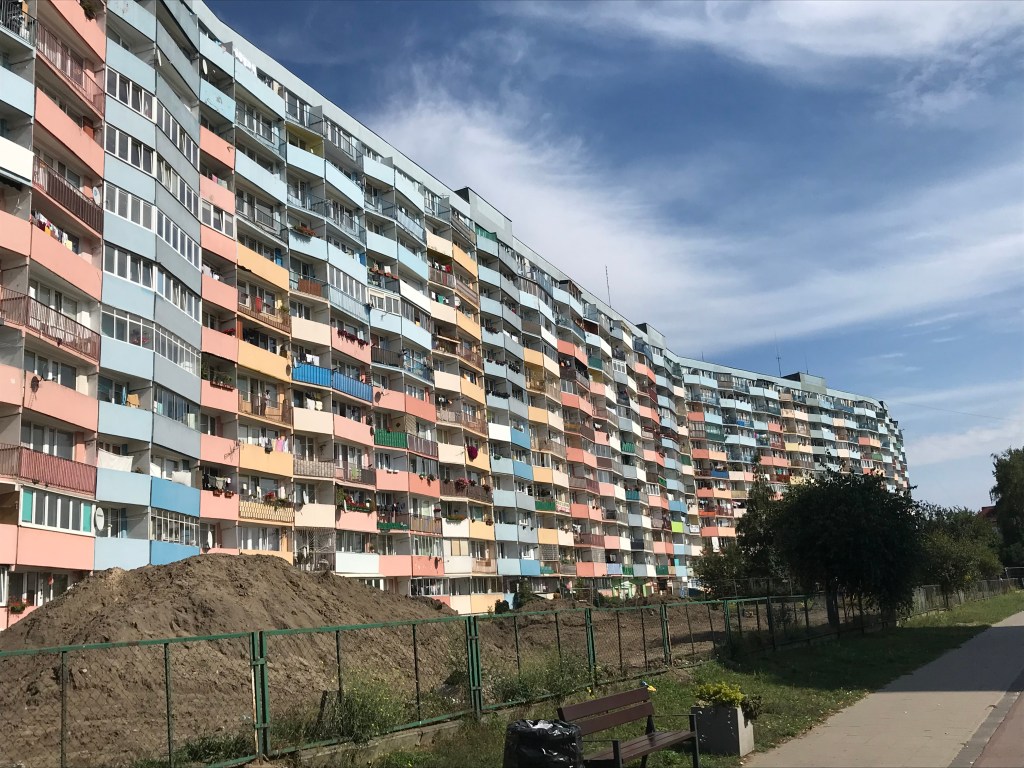
Communist-era housing block seen on the way back from Sopot 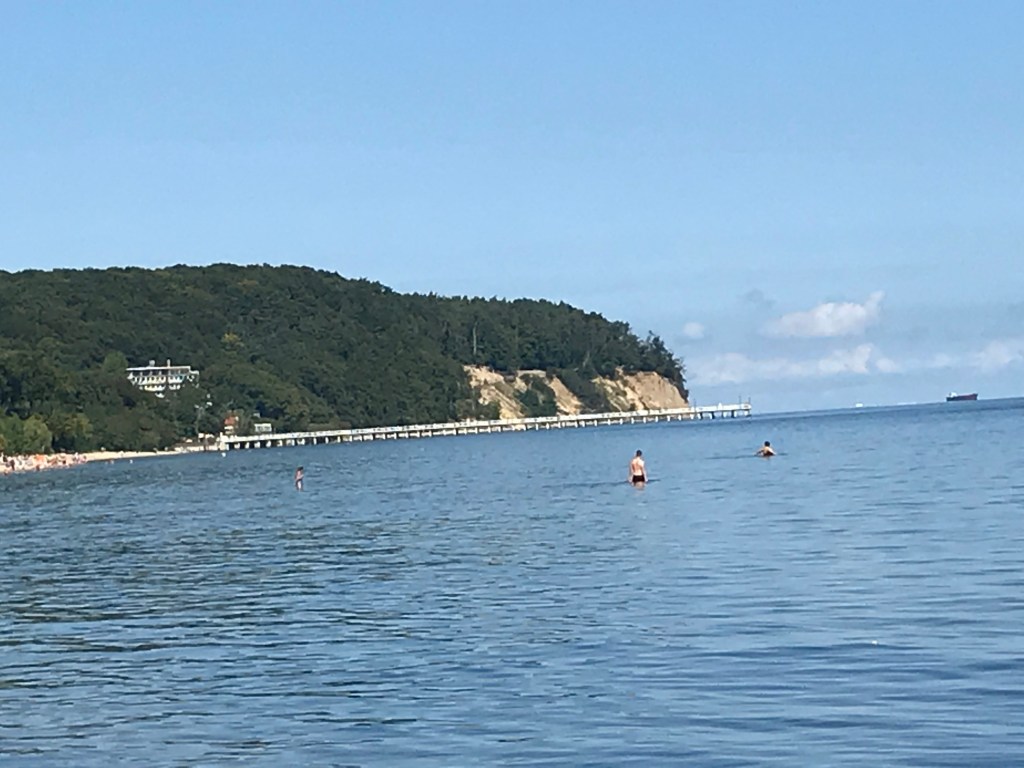
Promontory at Sopot That night I went to a vegan restaurant outside of the old town for a much needed break from the heavy Polish cuisine. The food was excellent and the walk back at dusk was pleasant. I looked forward to a quiet night at the apartment before my flight to Warsaw the next morning. I was quite pleased to have added Gdánsk to my Polish itinerary.
-
Kraków: August 28-31
My Airbnb was perfectly located in Kraków’s Stare Miasto, or Old Town, a two-minute walk from Market Square and the iconic Gothic St Mary’s Basilica.
Market Square with St Mary’s Basilica and the Cloth Hall The square was full of tourists but not nearly as packed as other cities like Prague or Vienna. I had a snack and a glass of wine before joining an Old Town tour in the late afternoon. It was a large group with a fair number of British tourists, some of whom were drunk. We visited the main sites around the square and walked through Jagiellonian University, founded in 1364 by King Casimir II the Great. There’s a famous scene in the Polish film Katyń in which an SS general informs the faculty that the university is to be closed indefinitely after which many professors are arrested and deported to German concentration camps. The other famous movie filmed in Kraków is Schindler’s List.
Kraków dates back to the 7th century and was the capital of Poland until 1596. Interestingly, it was also the seat of the German General Government from 1939 to 1944 under Dr Hans Frank, the Nazi Governor General. Frank ruled from the famous Wawel Castle, on the Vistula River. Most readers are aware that the Auschwitz-Birkenau concentration camp was built in a western suburb, which has become a major, if depressing, tourist destination.
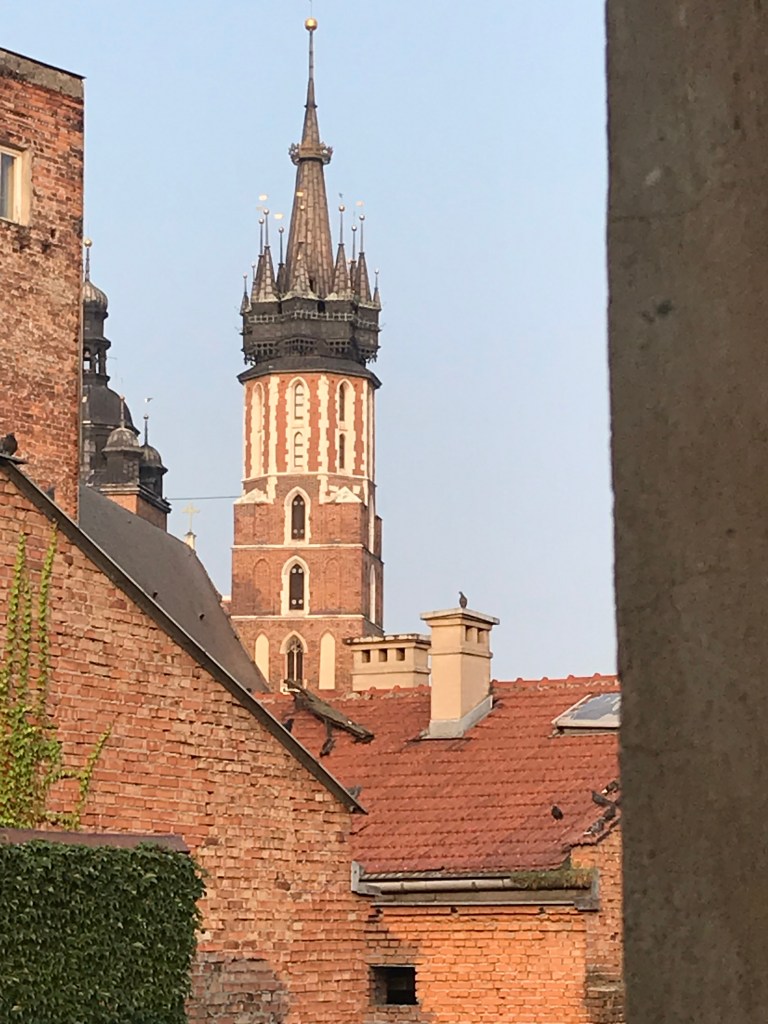
View of St Mary’s from my Airbnb 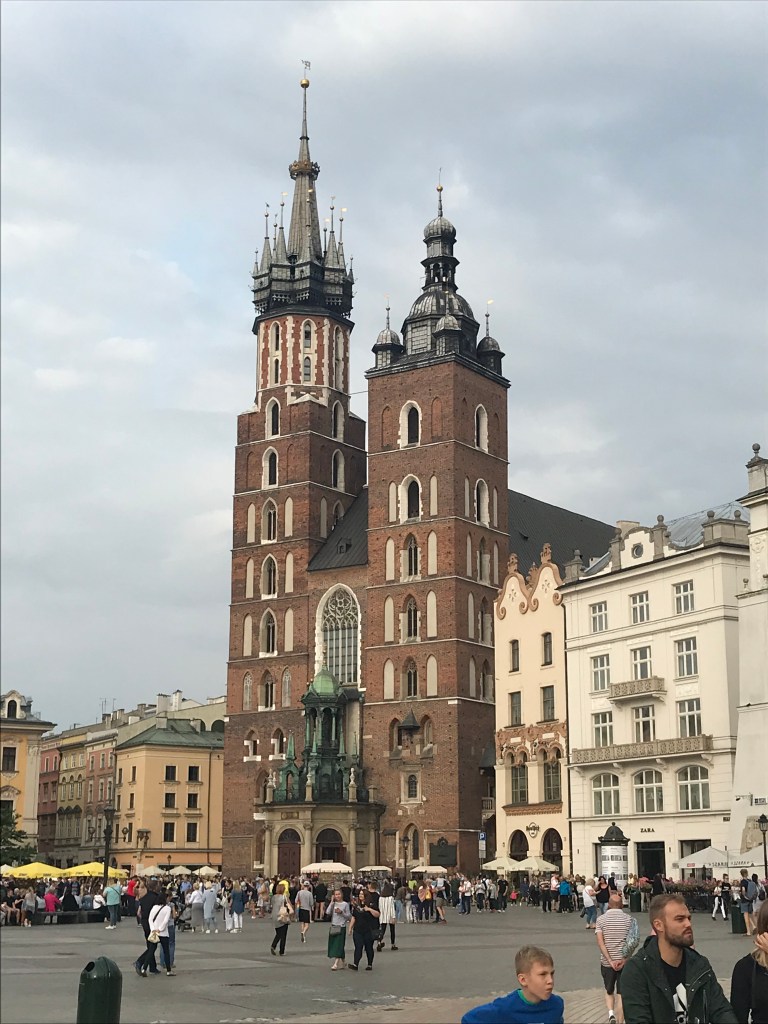
St Mary’s Basilica 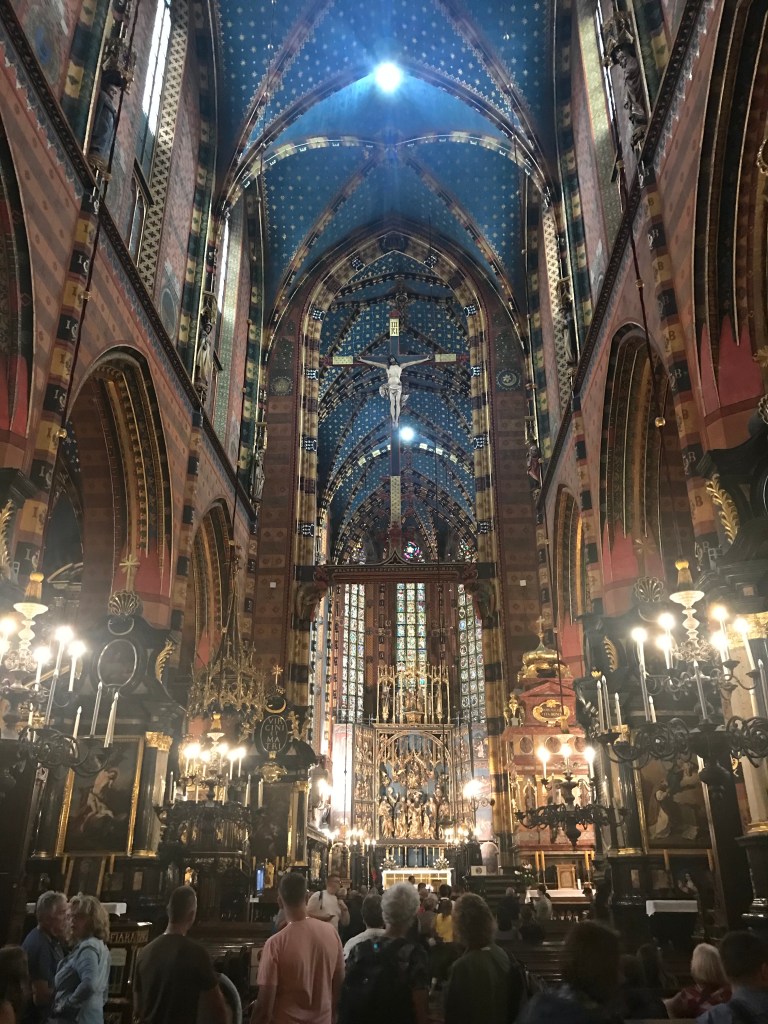
The nave of the basilica 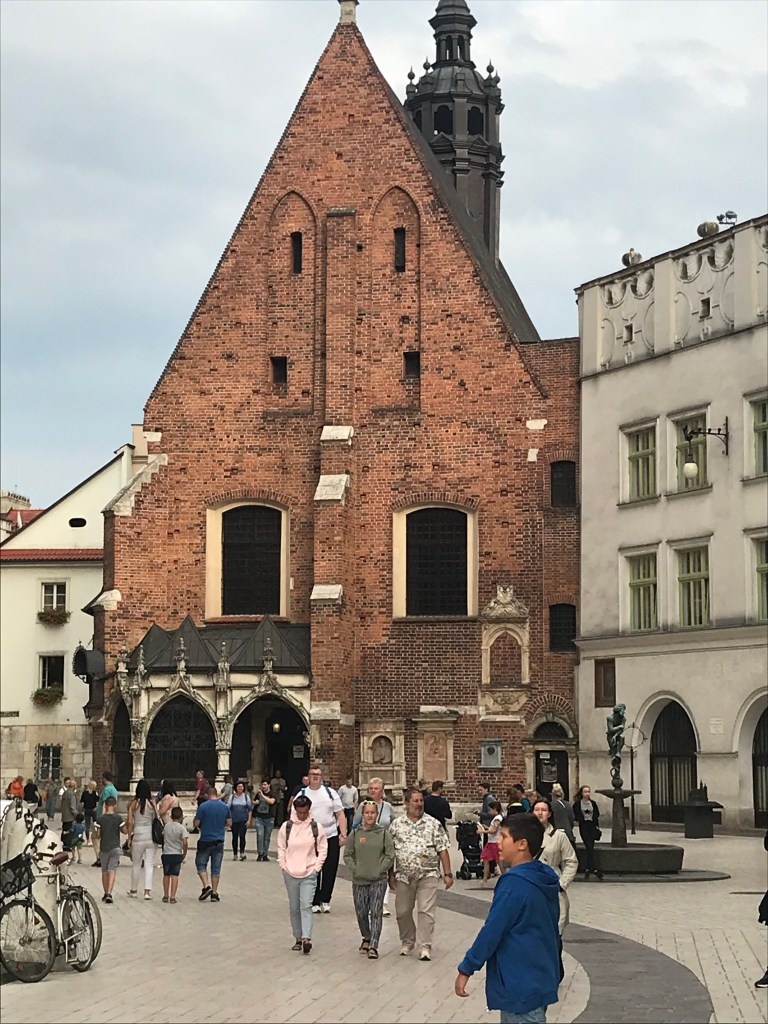
St Barbara’s Church, late 14th c. Jesuit 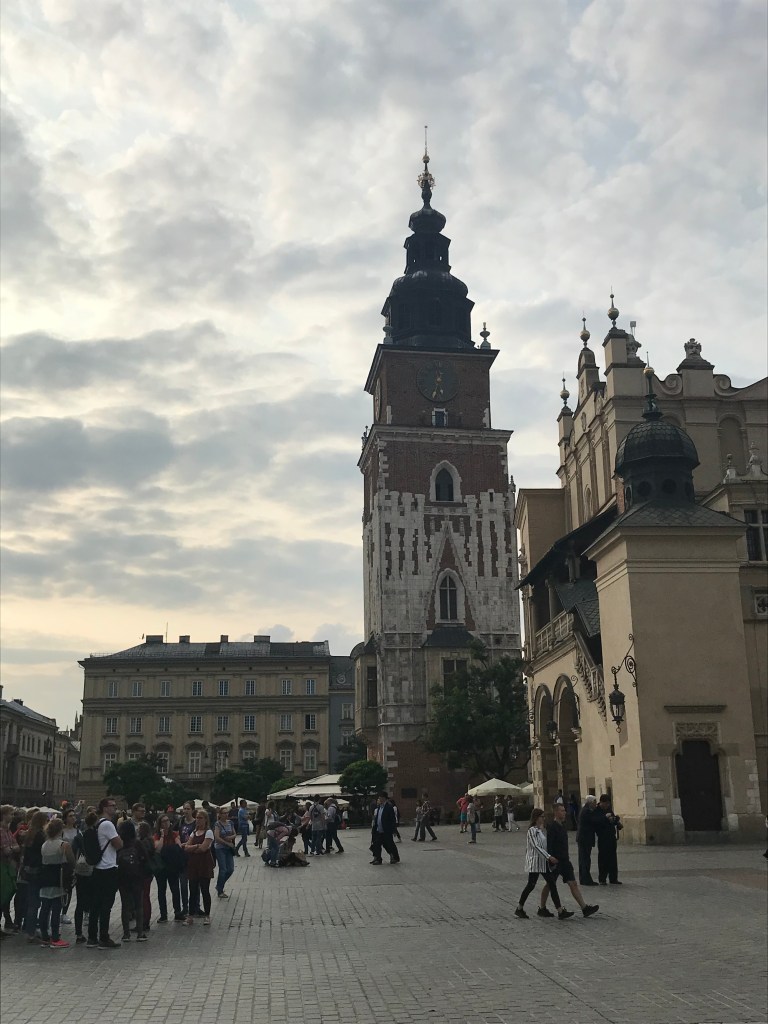
The 14th c. Town Hall 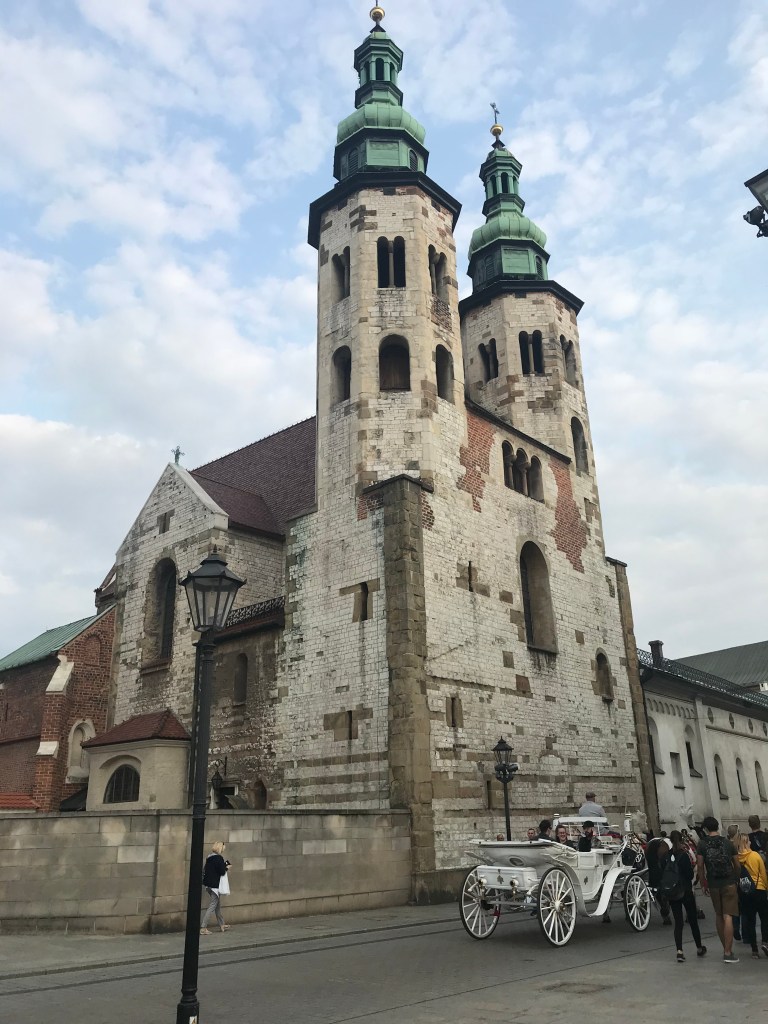
Romanesque St Andrew’s Church late 11th c. Kraków, like Prague, wasn’t destroyed in either of the world wars, so many ancient churches and castles are still intact and in pristine condition. I spent a few weeks in Prague in September 2001 and feel that Kraków is just as impressive.
I decided to eat dinner at the cafe in my building and had a nice chat with the bartender about Kraków who offered suggestions for offbeat destinations, so I decided that I’d visit the salt mines and Nova Huta towards the end of my visit on his recommendation.
After a great night’s sleep, I had some coffee and yogurt in the apartment and took a long walk through Old Town to pick up a rental bike. The woman at the shop was helpful and gave me a cycling map. I also rented an iPhone holder so I could follow my route without trying to look at the map. I headed out through the city and suburbs towards Auschwitz, although I didn’t visit since I didn’t have reservations and wasn’t sure what to do with the rental bike. The bike lanes were well marked and I was surprised by the size of Kraków outside of the historic core. There were also a number of parks. After my ride out to the western suburbs, I headed back along the bike trail to view Wawel Castle and the former Jewish quarter. The castle was magnificent and contained its own cathedral and massive ramparts. The Vistula is broad and makes for a beautiful riverfront ride or walk.
The ghetto was interesting, although perhaps to the chagrin of its survivors it is undergoing gentrification and is becoming a hip neighborhood. From my bike I saw quite elderly tour groups walking through the ghetto neighborhoods. It was a lachrymose scene on a beautiful sun-filled day. I drove by the Schindler Factory but the line was long and I was eager to try out a hip outdoor restaurant nearby for a late lunch.
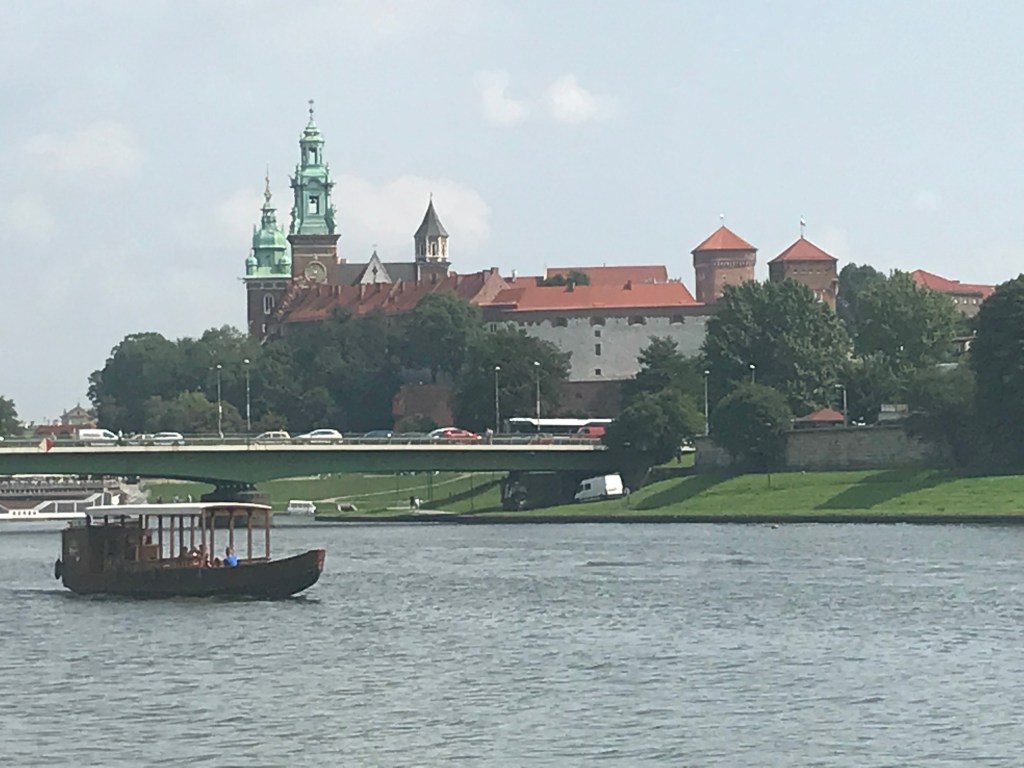
Wawel Castle on the Vistula 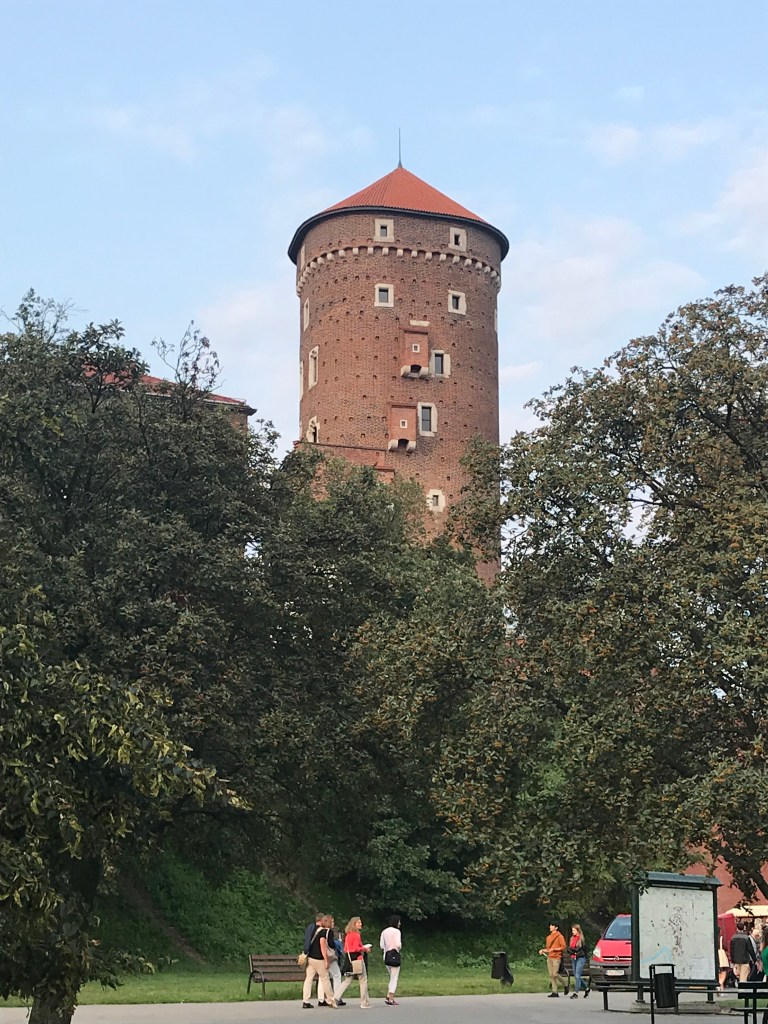
Wawel tower 
Wawel Cathedral in the castle complex 
Looking up at Wawel Hill 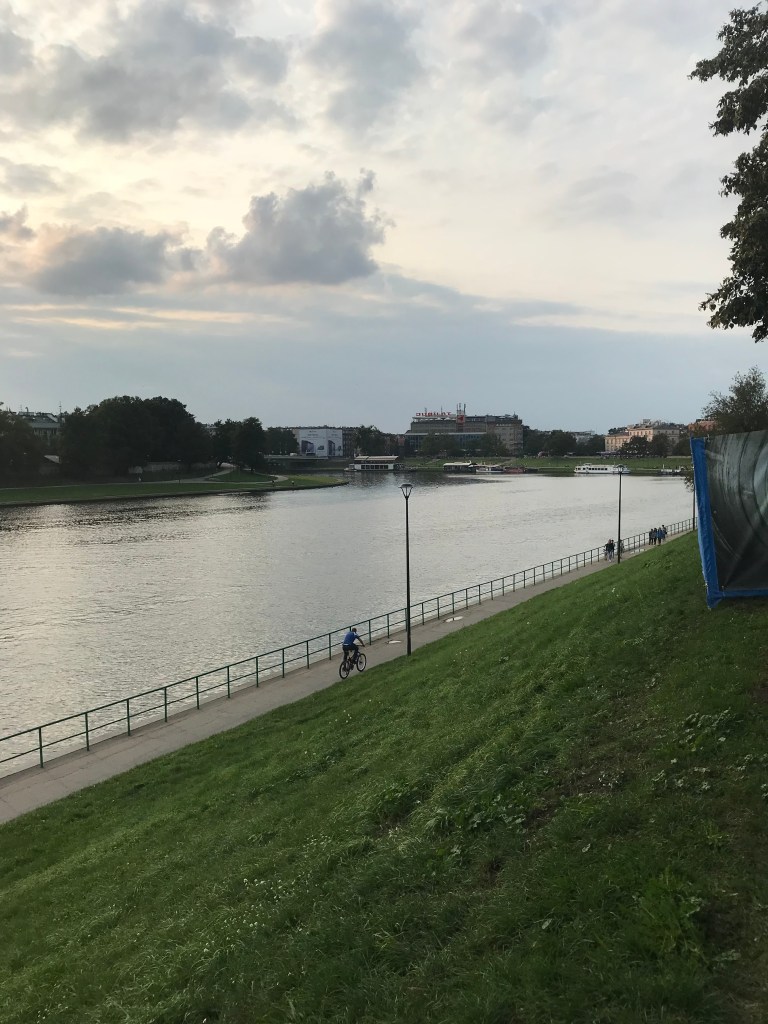
The Vistula near the castle 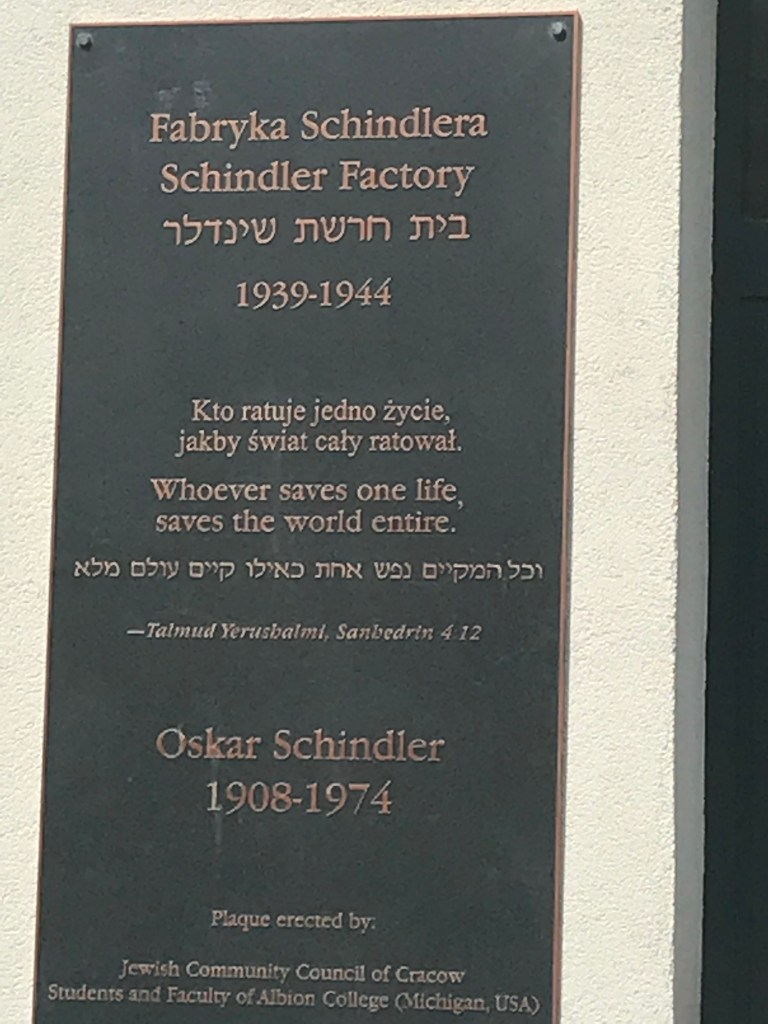
Schindler plaque I booked a spot on the Kraków Dark History evening walking tour that night, which was excellent. The atmospheric city center takes on an even more impressive aspect when viewed at night. Our guide showed us where famous murders and other scandals had occurred over the centuries and pointed out haunted buildings and cemeteries.
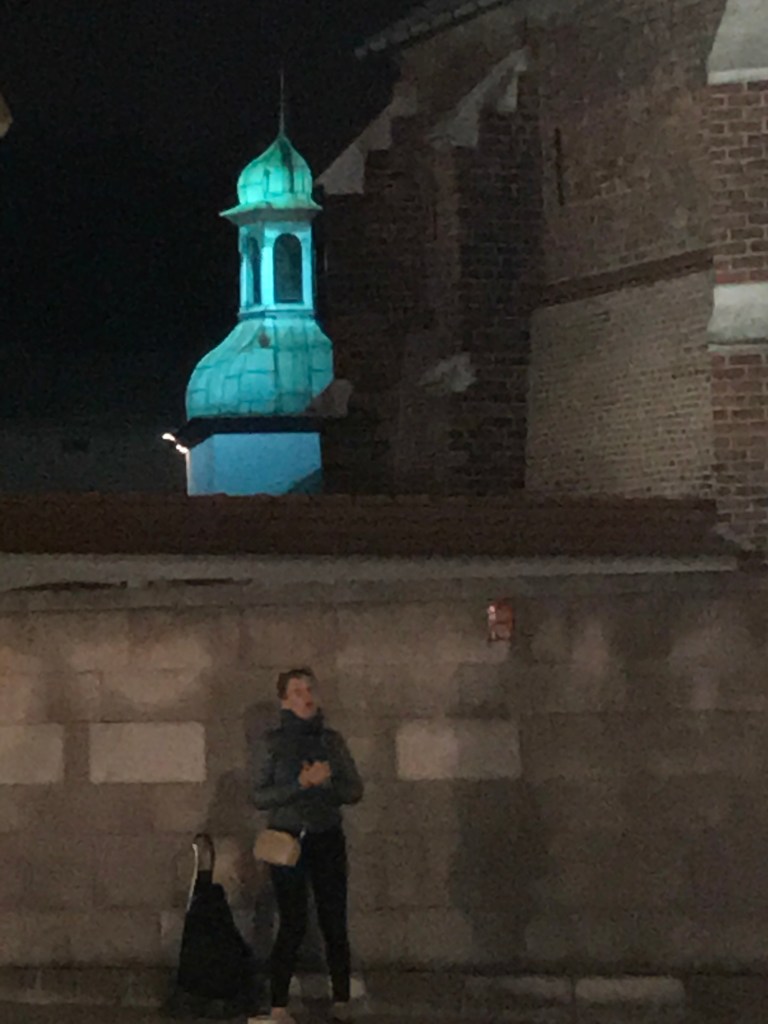
Soprano singing Mozart inside the university grounds 
Church of SS Peter and Paul within the university. Early 17th c. Baroque 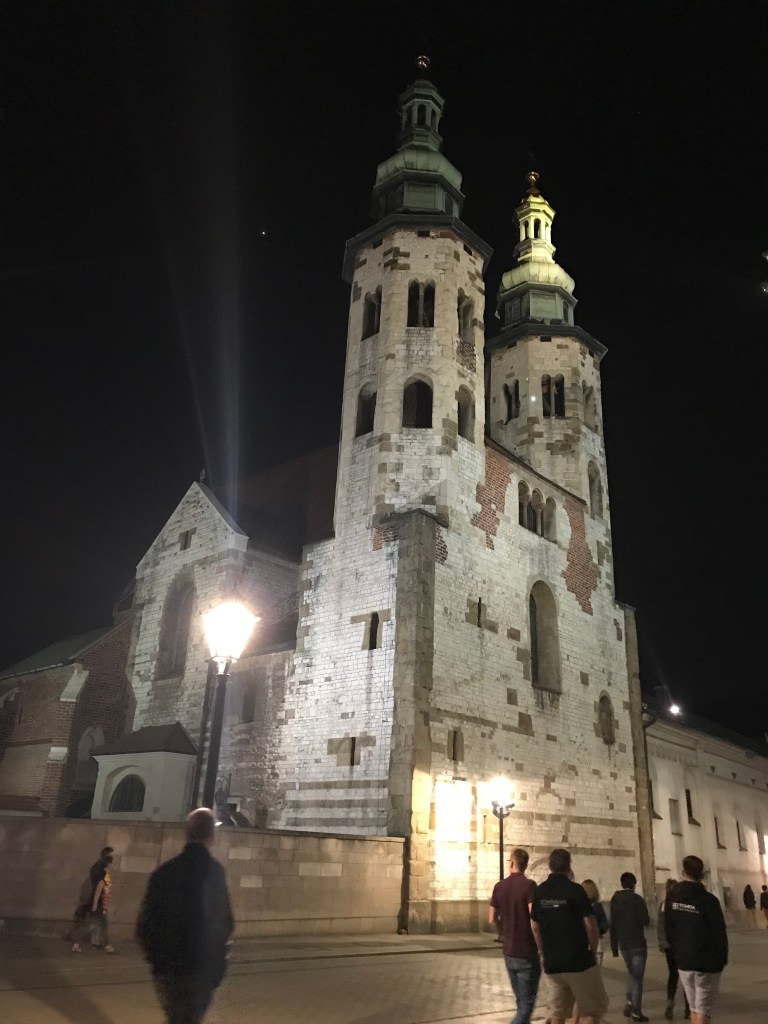
St Andrew’s Church at night 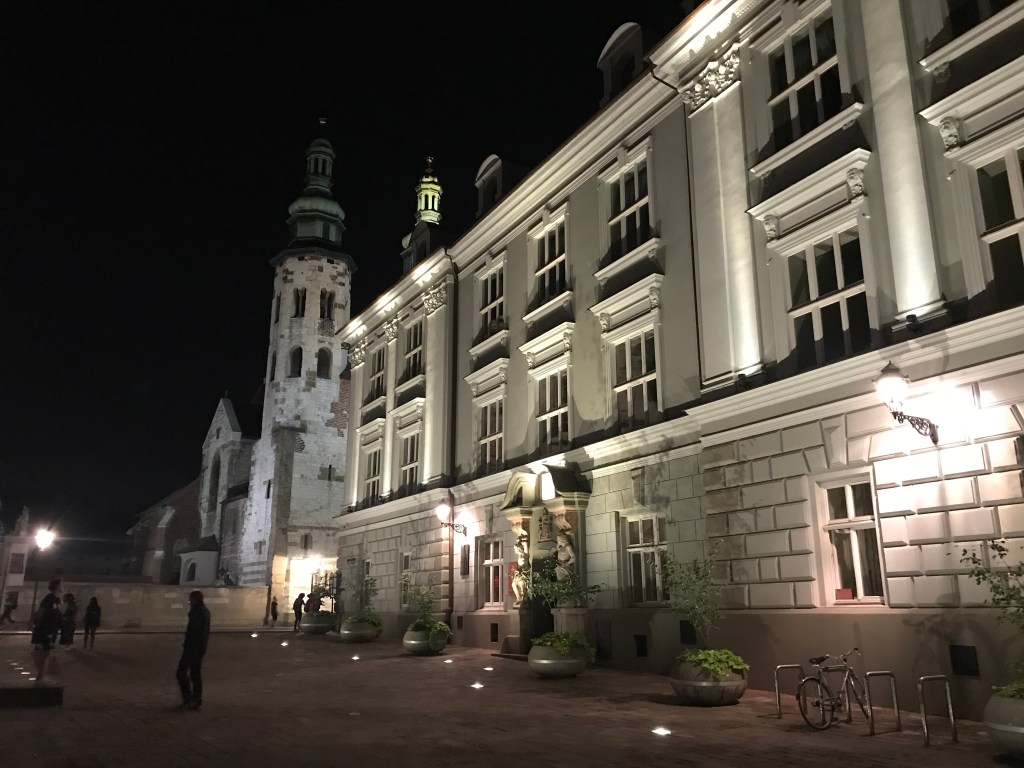
University faculty near St Andrew’s 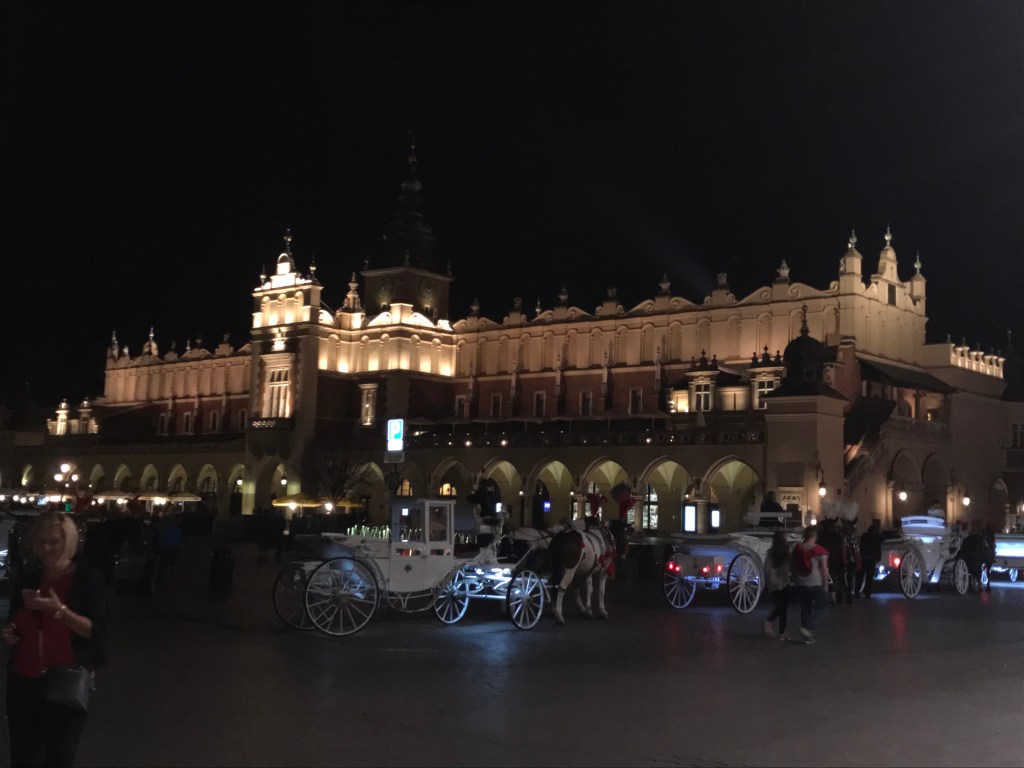
Market Square with Cloth Hall lit up at night The next morning I booked a tour of the Wieliczka salt mines, an hour outside of Kraków. Our guide drove us out in a Mercedes Sprinter which was quite comfortable. The mine is immense and was worked for centuries. It even contains a basilica and dormitories. The air was quite cool and refreshing. The full tour lasted almost three hours and involved a significant amount of stair-climbing, making for a good cardio workout.
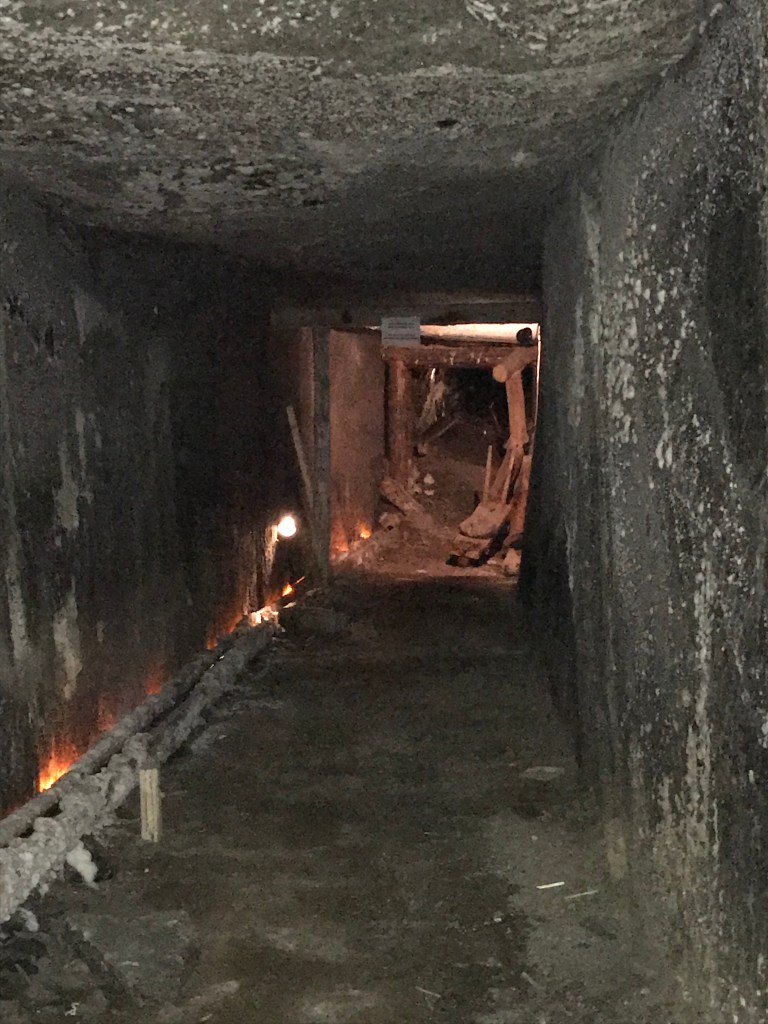
Spooky passageway in the depths of the salt mines That night I treated myself to dinner at Pod Aniolami in Old Town, which was billed as traditional Polish cuisine with a French flair. It wasn’t that busy, so I felt like a mob boss sitting at an elegant table with my own private waiter. The food was superb as was the Burgundy. My waiter said that it’s packed during the tourist season. I went for a 5k walk around Old Town afterwards before heading back to the Airbnb for the night.
The next morning I found a hip breakfast spot on the other side of Old Town that served excellent coffee and food. After breakfast, I hailed a taxi to take me out to Nova Huta, the master-planned Communist city on the eastern edge of Kraków.
After the Communists solidified their power in 1948, they turned Poland into a totalitarian police state. The new regime looked on Kraków with suspicion, given the city’s long bourgeois past and palpable distaste for communism. In many ways, the new rulers represented the formerly rejected part of the population, so they were seething with resentment against traditional society and some felt that they built the vast Socialist Realist suburb to introduce a proletarian aspect to this genteel city.
Nova Huta means New Steelworks in Polish and was the site of the Vladimir Lenin Steelworks as well as a giant cigarette factory. Most of its 50,000 residents were brought in from other parts of rural Poland, so they held no allegiance to Kraków. I actually find the Stalinist architectural style impressive, if a bit dehumanizing. Any fan of this style will be in heaven in Nova Huta, with its broad boulevards and massive housing blocks.
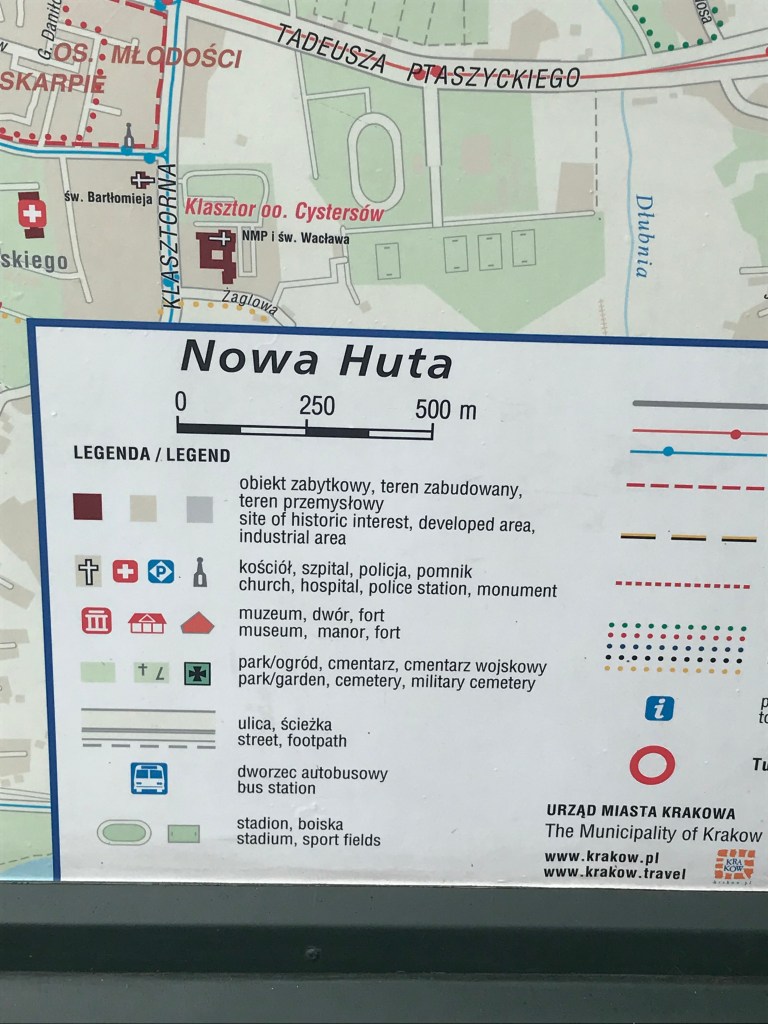
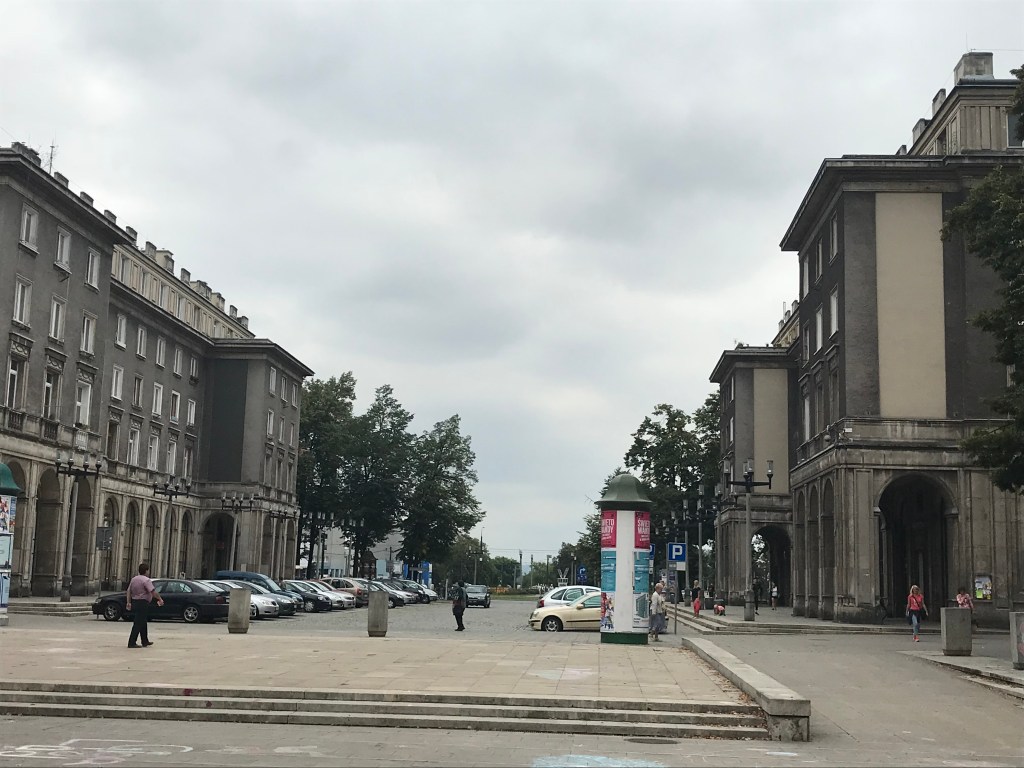
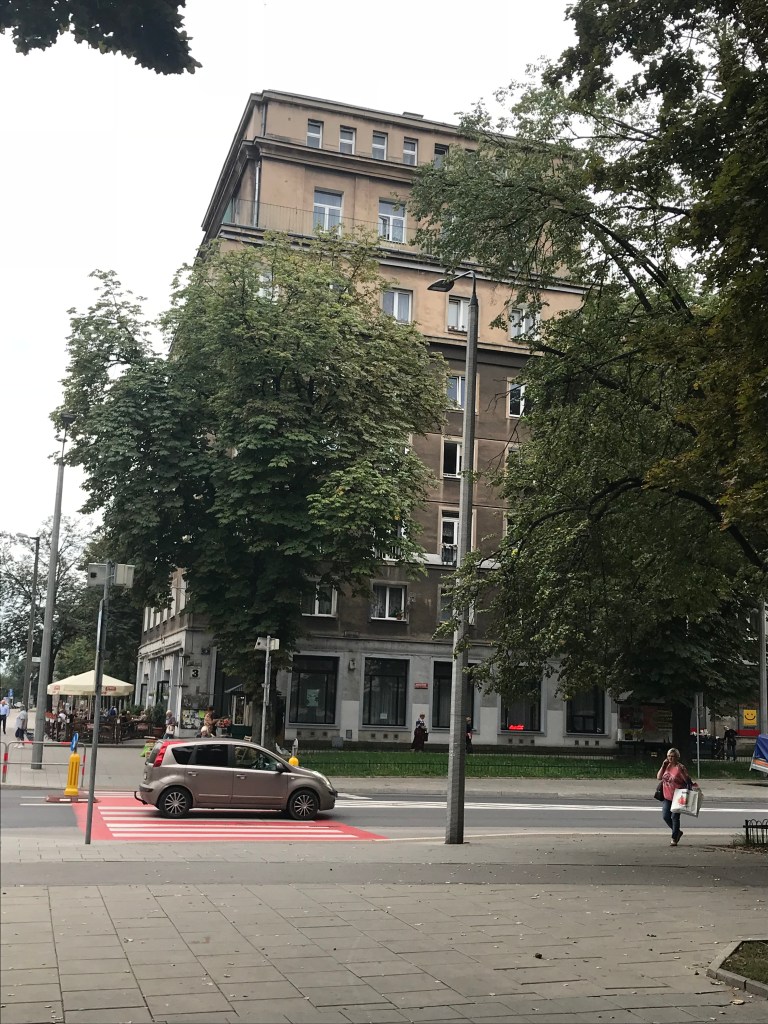
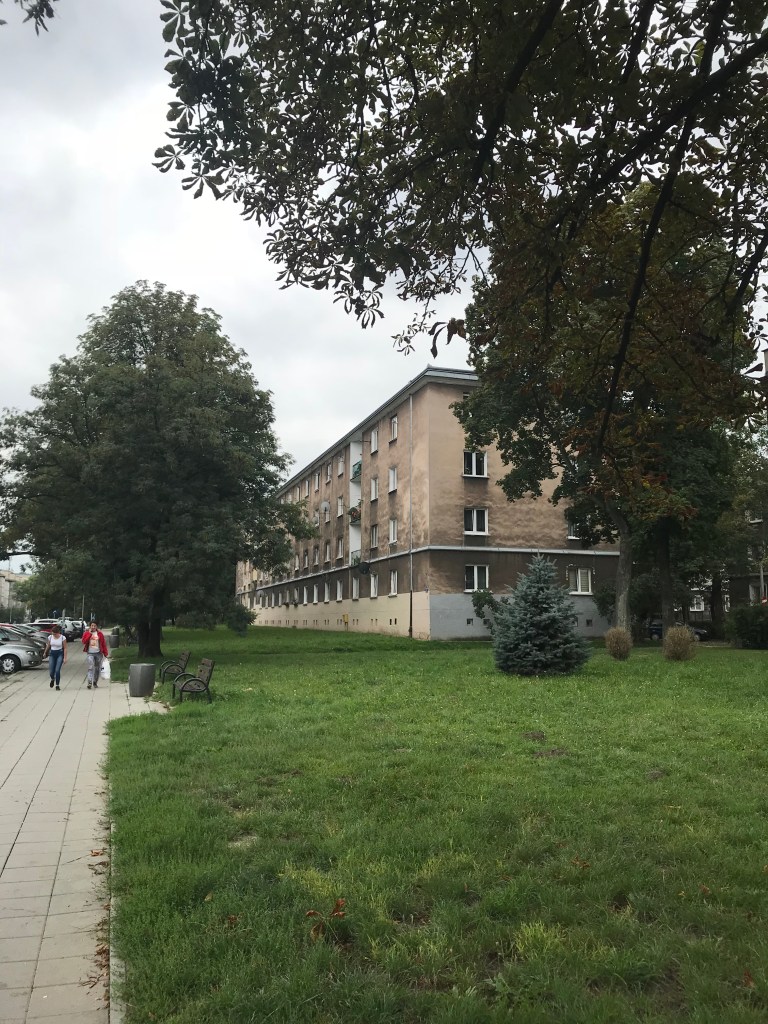
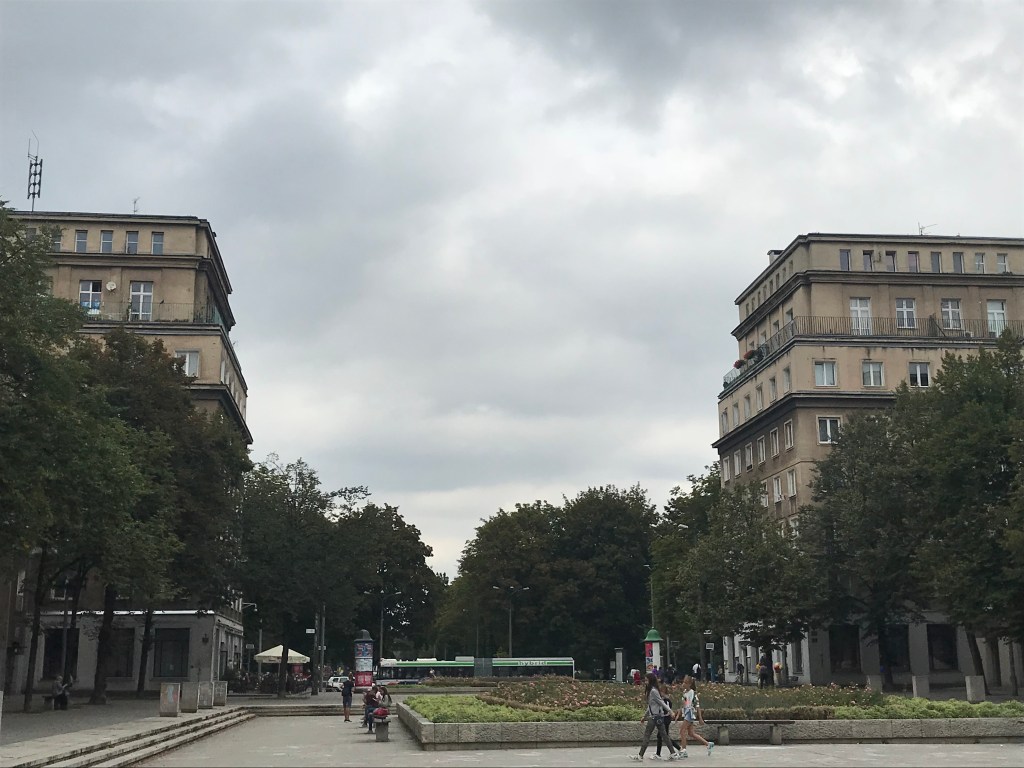
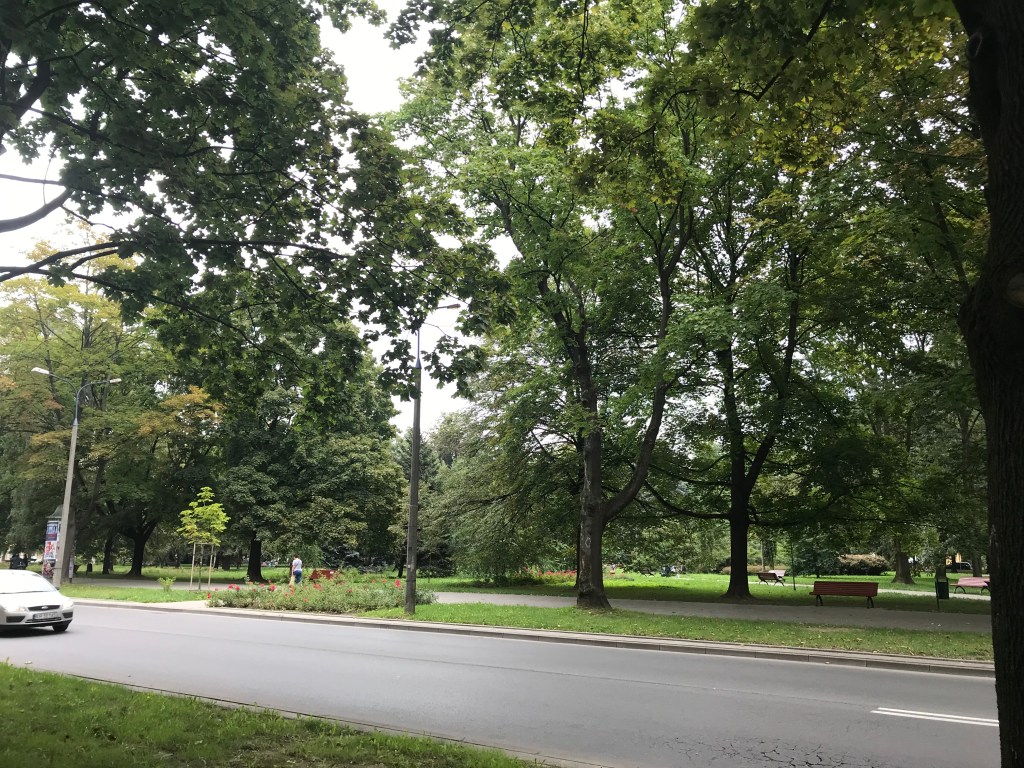
The steelworks have long been dismantled and Nova Huta is becoming a gentrified area for young professionals, although in the 1990’s it was a dangerous drug-infested slum.
After checking out, I grabbed an Uber to the airport for my late afternoon flight to Gdánsk. My young driver told me that he was studying computer science and had a Ukrainian girlfriend, stating that Polish girls were snobby. I chuckled at that. He told me that over 600,000 Ukrainians were living in Poland in 2018 and that they were smarter and more ambitious than his fellow Poles. Of course now there are almost two million Ukrainians living in Poland because of the war. The Ukrainians assimilate more easily to Polish culture than other immigrants since they are fellow Slavs and speak a somewhat similar tongue, although the alphabet is different. One always gains interesting perspectives from drivers!
-
Lviv
I found a decent coffee place on Market Square and had a cappuccino and a Lviv Croissant, which is an unlikely Ukrainian chain. I had some time to kill before the first walking tour, so I caught up on emails and texts.
As I headed to the morning tour meeting spot, I noticed two unmistakable LDS missionaries. They were from Idaho and when I asked them about the success of their mission, they frowned and reported that while most of the Ukrainians with whom they spoke professed to believe in God, they were not at all receptive to their message. I said “good luck” and left before they started working on me!
The morning tour was really informative. As I’ve reported in previous posts, it’s amazing that so many old towns, though in various states of shabbiness or restoration, survived the antinomian impulses of the Soviets.
I struck up a conversation with an older New Yorker who had lived in Lviv as a child, but was able to flee in the early fifties. He and his wife and daughter were investigating their Jewish roots and he told me that he recognized several of the old churches and temples from his childhood. The Soviets stored horses in one old synagogue. It was amusing when his wife scolded him for talking during the guide’s presentation.
We all had lunch at an old cafe and shared the usual foreign tourist banter. A younger French couple were particularly amusing.
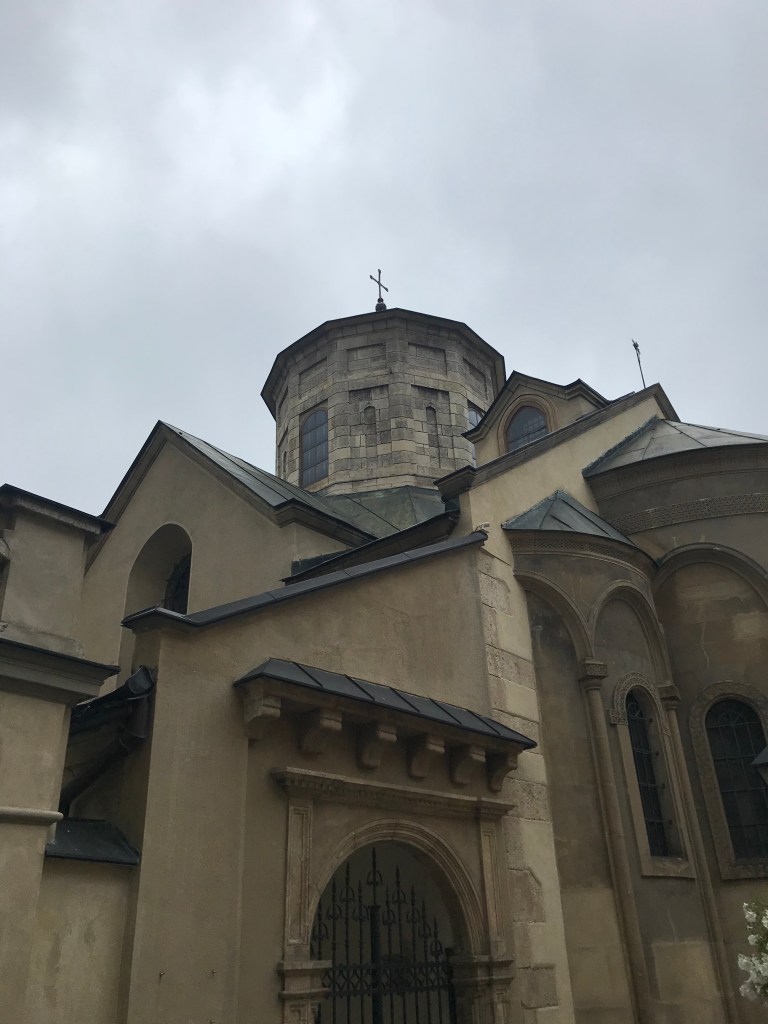
Armenian Orthodox Cathedral late 14th c. 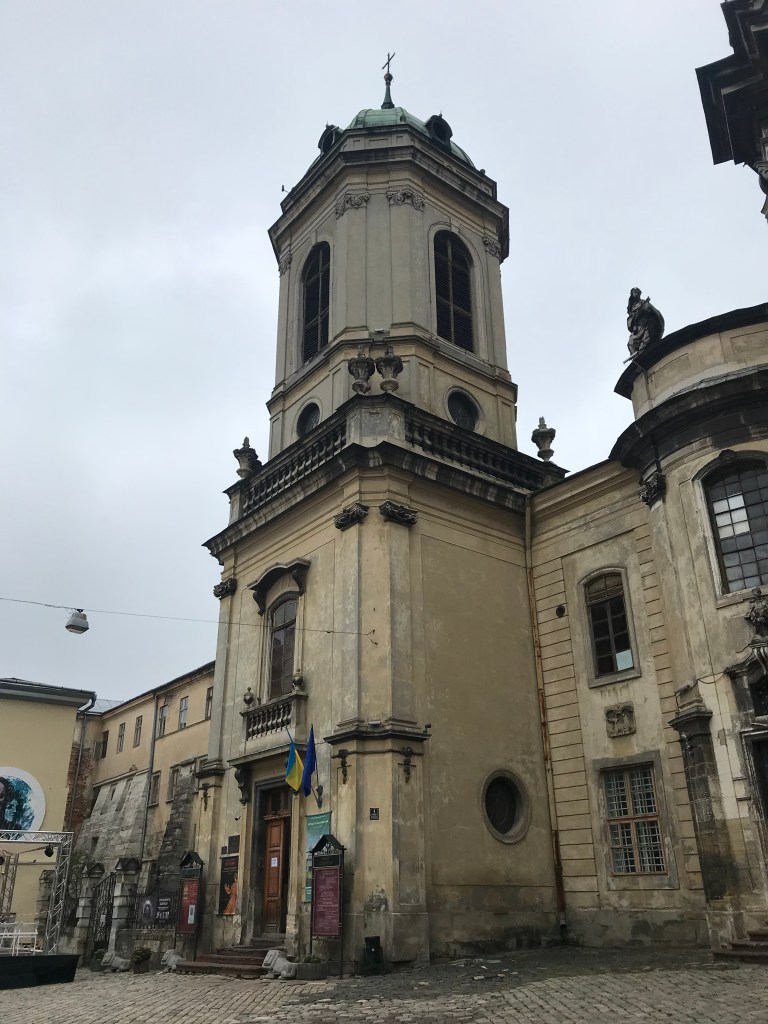
Church of the Holy Spirit 1729 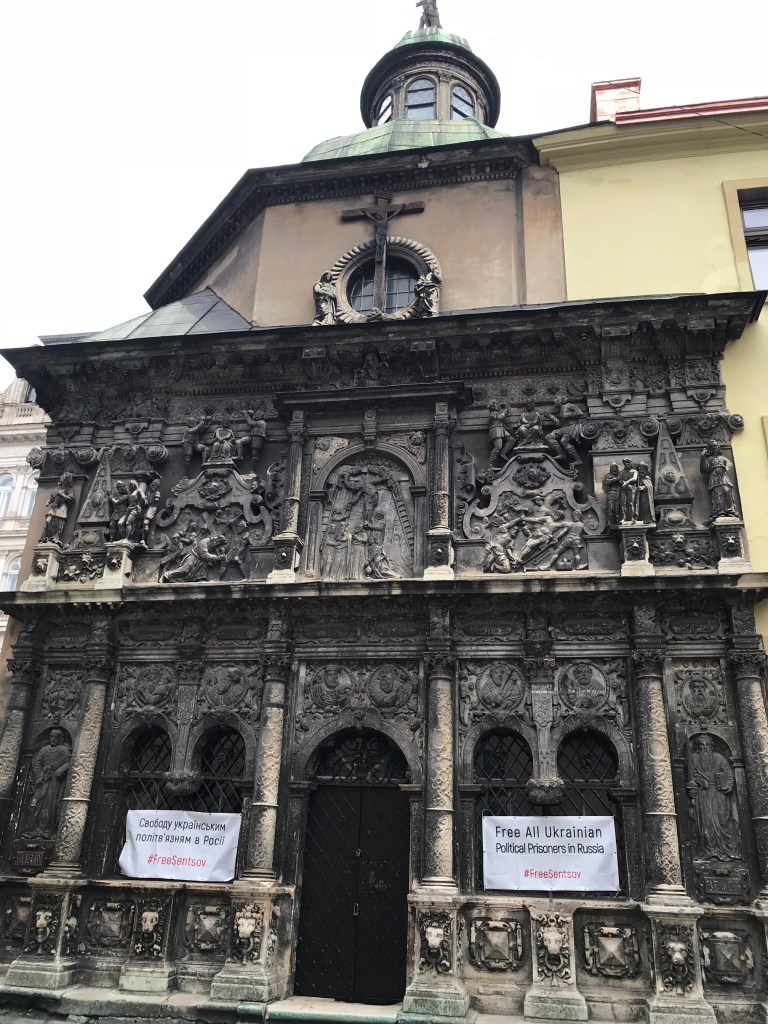
Mannerist Chapel of the Boim Family. Early 17th c. 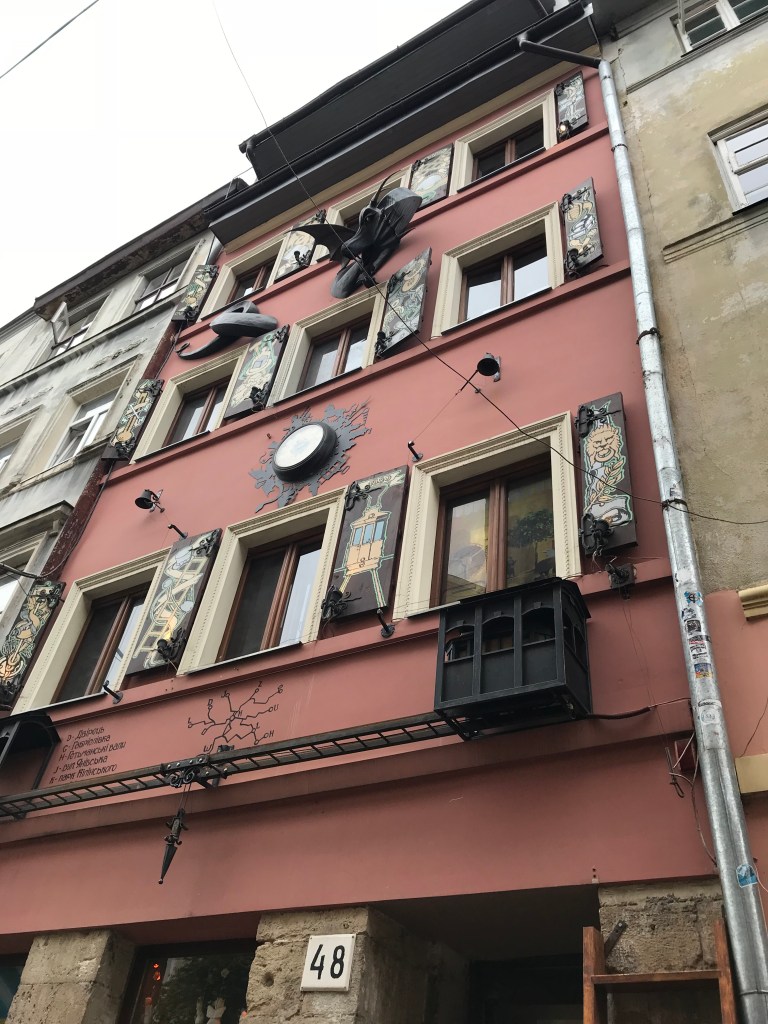
1930’s Jugendstil 
Art Nouveau block 
Interior of Armenian Cathedral After lunch I did a little shopping on Market Square and also walked into the opera house to see the restored stage.
The afternoon architecture tour was led by a recent graduate of the Ivan Franko National University of Lviv. We were joined by a Dutch couple and a very quiet middle-aged American who claimed to work for the Peace Corps. Our guide was very entertaining and he and I hit it off. Like many of the Eastern Europeans whom I met on this trip, he wasn’t afraid to hide his opinions. He was strongly anti-Russian.
We were impressed with the number and variety of buildings surviving the two world wars and fifty years of Soviet misrule. Some dated to the Polish-Lithuanian Commonwealth and many others from the Austrian period beginning in 1772.
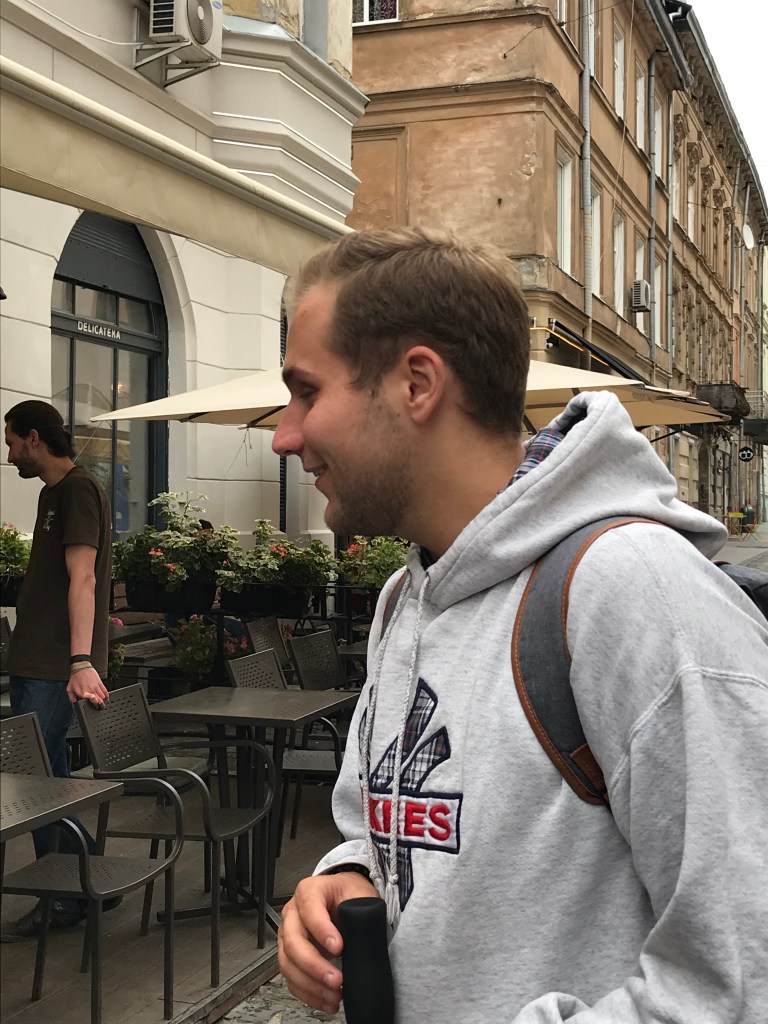
Our guide 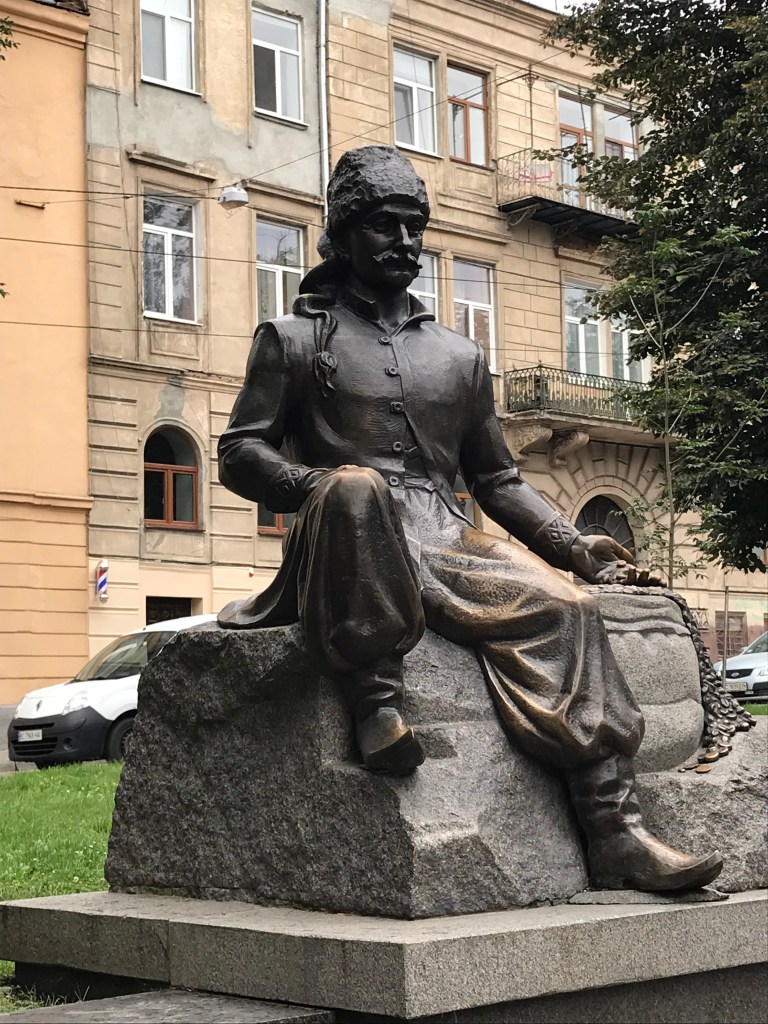
General Kulchitsky statue. Bringer of coffee to Lviv 
Benedictine Monastery early 18th c. 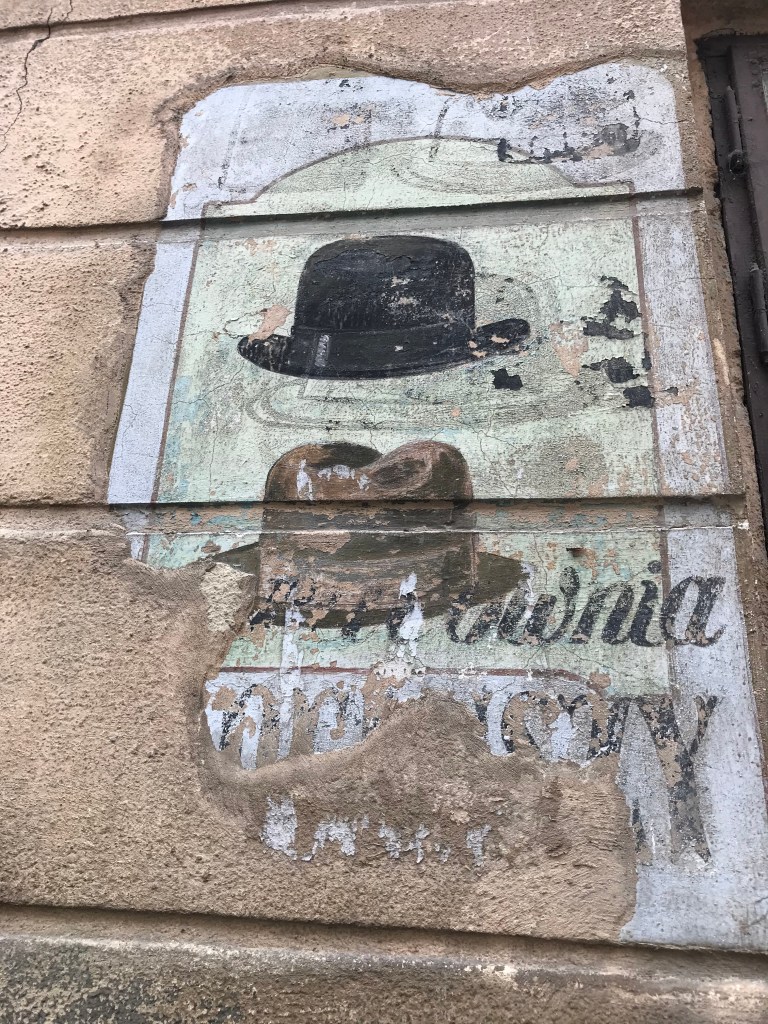
Pre WW2 Yiddish hat shop 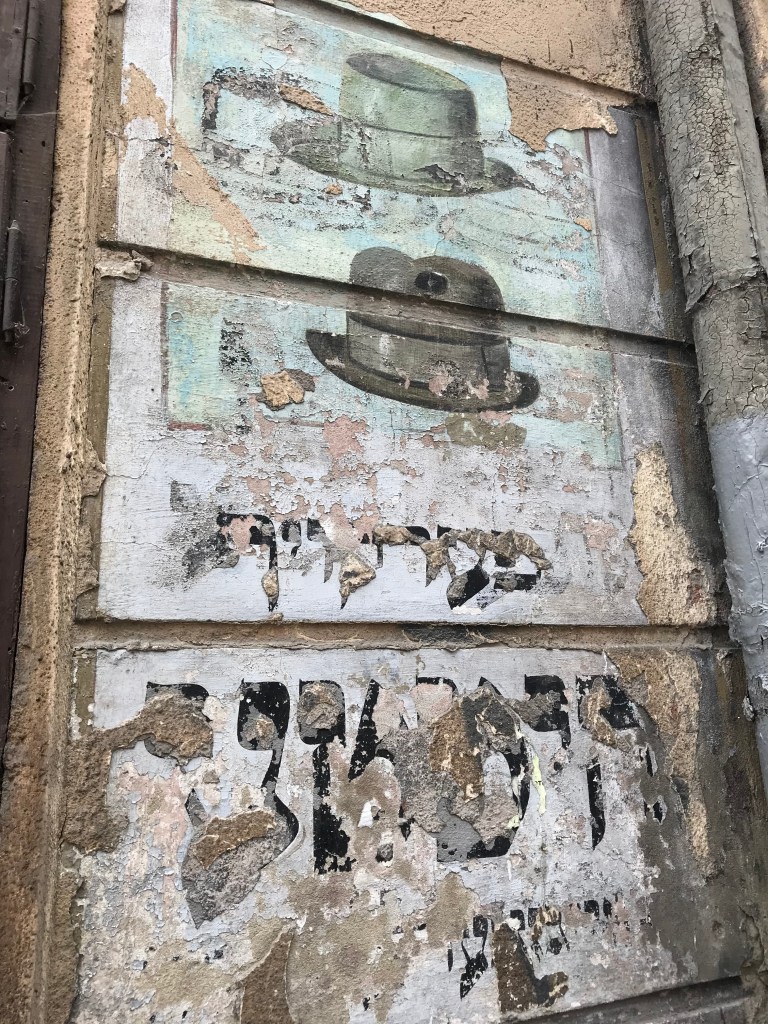
Another view of the hat shop 
St John Baptist mid-13th c. 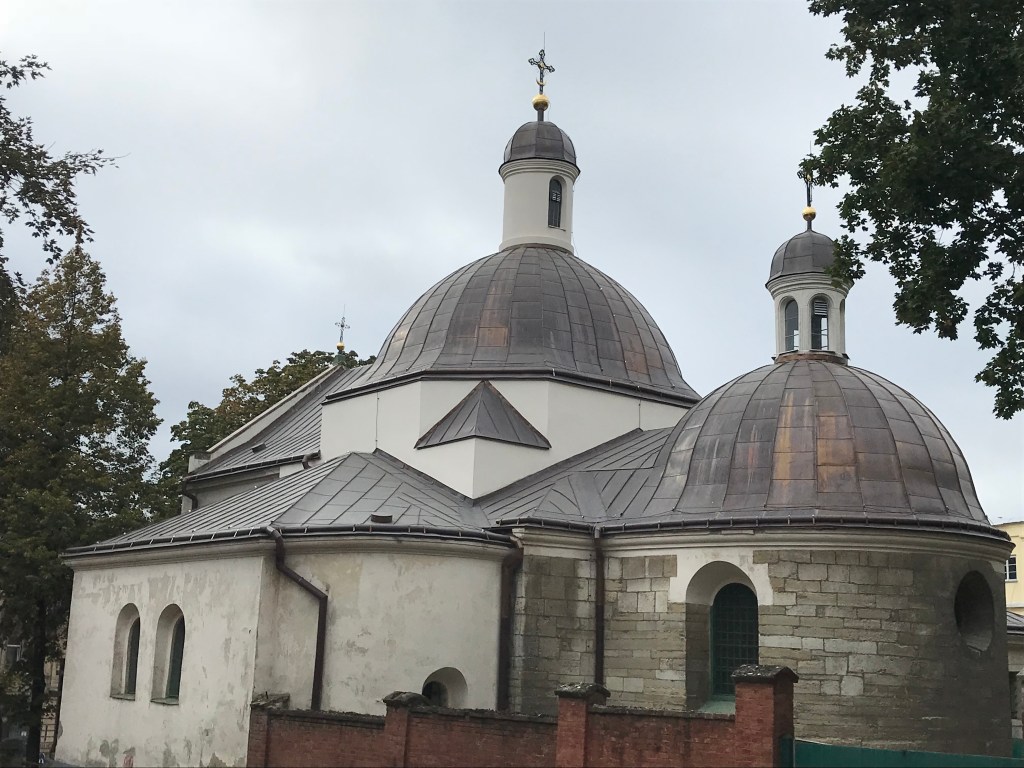
St Nicholas Church. Oldest building in Lviv 13th c. 
St George slaying the dragon 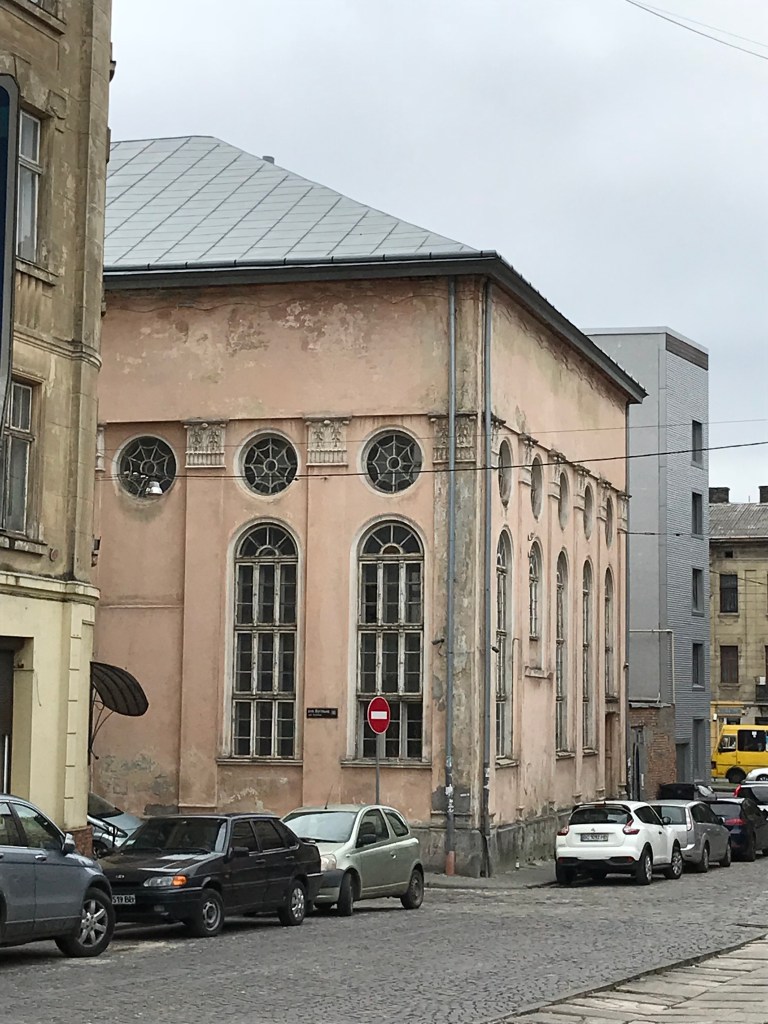
Secessionist-style synagogue During recent restoration, advertisements in Yiddish for a men’s hat shop were revealed (above). They’re finding all sorts of architectural gems under decades of cheap Soviet paint and stucco.
The Ivan Franko National University, formerly the University of Lviv, was founded by royal charter in 1661 and was run by the Jesuits. It was the second oldest university in the Commonwealth after Kraków’s Jagiellonian University. Ivan Franco was a renowned Ukrainian scholar in the 19th century and the university was renamed after him upon the collapse of the USSR. It was a center of the Ukrainian intellectual renaissance under the tolerant Austrian rule.
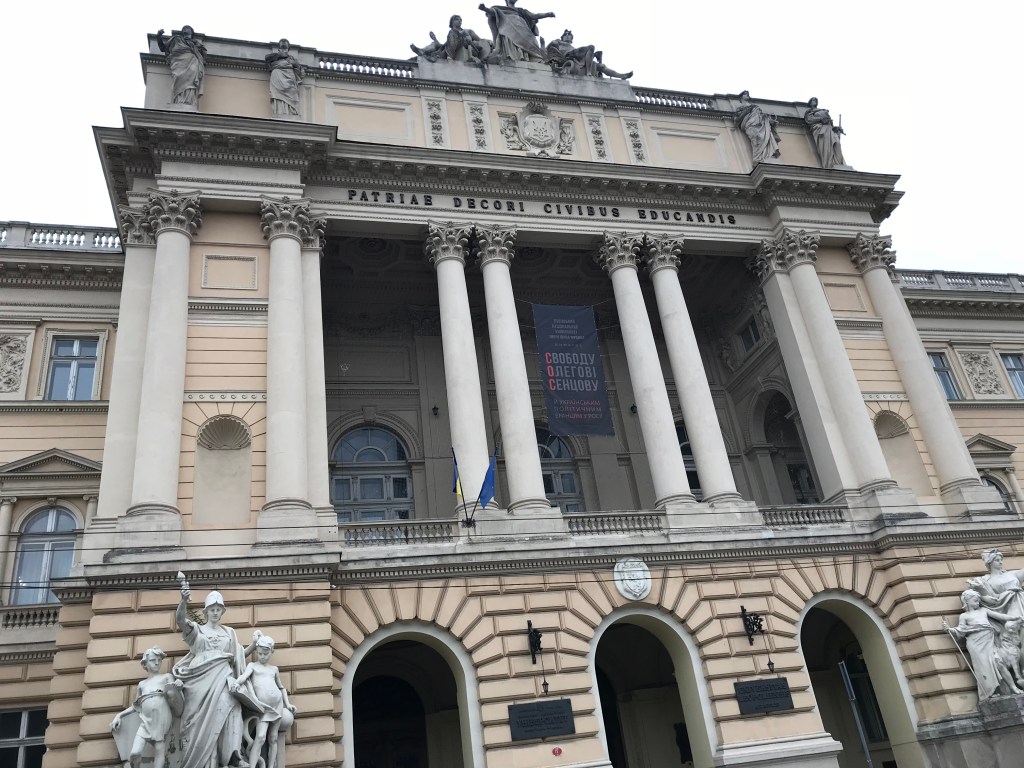
Entrance to the university 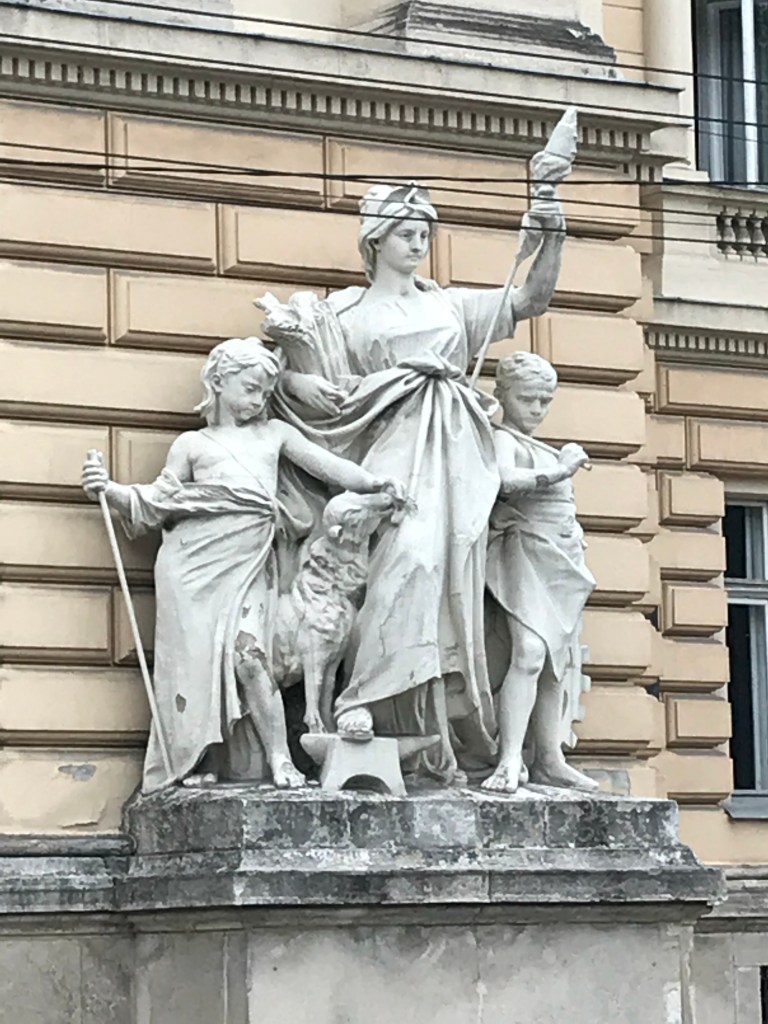
Allegorical statue of Science on university facade 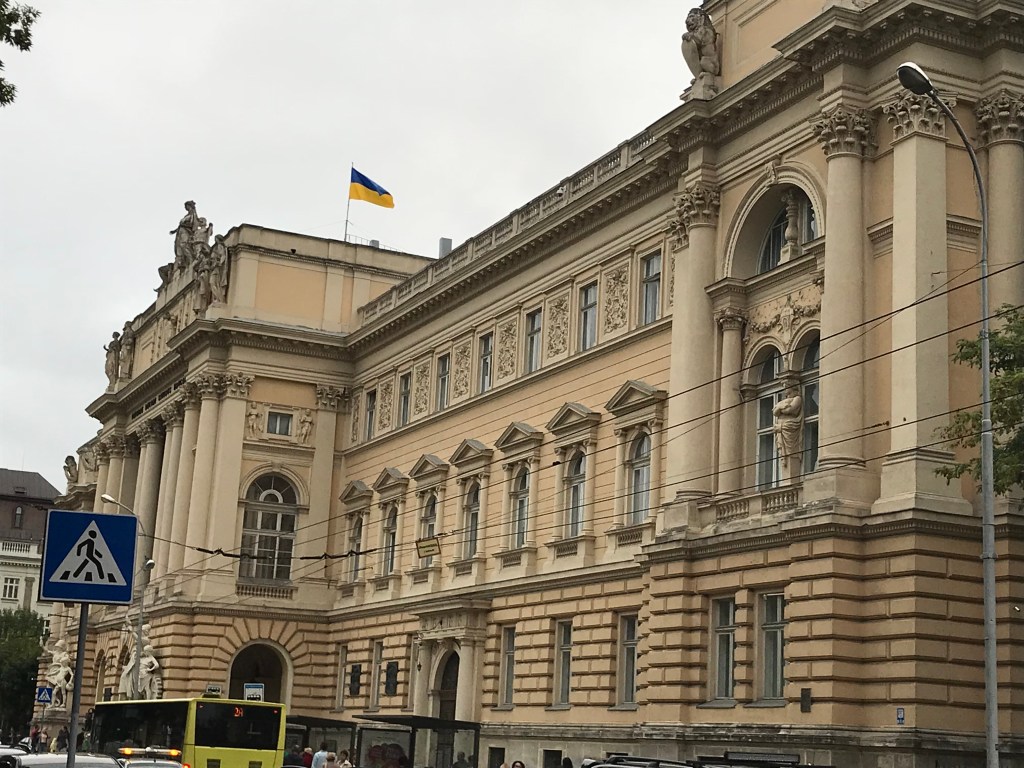
Another view of the main building in Viennese Renaissance style 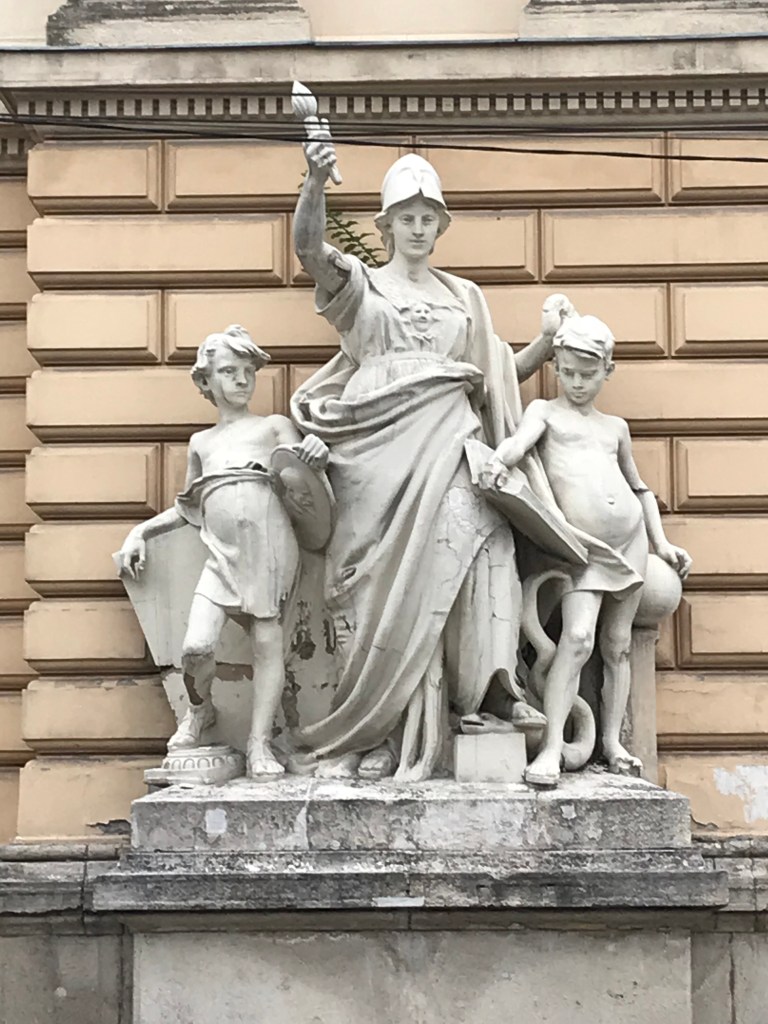
Allegorical statue of Love 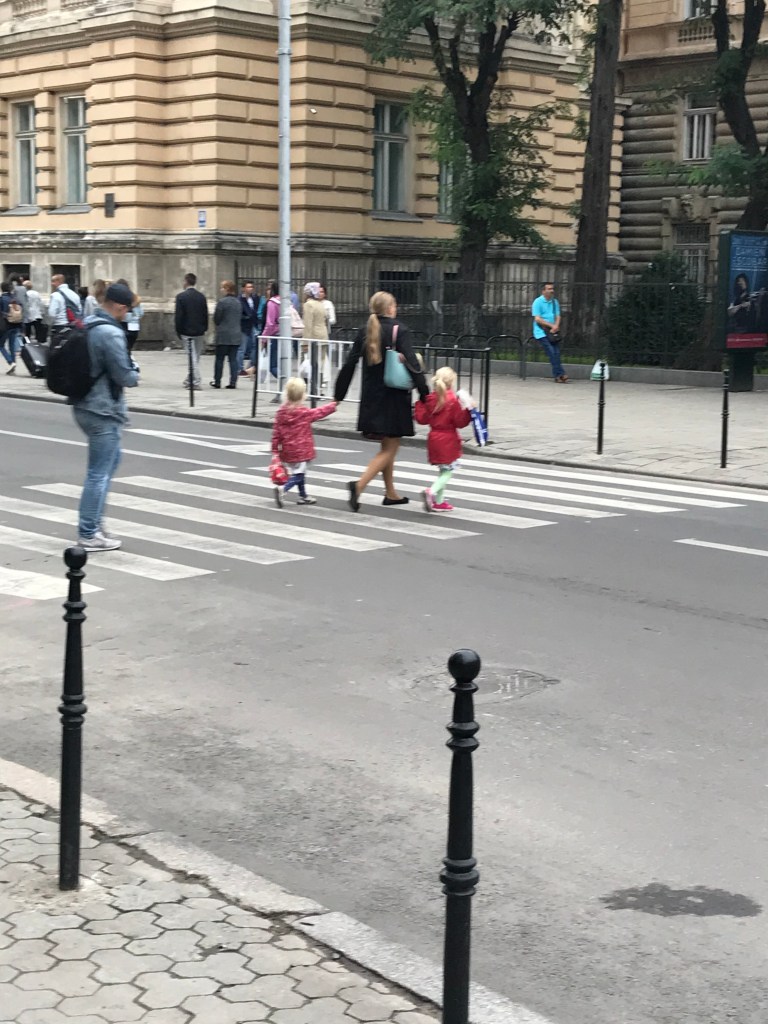
University street scene 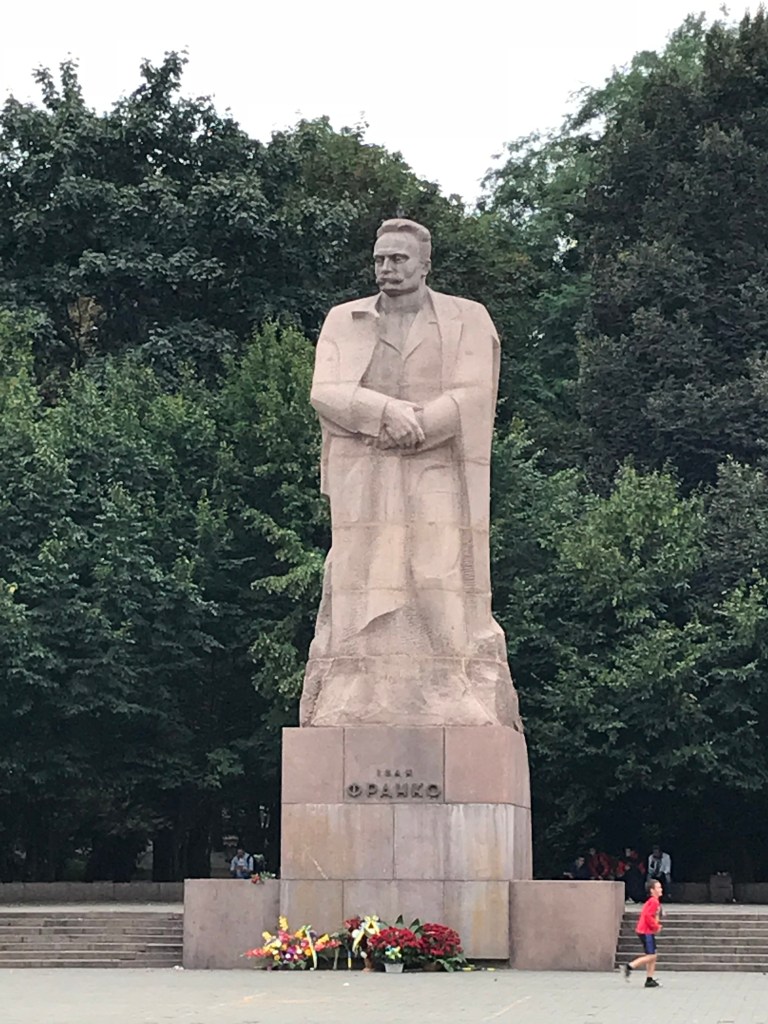
Ivan Franko 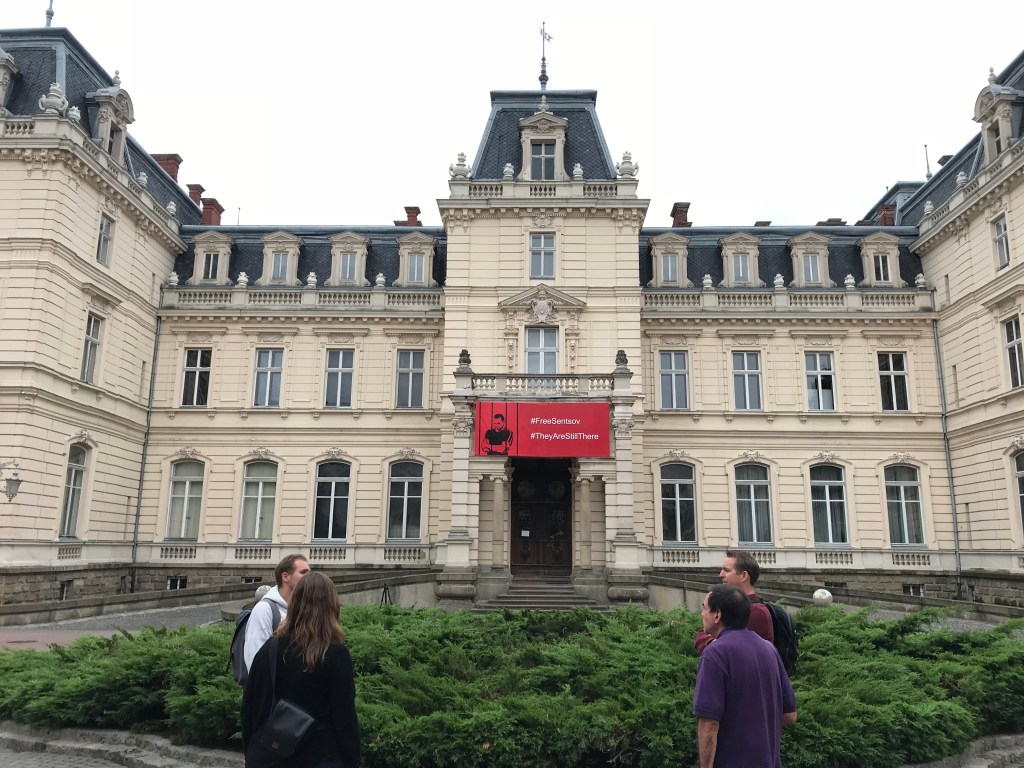
The group in front of a Secessionist-style building 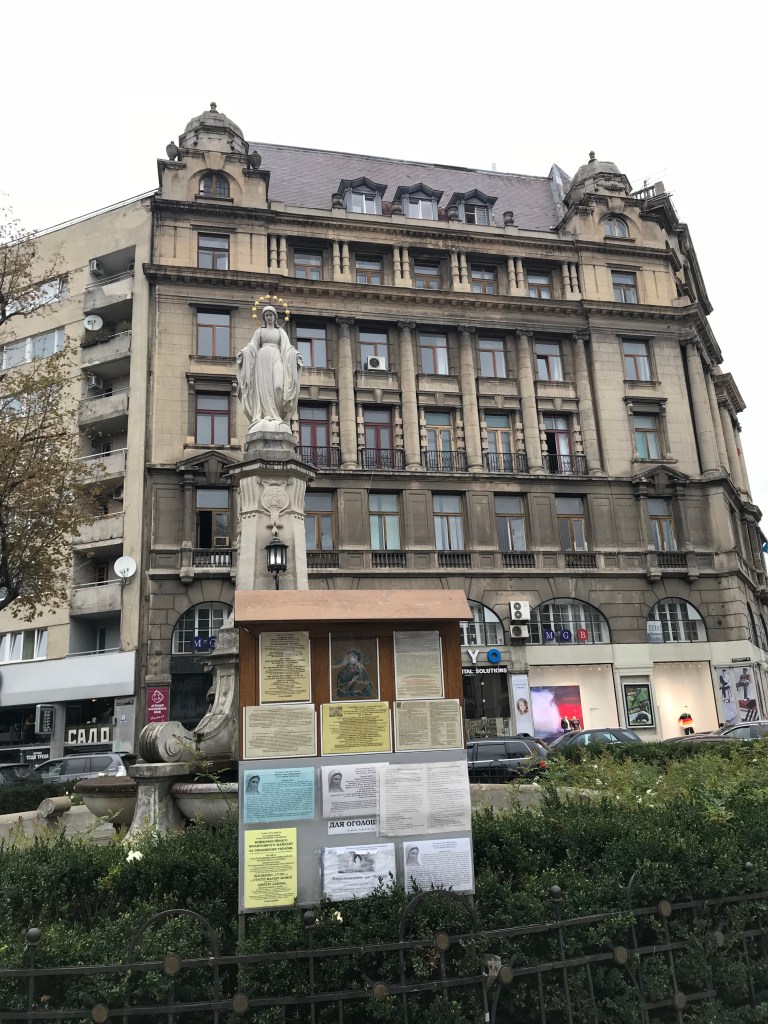
Monument to the Virgin Mary 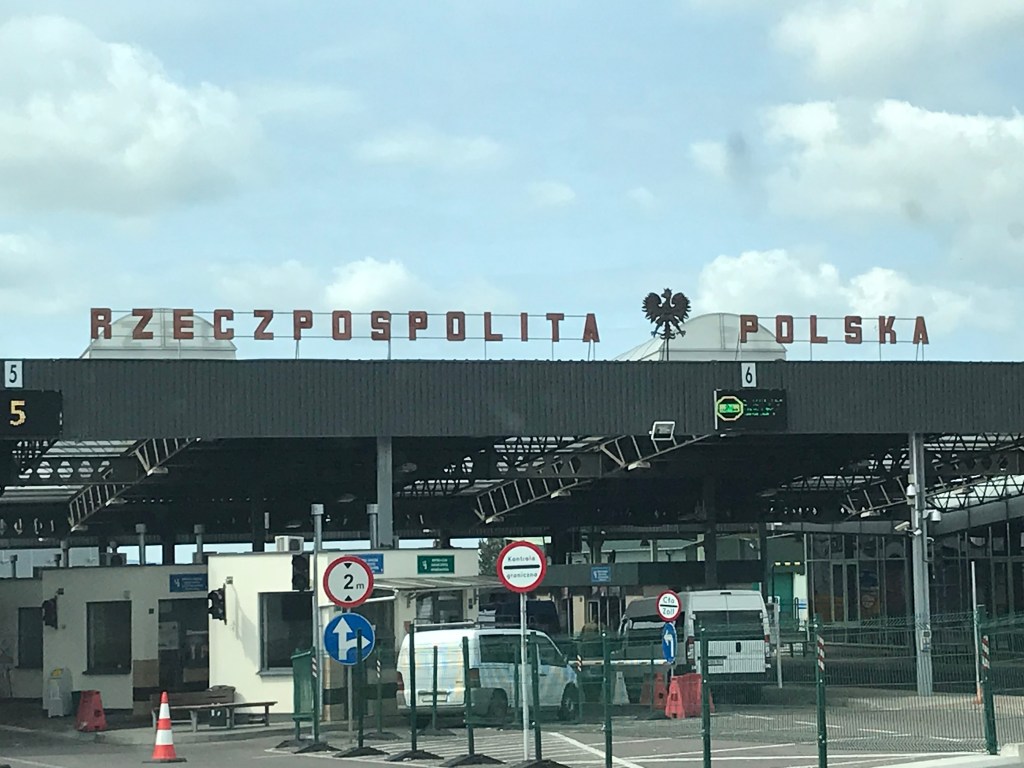
Polish-EU border crossing Since it wasn’t convenient to fly from Lviv to Kraków without backtracking east to Kyiv, I decided to use the driver service that I’d used in Bulgaria-mydaytrip.com
After an excellent breakfast the next morning, I packed up and checked out of the Airbnb and met my young Polish driver, Michał, right on time in his white Audi A3 wagon, the same model as in Sofia. He told me he had never been across the border to Ukraine and was nervous, which surprised me since Lviv looks like a somewhat prosperous Central European city. He was also worried about the border wait, but we were through in less than 20 minutes. He was relieved to be back in Poland and proudly contrasted the modern freeway with the two-lane highway in Poland. He also told me, unbidden, about some obnoxious Americans he had driven around Poland earlier in the week. I laughed and said that I hoped I didn’t fall into that category.
The drive to my Airbnb in Kraków’s Old Town was less that 4 hours and he was an enjoyable companion so I gave him a hefty tip. As a hard-working new father, I was happy to help out since the drive itself was faster and cheaper than going by plane.
-
Kyiv to Lviv: August 26, 2018
On Sunday morning I met up with the bike tour folks for our postponed bike tour of the Trukhaniv Island in the Dnipro and other riverside sites. I dropped by McDonald’s beforehand for breakfast since nothing was open. It was fine. I hadn’t been to one in 25 years.
We started our ride near Mariinskyi Park, which connects to the bike trails heading down the deep banks to the Dnipro bridges. The park was built as part of the Mariinskyi Palace, which was built for Empress Marie, the wife of Tsar Alexander II. From there we descended to the Dnipro and crossed the pedestrian/bike-only Park Bridge over to Trukhaniv Island, which is quite large and unspoiled and is a popular beach and picnic site for Kyivans and tourists. It’s pretty unspoiled and my guide had trouble keeping up with me as I tore across the gravel towards one of the beaches.

View of Kyiv from the Park Bridge 
In front of Mariinskyi Palace 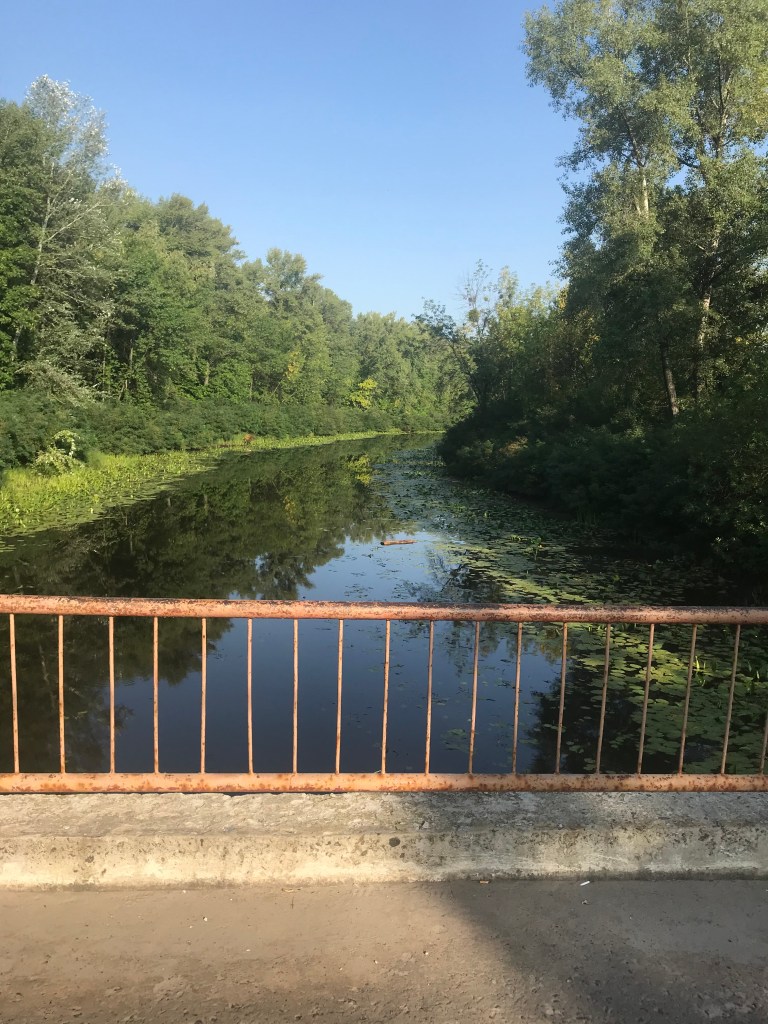
Semi-rural Trukhaniv Island 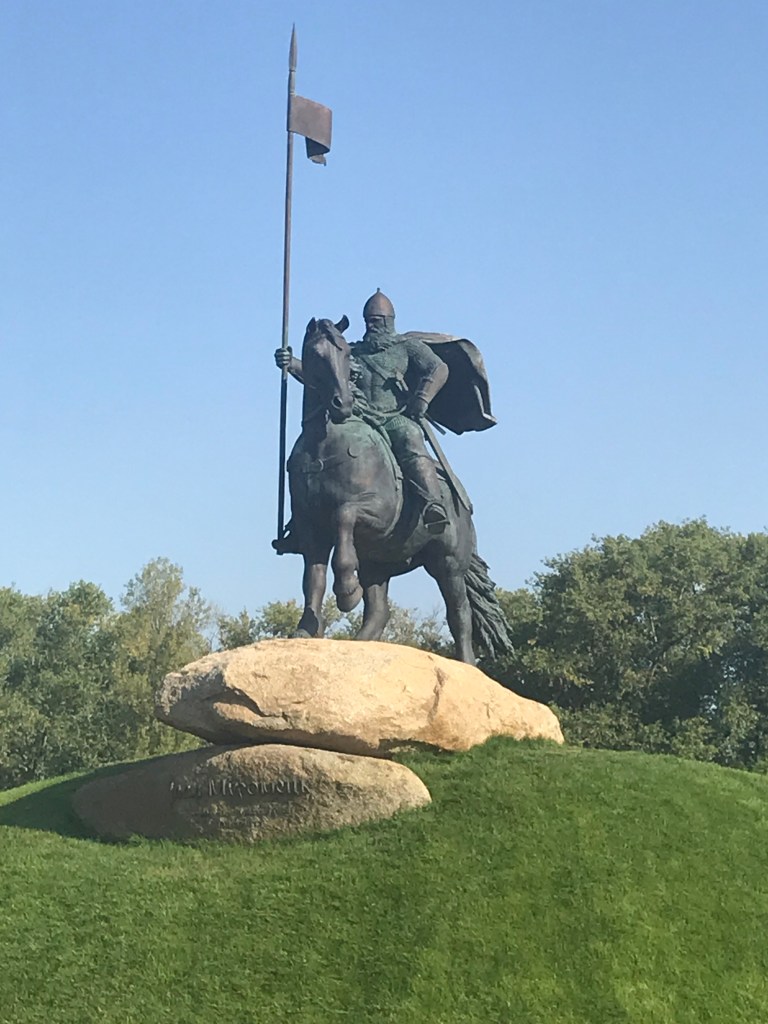
Ilya Muromets Memorial We stopped at the massive Ilya Muromets Memorial, which had just been dedicated three weeks earlier. He was a famous warrior of the Kyivan Rus’.
When I got back to the hotel I checked out and bade farewell to the lovely receptionist. She expressed her hope that someday soon Ukraine would be a prosperous democracy so that her children could thrive. I somehow elicit these hopeful comments while traveling. My sad-faced driver took me back to Boryspil Airport for the short flight to Lviv.
From Lviv Airport I grabbed an Uber to my exquisite Airbnb right on Svobody (Freedom) Avenue in the heart of Lviv. Before 1939, Lviv, then known as Lwow, was part of the Second Polish Republic. Stalin grabbed it after he and Hitler partitioned Poland in late 1939. People often forget that Hitler and Stalin were allies for almost two years before the German invasion of the USSR on June 22, 1941.
Before 1918 Lviv, also know as Lemberg, had been part of the Austrian Crown Lands, and the Austrian influence is widely visible in the architecture. My Airbnb was right across from the Lviv National Opera, a neo-Baroque theater built by the Austrians at the end of the 19th century.
Before the first partition of Poland, which was divided up by Catherine the Great of Russia, Frederick the Great of Prussia and the Austrian Hapsburg emperor, Lviv had long been part of the powerful Polish-Lithuanian Commonwealth, which ruled a vast area of Eastern Europe for centuries. It was so powerful that the then-Pope christened it The Bulwark of Christendom.
The Commonwealth long ruled what is known as Right Bank Ukraine, which is the area west of the Dnipro. The Ukrainians had a love/hate relationship with the Poles, and had several uprisings against them. One of the legacies from the Commonwealth era is the Uniate Church, which is unique in that is has an Orthodox liturgy and a married priesthood, but is under the authority of the Pope.
Under the more liberal Austrians, Lviv became a center of the Ukrainian revival and its language was restored. It became the thriving capital of Galicia, and its population was divided equally among Poles, Ukrainians and Jews, with a small Armenian community. Stalin sent thousands of Poles to Siberia or forced them back to Poland, while the Jews were largely sent to the Nazi concentration camps. Stalin wanted Lviv to be a Ukrainian city, and so it remains.
Lviv is perhaps the most nationalistic city in Ukraine and its inhabitants speak Ukrainian overwhelmingly. In the US, immigrants from Galicia were known as Ruthenians, and many settled in the Pennsylvania coal and steel regions. A significant number emigrated to the Canadian Prairie Provinces and established prosperous wheat farms.
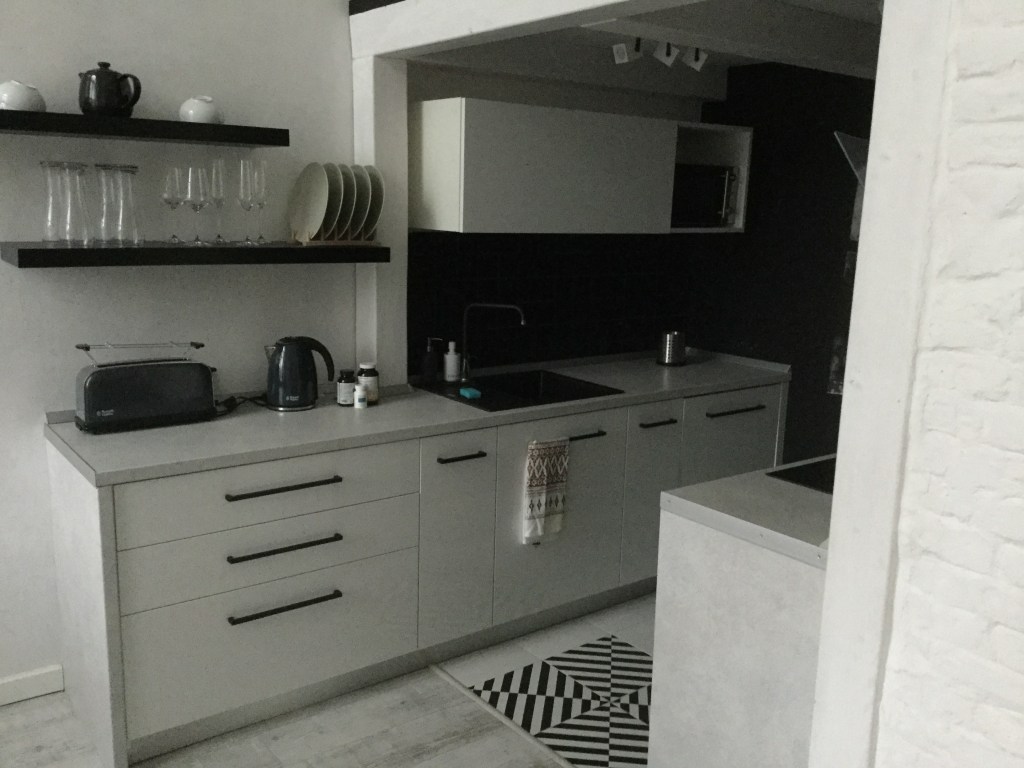
Stunning Airbnb 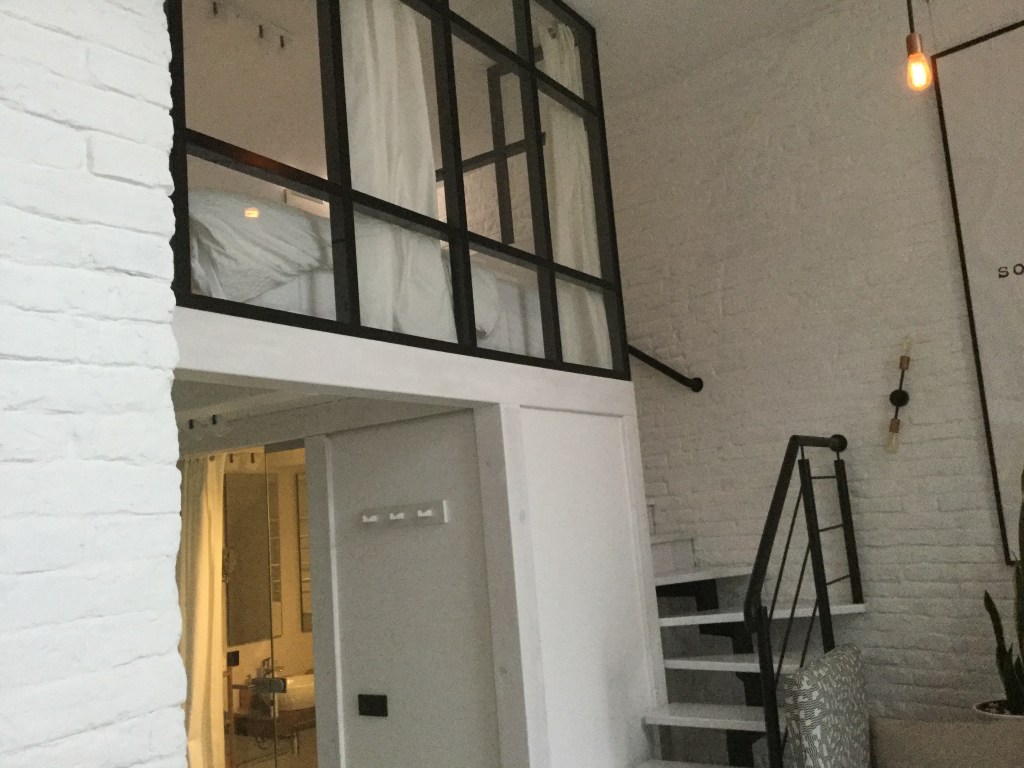
Steps to the sleeping area 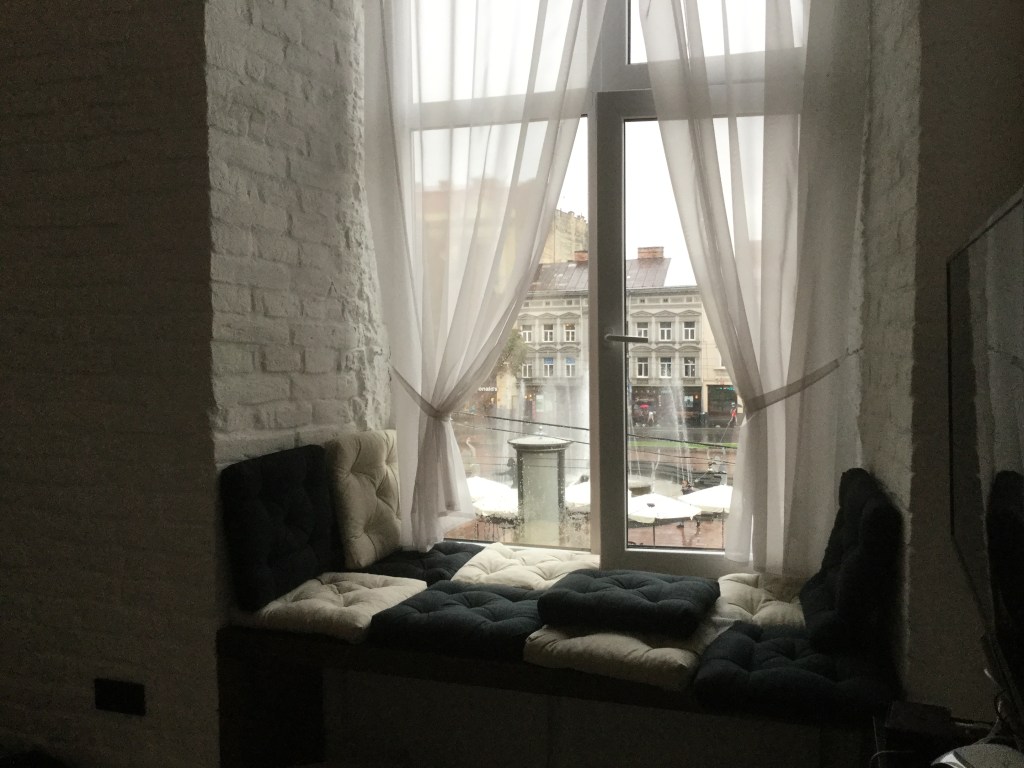
View from the living room 
Market Square from my Airbnb 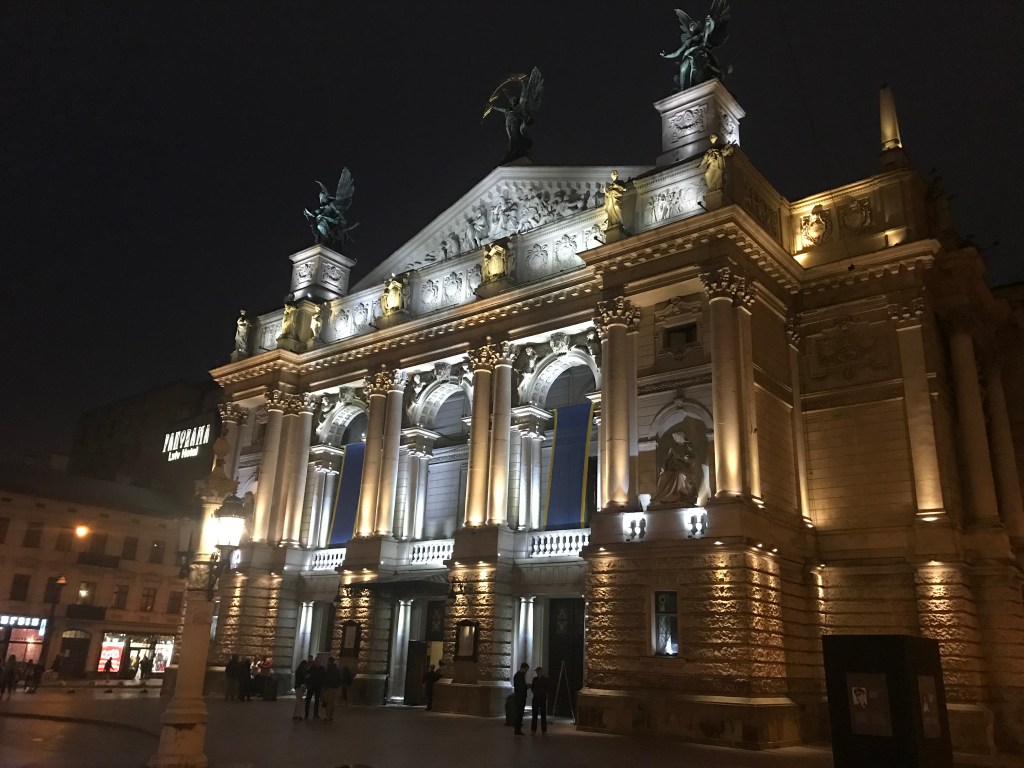
Lviv National Theater 
Typical old town street scene with classic tram The historic core is really atmospheric, like Prague. Wandering around the streets after a cooling rain generated an appetite, so I walked back to Market Square and had an excellent meal at Centaur, located inside a 16th century building. During the long trip through Eastern and Central Europe in 2018, I often consulted http://www.theculturetrip.com for restaurant suggestions. They’re usually spot on.
I had a drink at the bar next door and had a nice conversation with a Swedish couple before heading back to the apartment. I’d booked two walking tours for the next day and looked forward to a restful sleep.
-
Chornobyl
Dark Tourism has always fascinated me, and the prospect of visiting Chornobyl (Chornobyl is the Ukrainian word; Chernobyl is the Russian) was too enticing to pass up, so I signed up for a tour a month before. Most readers are familiar with this nuclear catastrophe from watching the acclaimed HBO series, which was based on the book Midnight in Chernobyl. When I told Ukrainians that I was taking the tour, they paled. Their memories of the disaster were such that it was the last place they’d want to visit.
The bus left from the main train station and I was one of the last to board. Finding the bus was a bit confusing. I sat next to a young German who worked for an NGO. His parents were seated in the seats across the aisle from us. The trip took about two hours on a two-lane highway and we passed through a few forest settlements on the way. I was struck by the ornate Orthodox churches looming above crude wooden houses.
We arrived at the military checkpoint at the Chornobyl Exclusion Zone, which was set up by the USSR in April 1986 and which encompasses a circular region of 30 km from the site of the Reactor 4 explosion. We were required to wear long pants and long shirts. Once we passed through the checkpoint, our first stop was at an uninhabited village about 20 km from the site. The majority of the visitors were Germans, and a couple of guys ventured a little beyond the approved path. Our guides were two Kyiv university students, Viktor and Olena. They issued FLIR radiation detectors which measured levels in millisieverts.
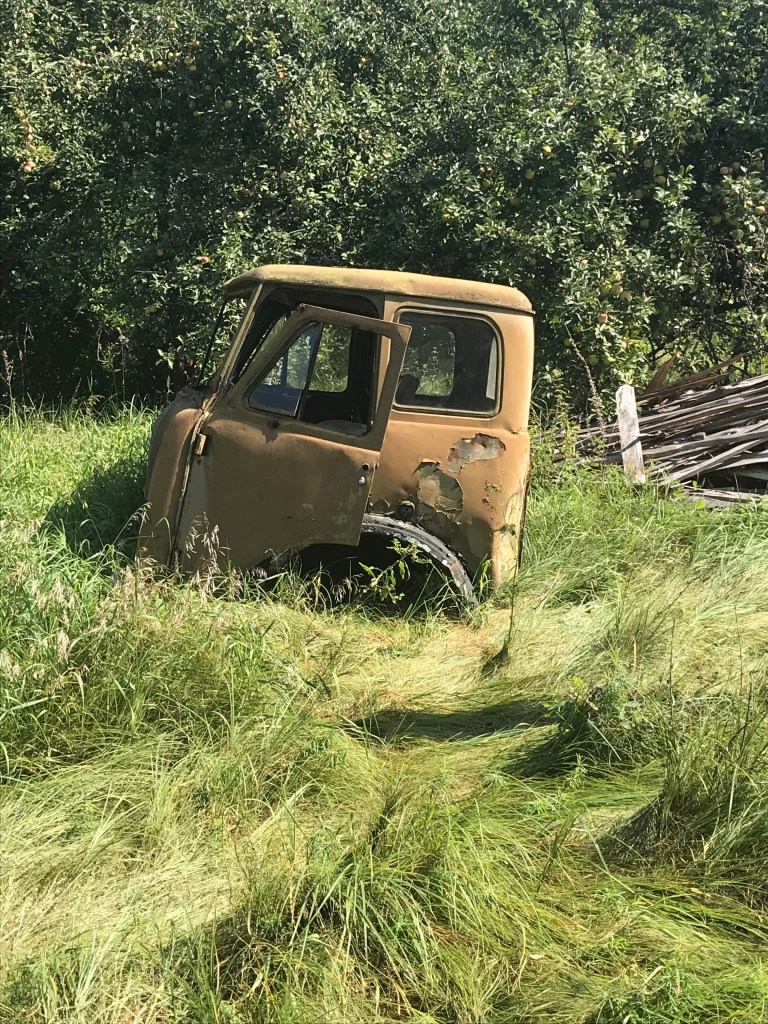
The photos below are from the first stop, the ghost town Kopachi.
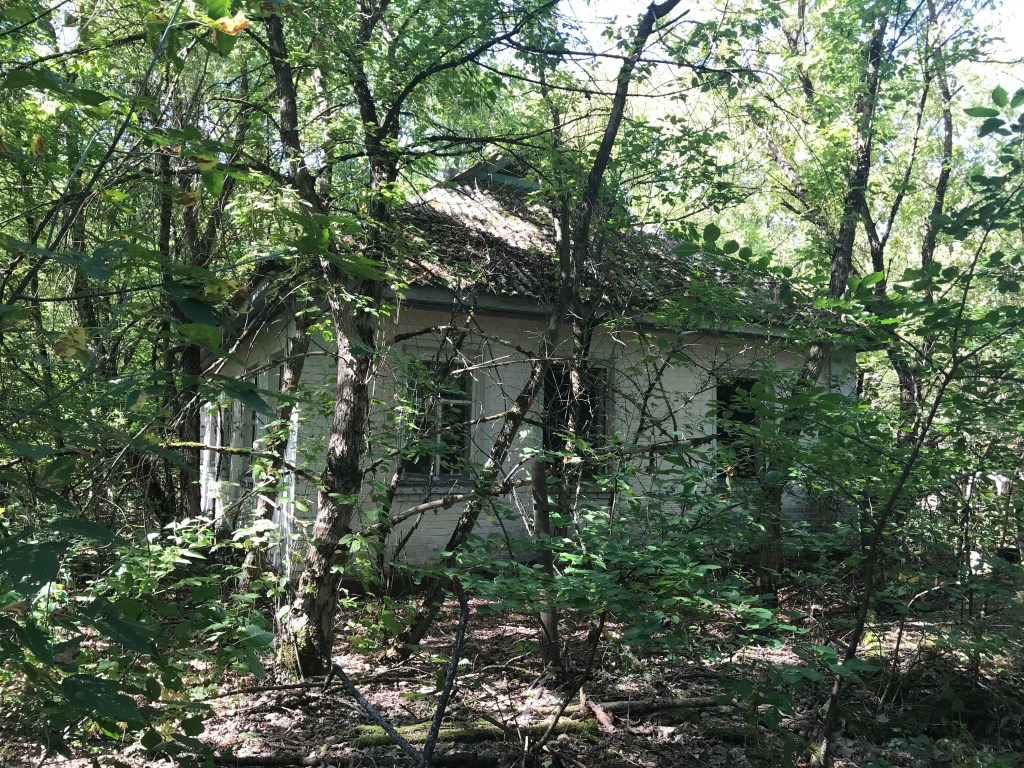
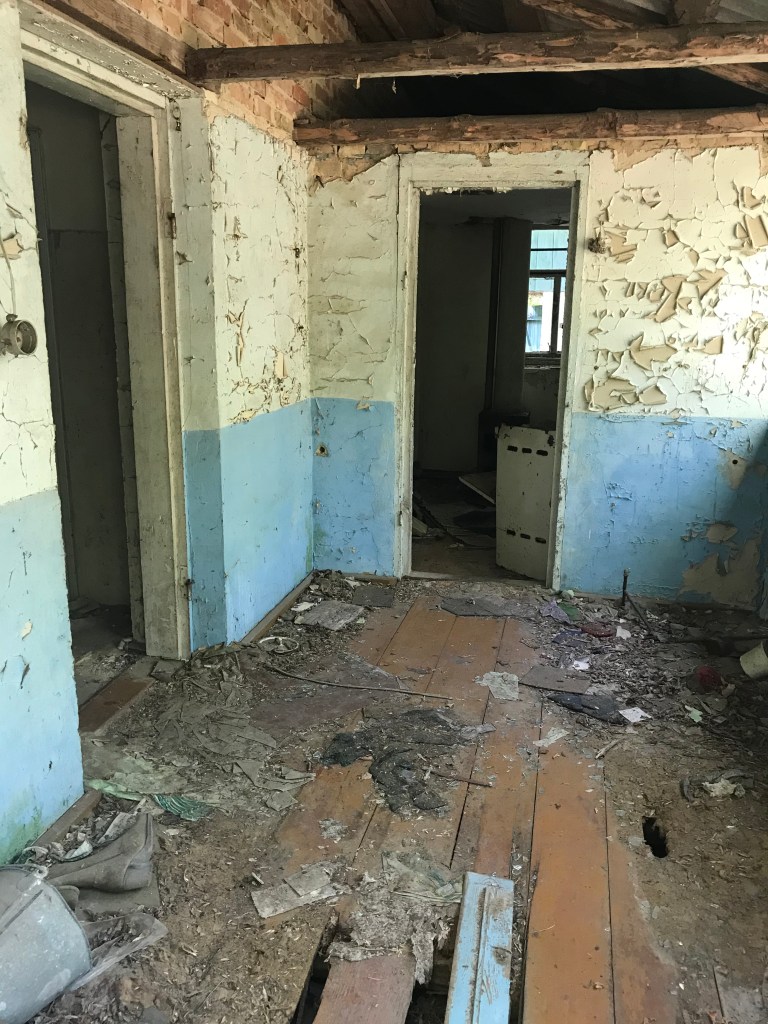

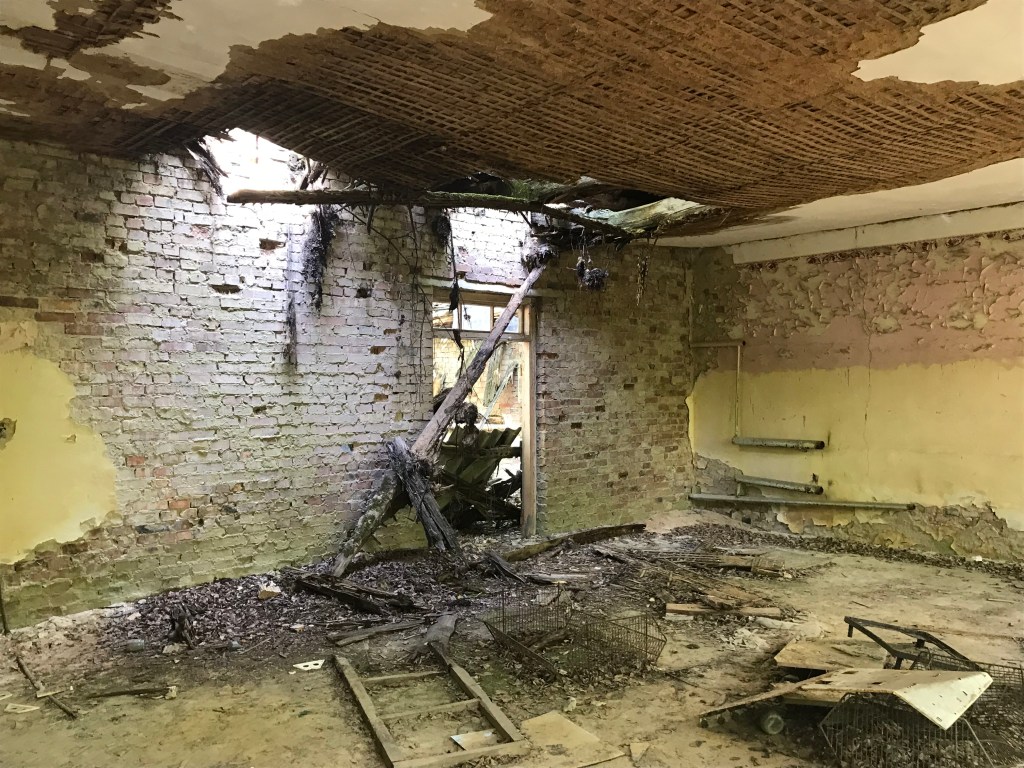
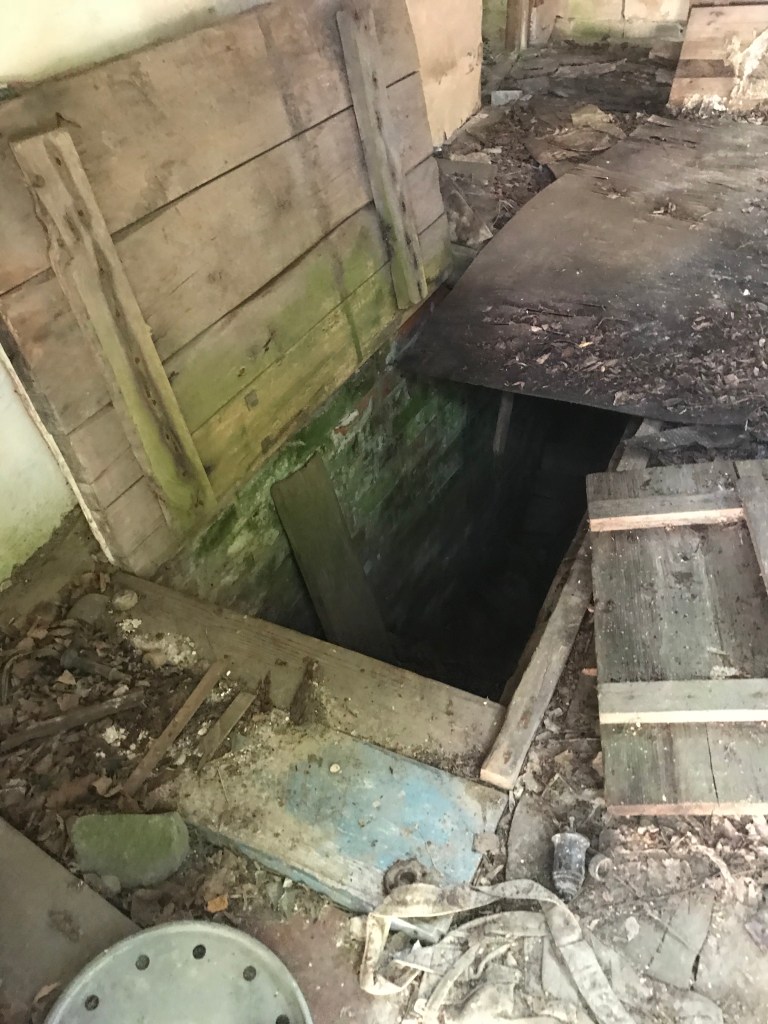
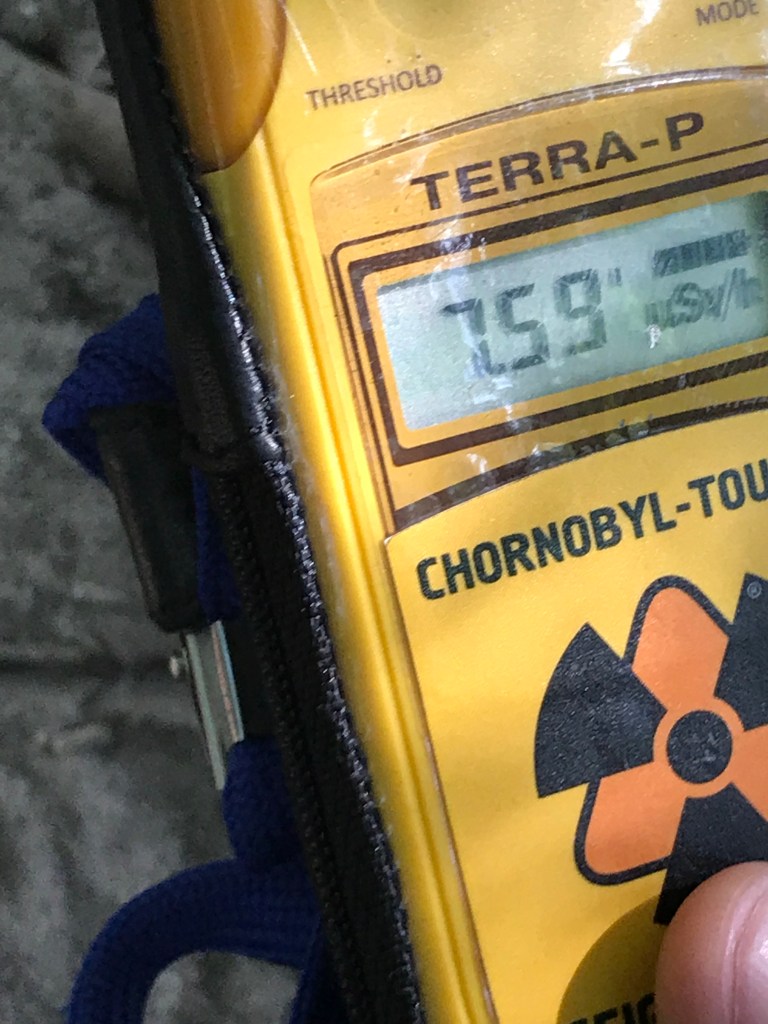
The next stop was the immense Soviet Duga ICBM detection radar facility, which is 150 meters high and over 700 meters in length.
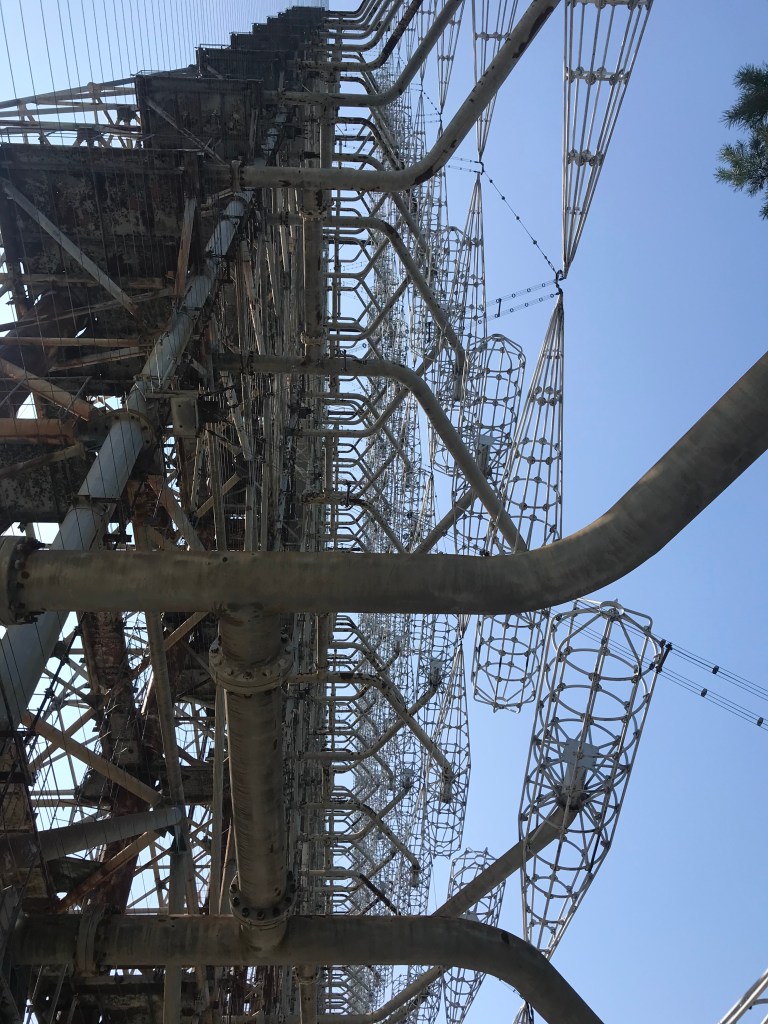
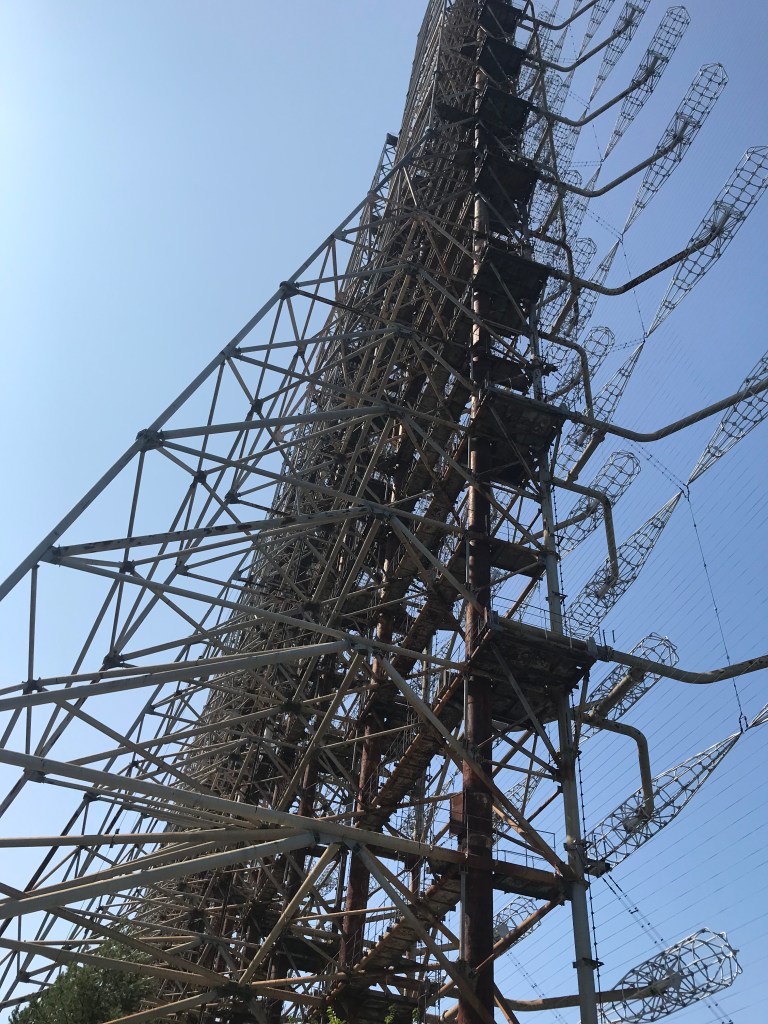
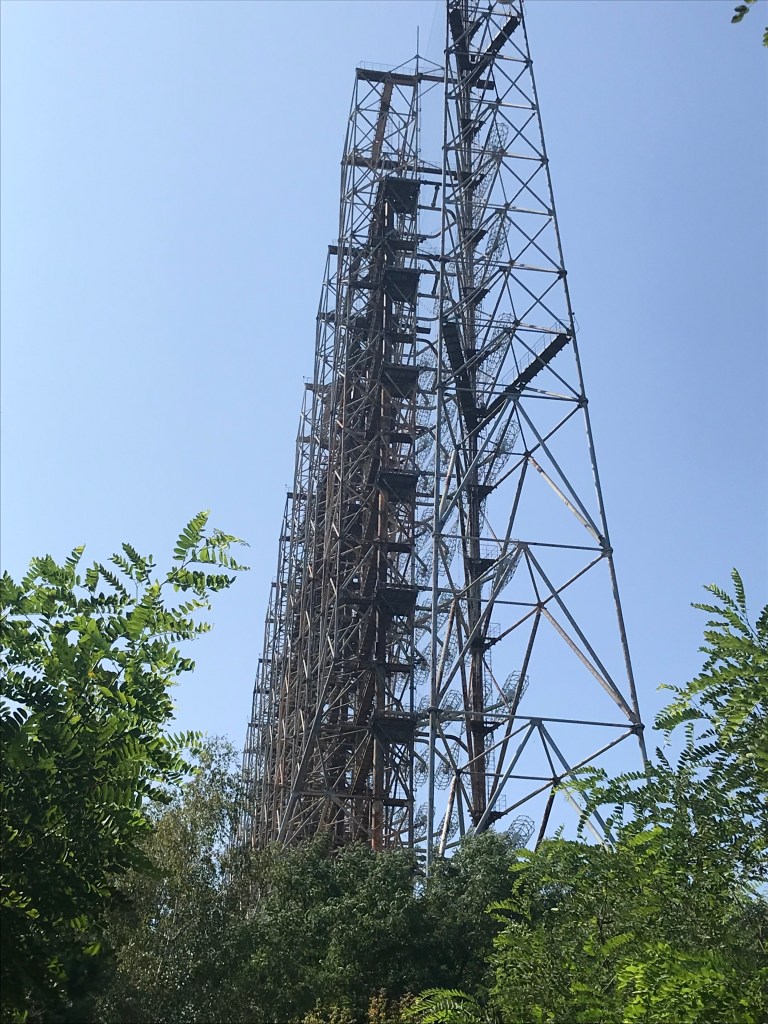
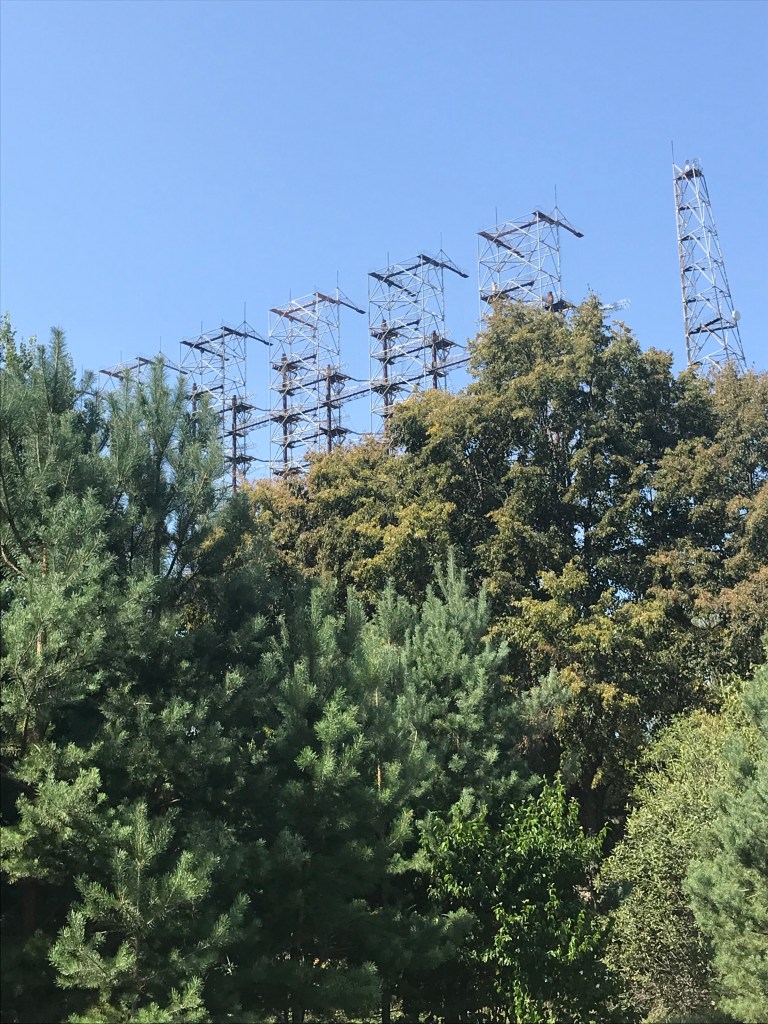
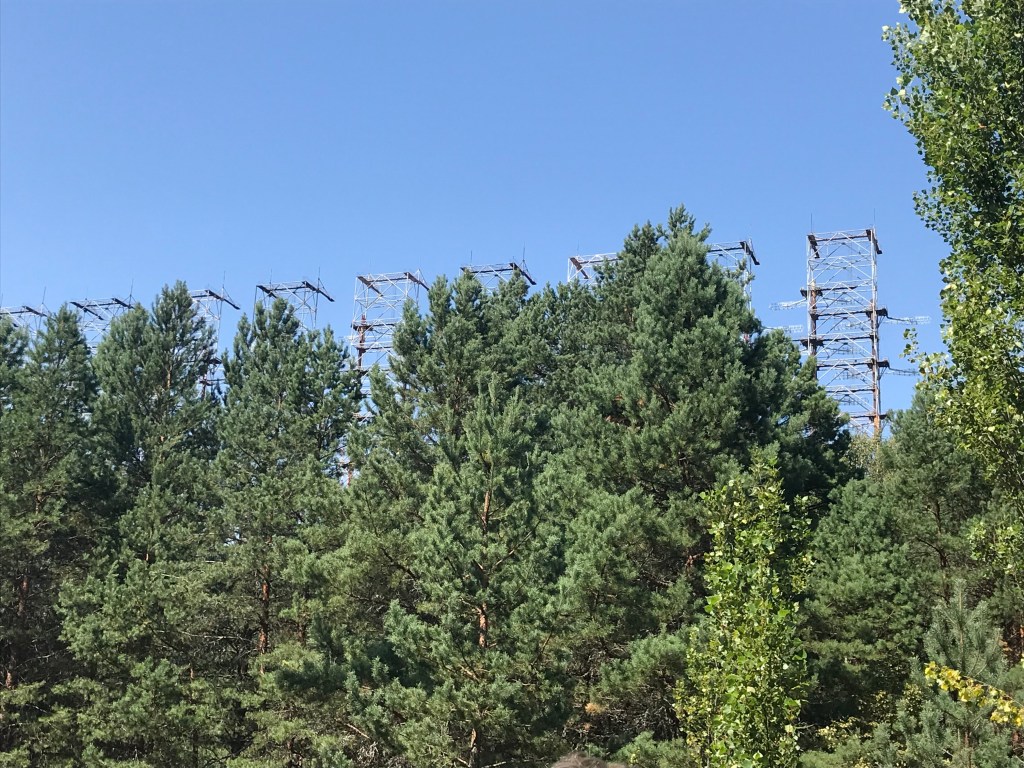
When we got to the main attraction, Viktor pointed out the enormous new steel dome funded by the EU and the USA to cover the Soviet-era concrete sarcophagus that had been formed by dropping immense amounts of concrete from Soviet military helicopters. Views of the new dome and the reactor, with the Soviet statue of Prometheus. The Soviets had a fascination with Greek mythology.

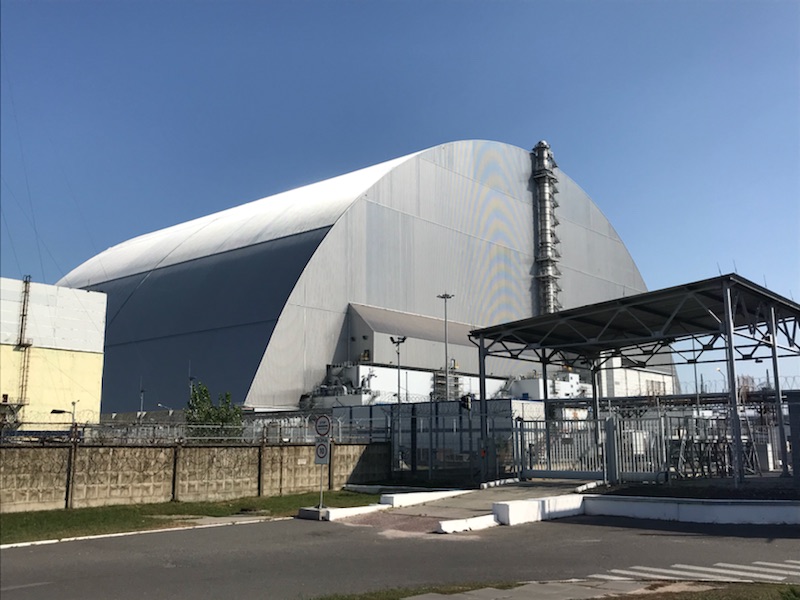
Close-up of the dome 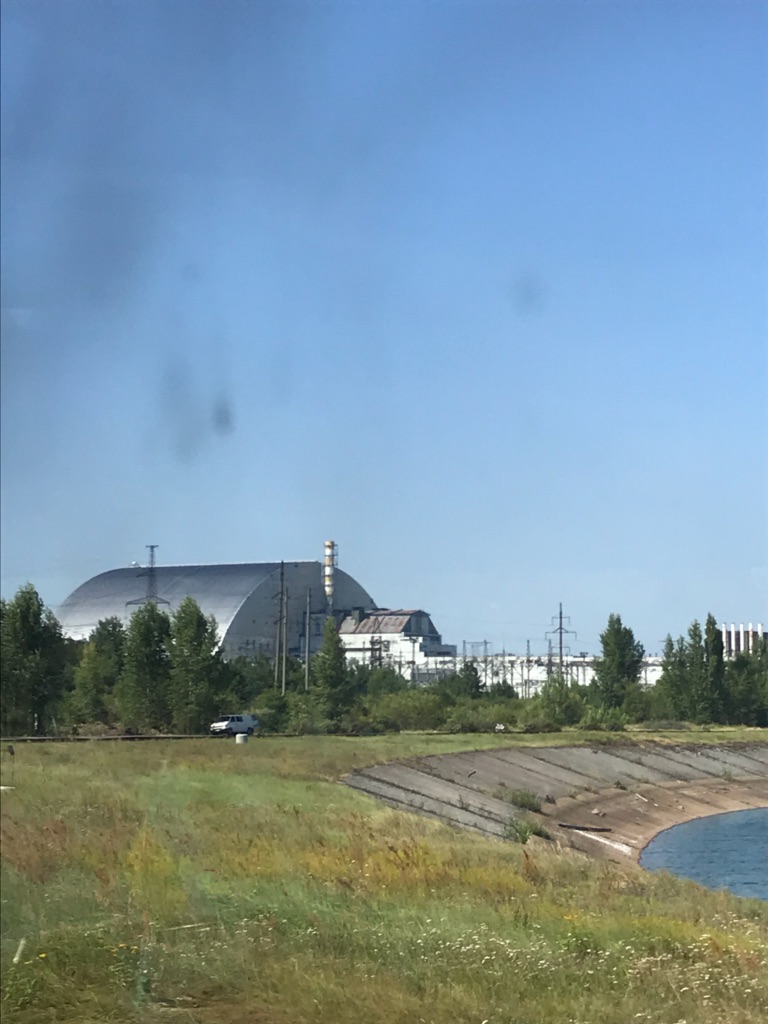
The new dome 
The cooling pond After passing the plant, we entered the abandoned city of Pripyat, which housed over 40,000 employees of the Chernobyl Atomic Power plant. By Soviet standards, this was a deluxe new city, with large flats, a well-stocked supermarket and theaters and parks. The famous amusement park and football field were scheduled to open on May Day 1986, a week after the disaster. It housed the Soviet elite-engineers, physicists and party luminaries. The forest has completely encroached on the city, and the football field is now a new growth forest. After Gorbachev declared the mandatory evacuation of Pripyat, 40,000 residents were commanded to pack for a weekend and boarded over 1,000 buses for Kyiv and Minsk. The evacuation was completed in under three hours.

Statue of Prometheus 
Monument to the Liquidators 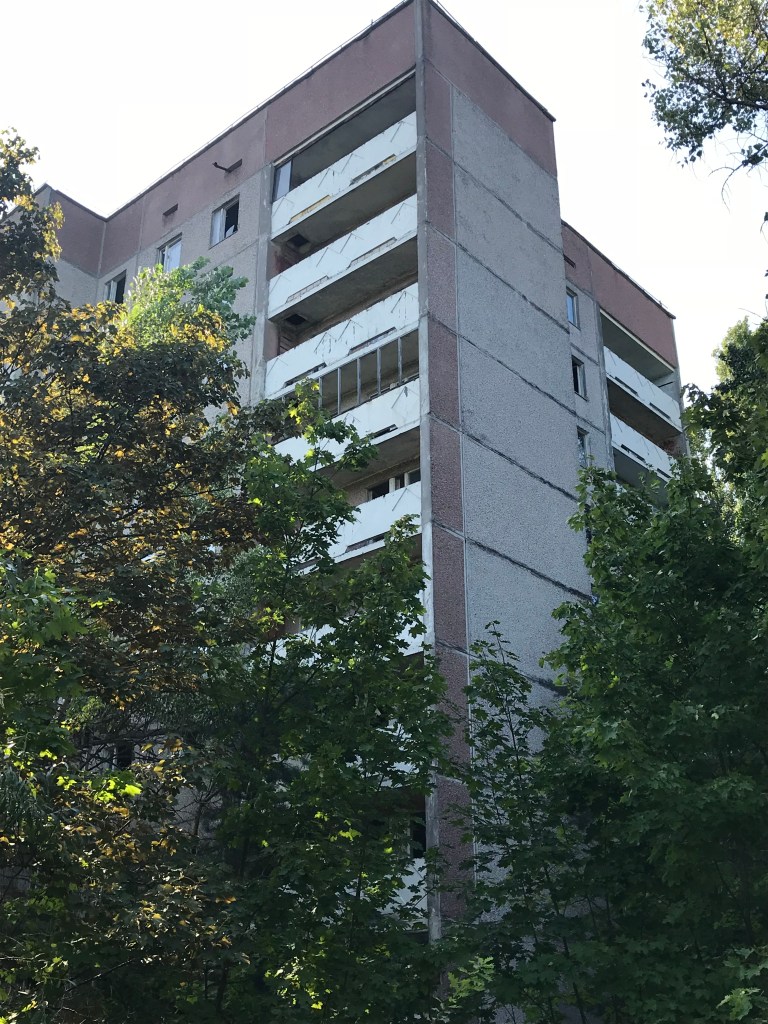
Apartment block 
Football field 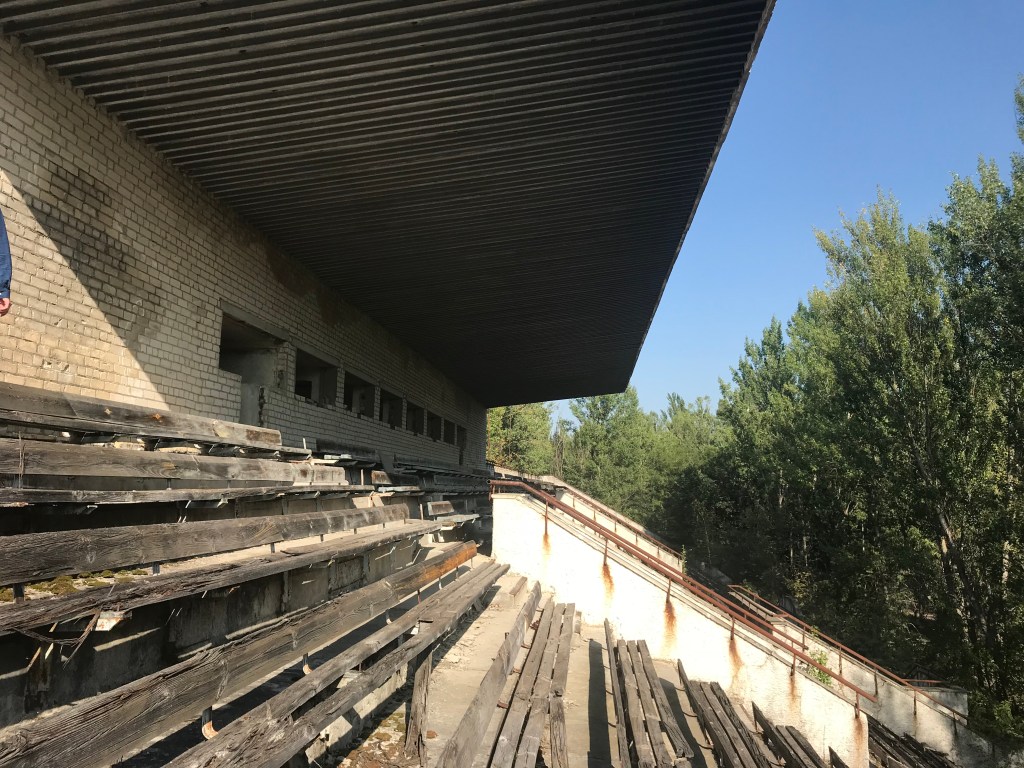
Close-up of stands 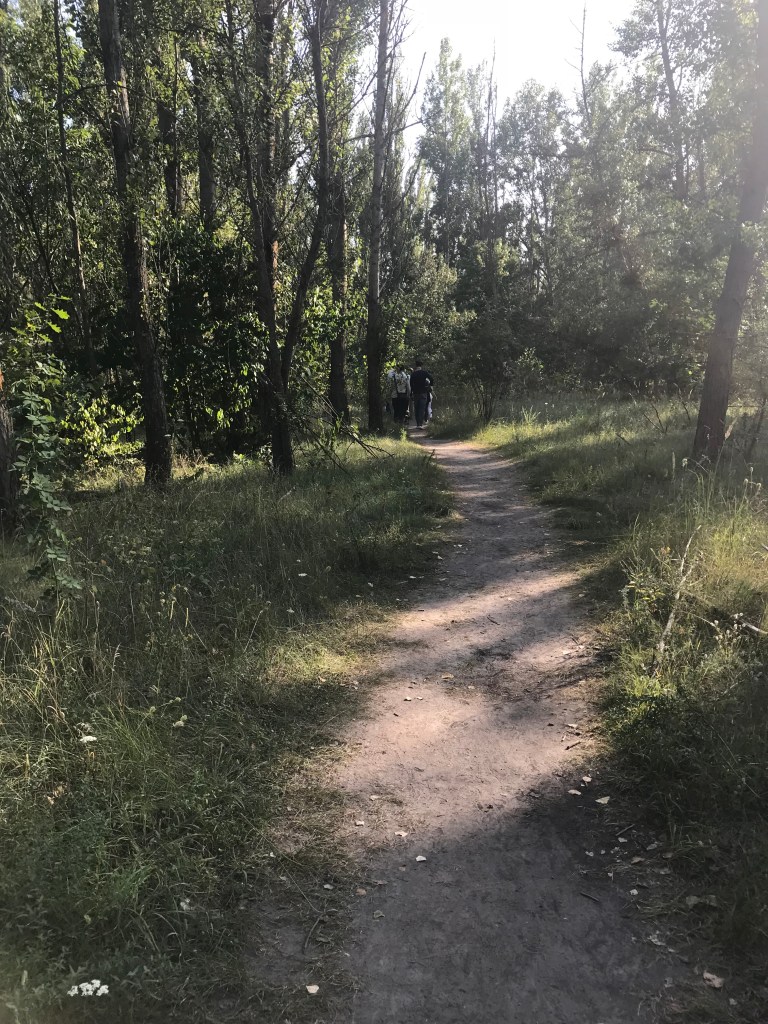
The football field 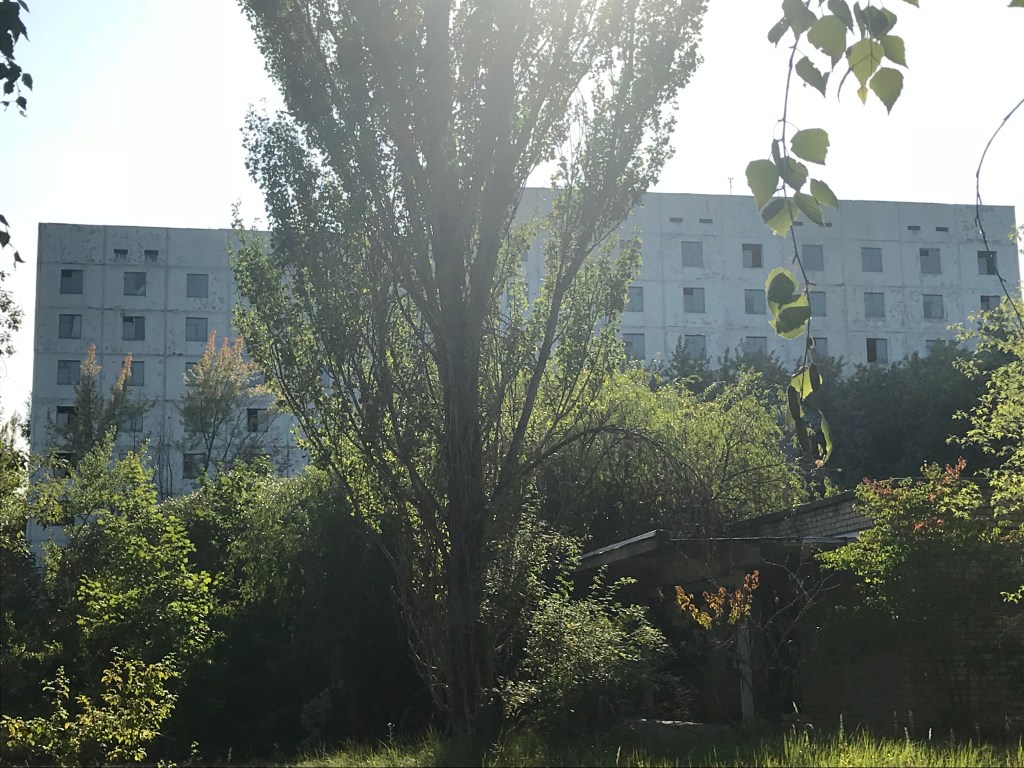

The iconic Ferris Wheel 
Bumper cars 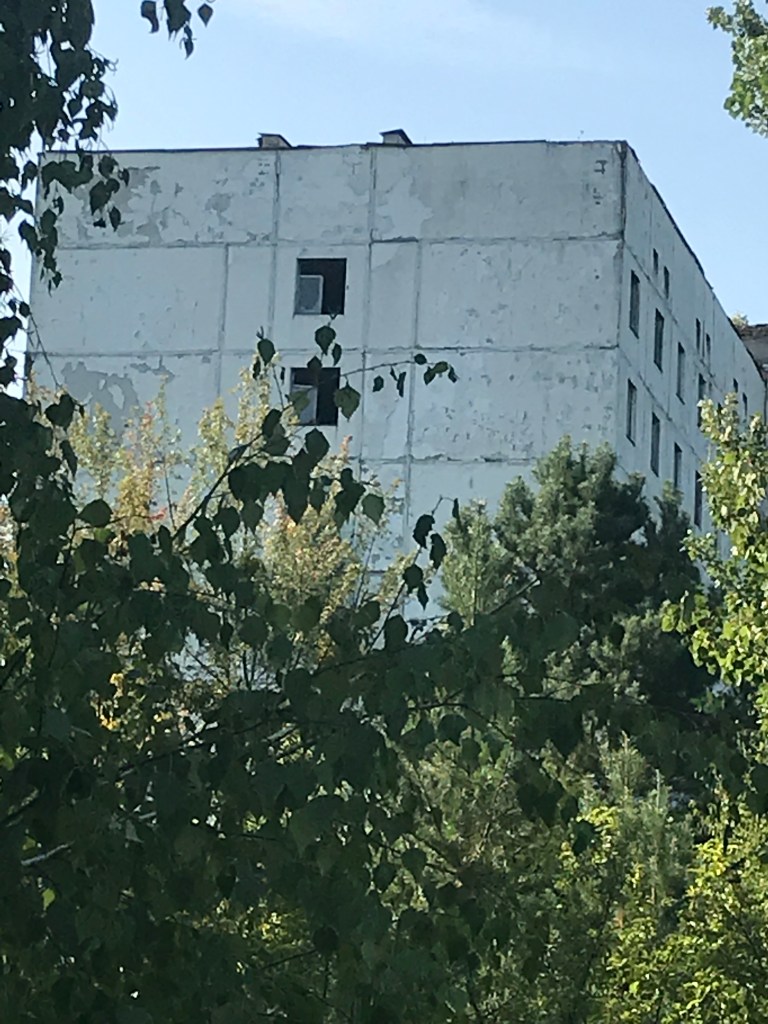
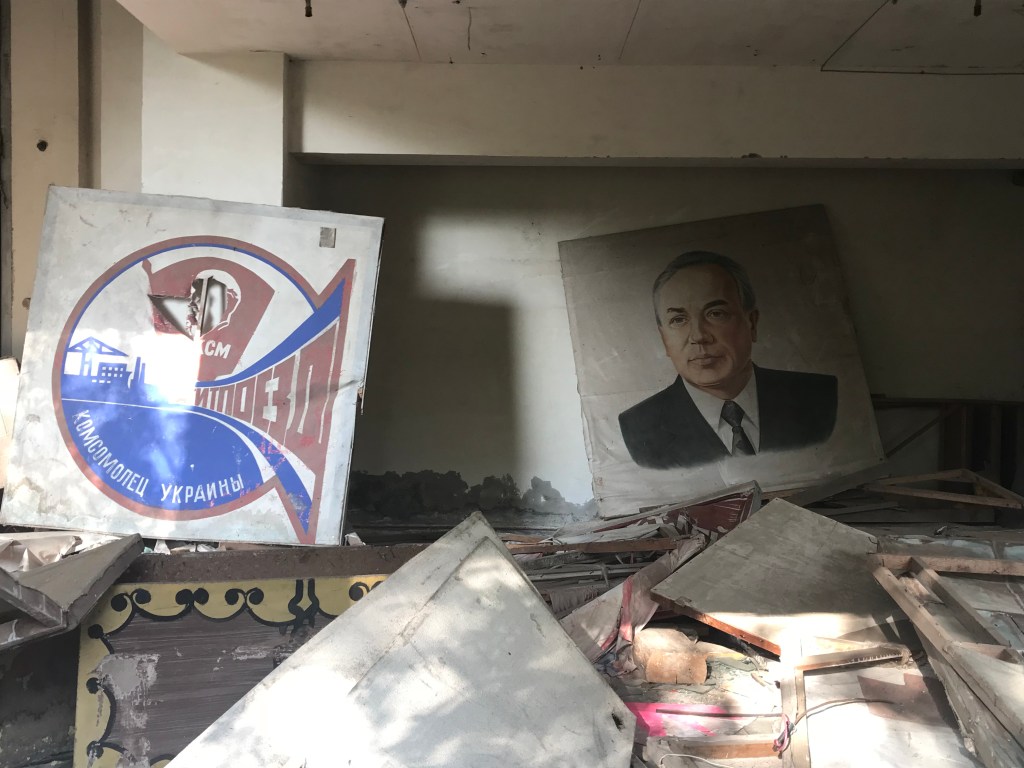

The shopping mall 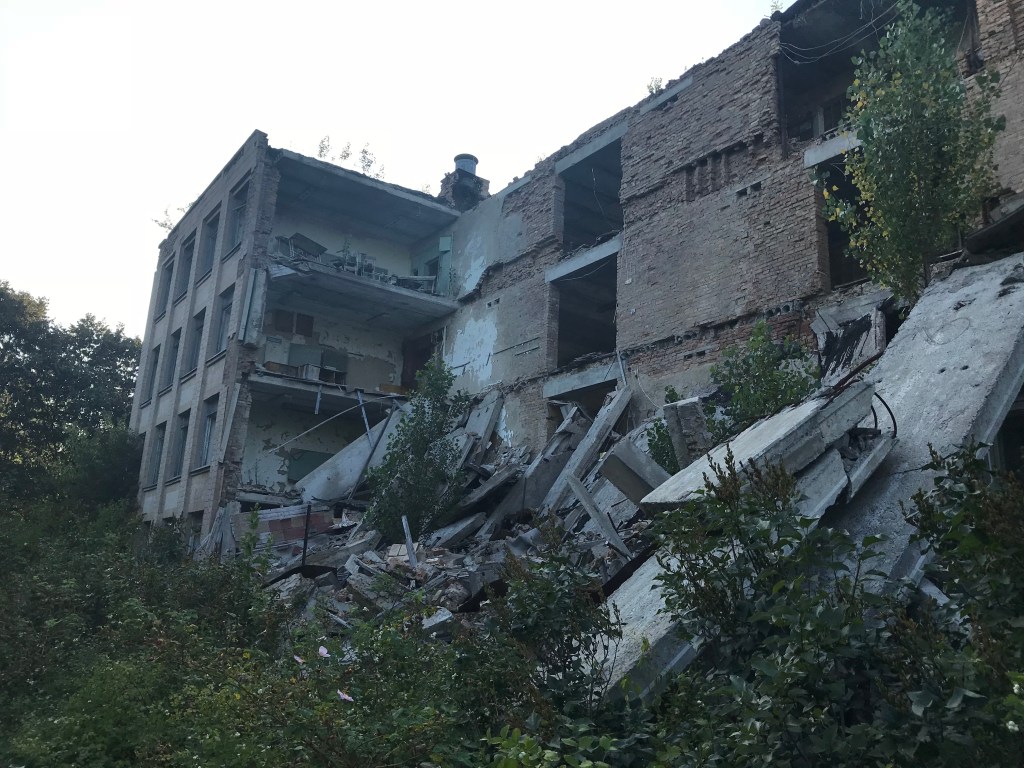
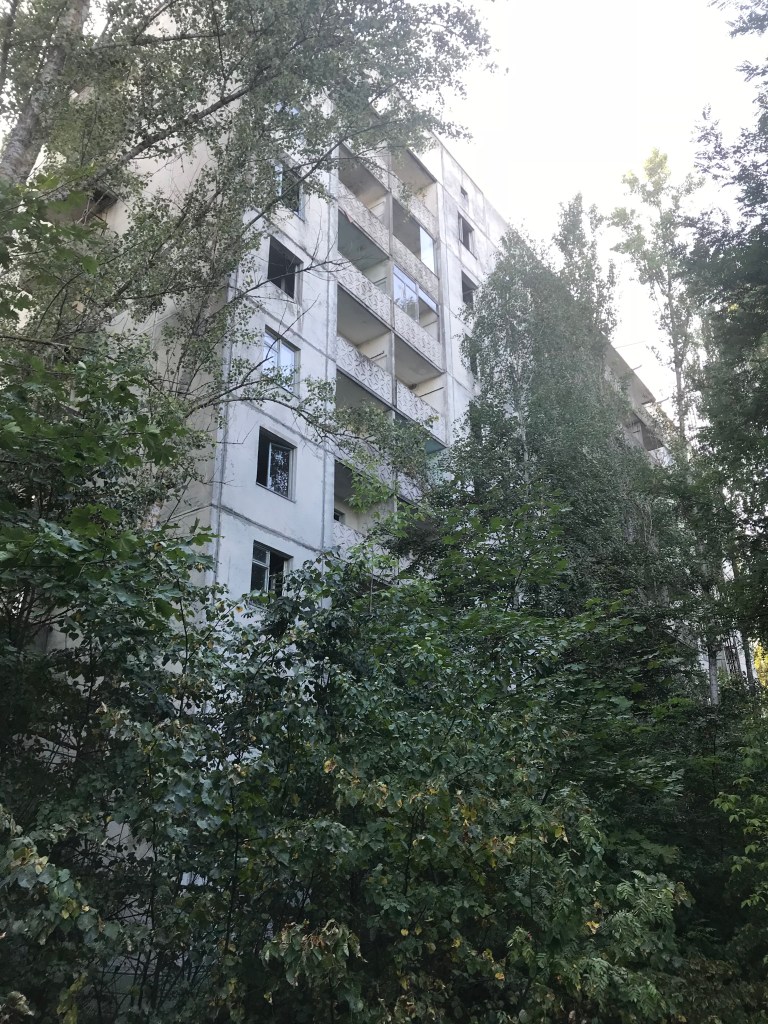
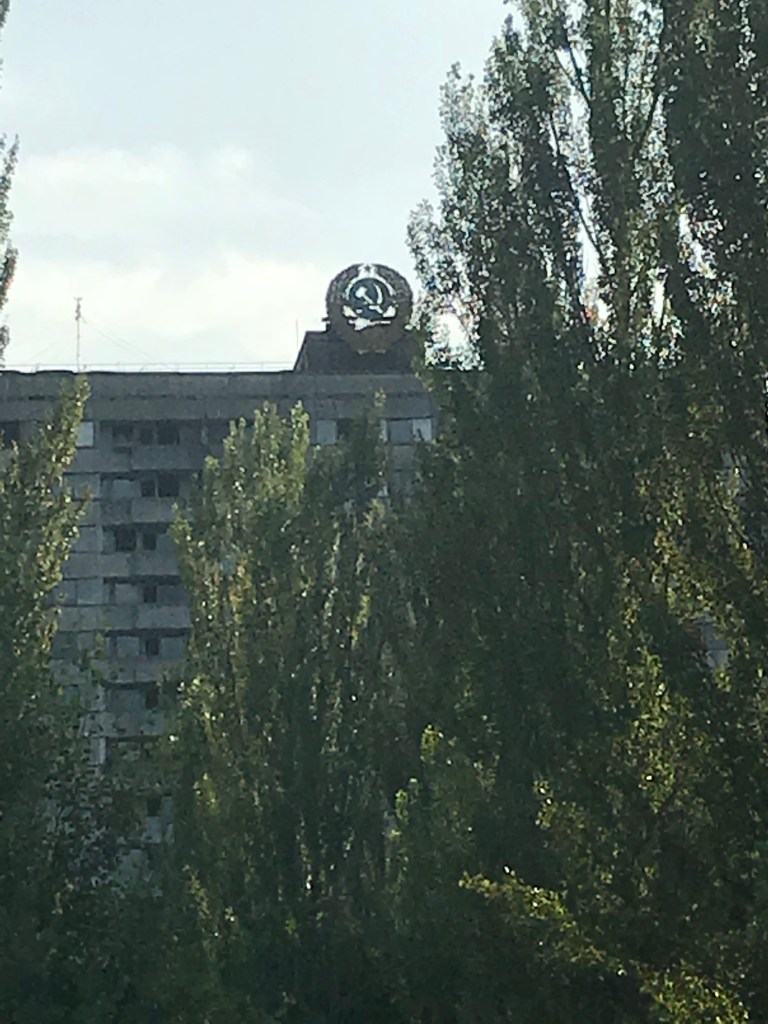

The Hotel Polissya where the post-disaster command post was set up We were warned to stay on the marked paths, since large areas of the city are still radioactive. The silence was eerie and everyone spoke in hushed tones.
Once the Soviet government acknowledged the scale of the disaster, they moved quickly to safeguard Ukraine and Belarus from the potential nightmare scenario, including the poisoning of the Dnipro, which provided water to millions of citizens. They mobilized 500,000 “liquidators”. The paths we traveled on were the result of the excavation of 3 meters of roadbed and its replacement with new soil and asphalt. The excavated dirt and all other contaminated items, including vehicles and all household furnishings and food, were buried in other areas of the exclusion zone. Red Army marksmen were assigned to exterminate all escaped pets and other wildlife. Ironically, during the initial failed offensive to take Kyiv in the opening weeks of the 2022 Russo-Ukrainian War, the Russian army sent armored units into the most highly contaminated sectors of the zone, including the notorious Red Forest, which led to the evacuation of hundreds of soldiers with radiation sickness. Russian denialism at its best.
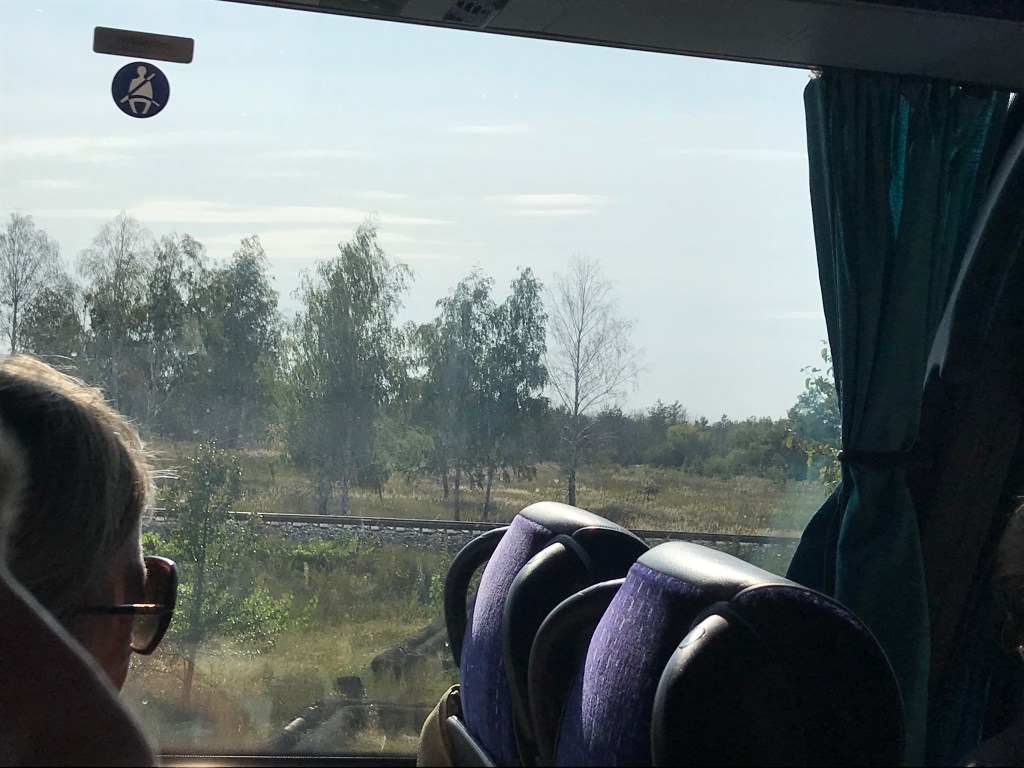
The Red Forest from the bus 
Radiation warning signs near the Red Forest As we left the city, we passed by the actual village of Chornobyl, which houses the employees involved in the decommissioning of the atomic power plant. We had to pass through a radiation detection device before boarding the bus for the journey home. I registered 3 millisieverts, about the radiation level incurred during a one-hour airplane trip.
We arrived at the Kyiv train station after a two-hour ride and I was able to hail a cab back to my hotel immediately. I ate dinner at a good Georgian restaurant around the corner from the hotel and was eager to sleep after such a sobering day.
-
Kyiv: August 23 to 26
I boarded my flight to Kyiv on Ukraine International Airlines and was seated next to a younger Israeli woman who was headed to Kyiv for a business assignment. Like me, she was on her visit to Ukraine, and we commented approvingly on the efficiency of the passport control process at Boryspil Airport. My hotel sent a driver to pick me up for the drive into the heart of Kyiv. He was a sad fellow, who related that he’d come to Kyiv from the Donbas to flee the Russians.
The drive west from the main airport was on an eight-lane freeway that passed some large residential towers under construction and then crossed the wide Dnipro River into the city center. The hotel was tucked into a small alley behind the main boulevard, Khreshchatyk Street, and just a short stroll from the famous Maidan Nezalezhnosti (Freedom Square), the site of the bloody 2004 and 2014 color revolutions. The reception folks at the Crystal Hotel were lovely and my room was well-appointed and very quiet.
Right around the corner were some attractive restaurants, so I grabbed an outside table and ordered a big salad and a glass of Georgian red. A couple sat next to me who turned out to be a Canadian Embassy staffer and his lovely Ukrainian wife. I spilled a little wine on my jeans and asked the server to bring some soda water, but the Ukrainian woman poured a little salt on the stain, which happened to be on my right quad, and dabbed at it. The salt worked; however, I was surprised by the intimate gesture. She told me that if I met a Ukrainian or Russian woman, I’d stay in Kyiv. Her Canadian husband agreed, and told me that he far preferred Kyiv to Canada for a number of reasons and suggested that his comments would cause him trouble if known to his employer.
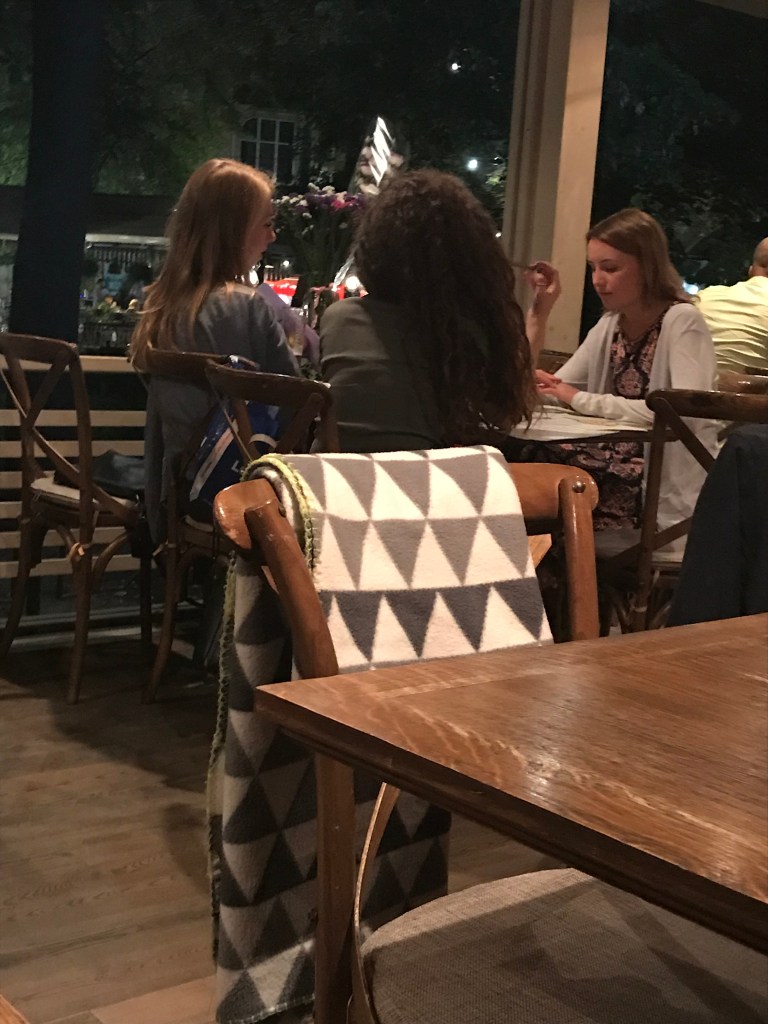
View from my dinner table 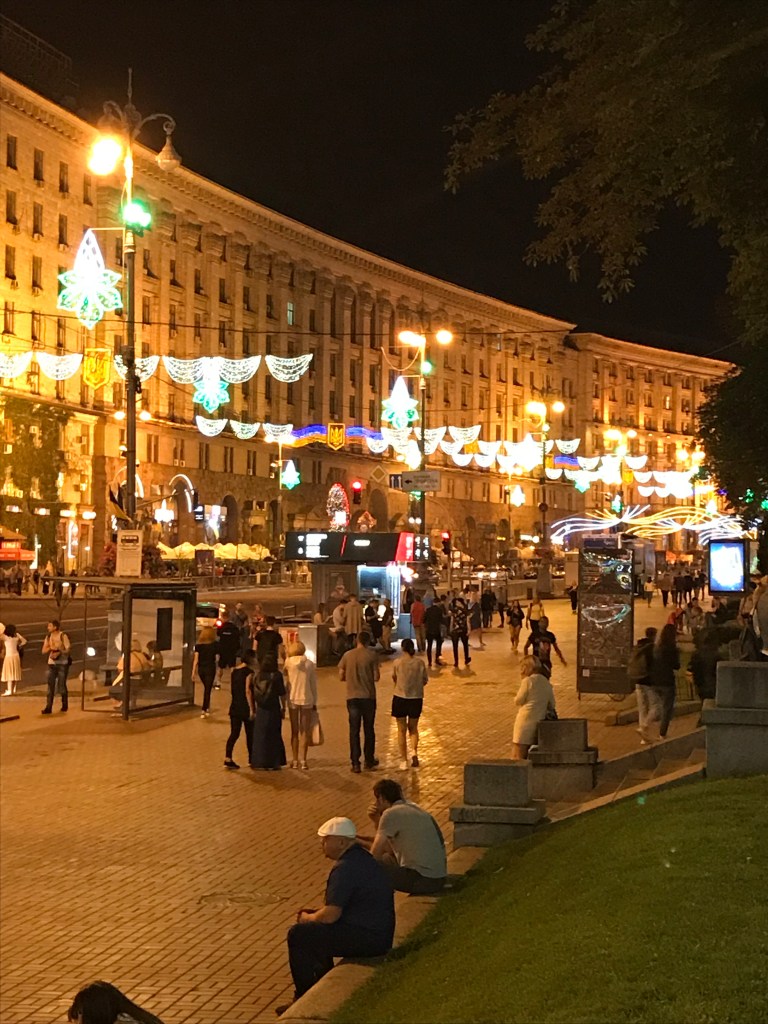
Preparations for Independence Day 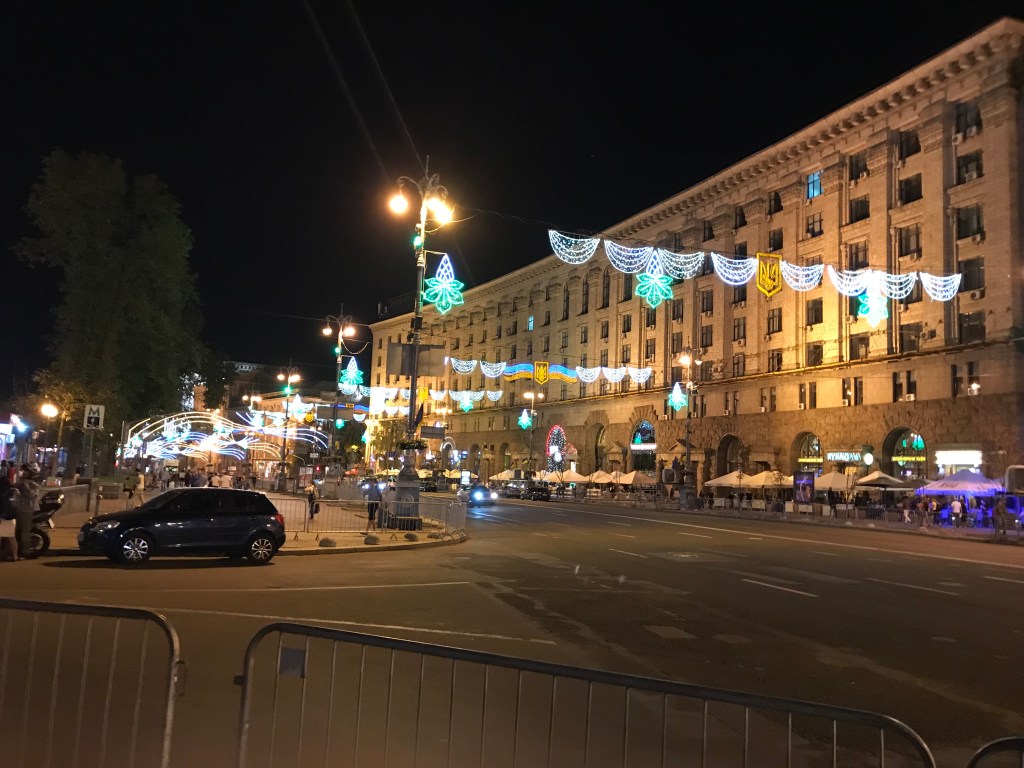
Khreshchatyk Street The hotel receptionist told me that she had a special pass for me so that I could grab a good spot to watch the next day’s big military parade. After a good night’s sleep and a coffee, I wandered around the corner and passed through security and presented my passport and found a great place to stand just a hundred meters from the tribunal on the Maidan. I chatted with some young Ukrainians who had pictures of the berets denoting the regiments that would be marching by. Many of the units were fighting on the eastern Donbas front. In 2022, many Westerners forget that Ukraine and Russia have been at war since 2014.
Finally, the moving national anthem was played. Then the current president, Petro Poroshenko, gave a speech and then presented decorations to soldiers serving in the Donbas. I noticed the band played the old German hymn Ich Hatt’ Einen Kameraden during the presentation ceremony.
The other notable sight was the presence of Ukrainian Orthodox priests blessing the formations. The whole parade structure was similar to Russian and Soviet military parades, which makes sense given Ukraine’s long history as part of both.
Independence Day Parade Infantry Battalion National Guard in blue Armored units SU-35 flyover It was quite an experience watching such a massive military parade, the first I’d seen since the Bastille Day parade in Paris in 1997. There were units from Poland, Romania, Georgia, Lithuania, the UK, Canada and the US. I learned that Polish President Andrejz Duda and US Defense Secretary Mattis were also present.
After the parade, I was to meet a woman who was a friend of my Croatian acquaintance. I asked her to meet me in the lobby of the hotel and we then went to lunch. She was a political activist and had participated in the 2014 Maidan revolt, the Revolution of Dignity. Her assessment of the political situation in Ukraine was enlightening. After lunch, she asked if I’d like to meet a volunteer soldier for a coffee and we headed across the Maidan to a cafe. Her friend was a Polish volunteer and had just returned from the Donbas, where he was serving with a volunteer regiment that would become legendary in the 2022 Russo-Ukrainian war. He said the combat was sporadic but intense and that regular Russian Army troops were active participants. After parting, I walked around the Maidan and looked at the various posters celebrating the lives of Ukrainian patriots including Bogdan Khmelnystky, Symon Petliura, the leader of the Ukrainian People’s Republic after 1917, and the controversial Stepan Bandera, who fought against the Soviets during WW2 but who is accused of being a Fascist, especially by the Russians who condemn virtually all Ukrainians that way.
I had booked a bike tour of Kyiv that afternoon, but the guide had to postpone it until Sunday because of the security cordon around part of our proposed route. I walked a few miles around the surprisingly green city before grabbing a light dinner. I had booked a day trip to Chornobyl the following day, so I wanted to get a good night’s sleep.
-
Subscribe
Subscribed
Have a WordPress.com account? Log in now.

