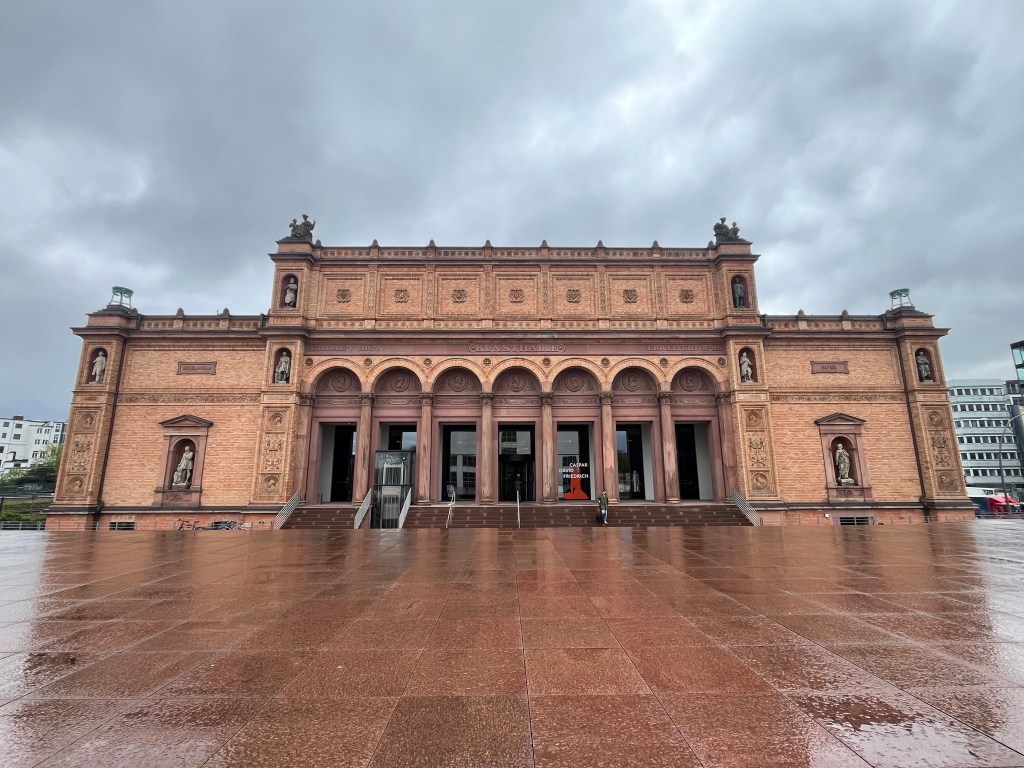
I slept over nine hours and awoke around 8:30 to a grey and rainy day. After coffee and some yogurt, I decided to take the S-Bahn into town to visit the highly regarded art museum built at the end of the 19th century—Hamburger Kunsthalle.
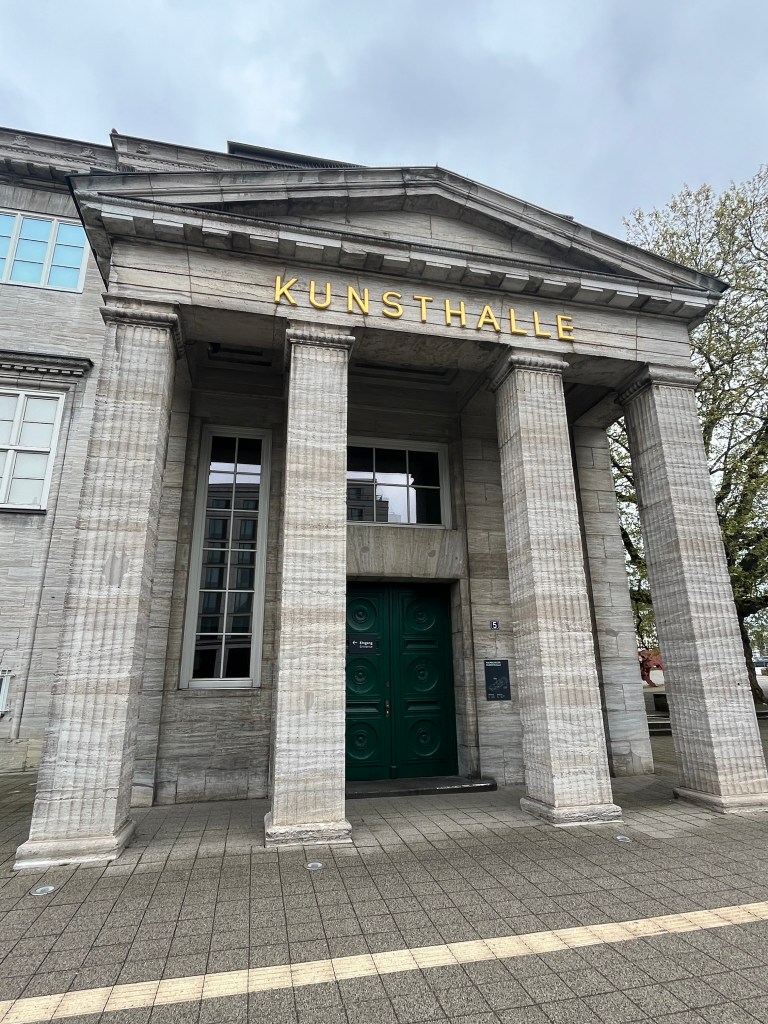
Kunsthalle front viewSide viewRear viewGrand entrance Side view with Central Station tower
The museum is easy to navigate and has an impressive collection of European art from the medieval period through the early 21st century. There’s a large array of French and German Impressionists including the famous Caspar David Friedrich work “Wanderer Above the Fog” c. 1817.
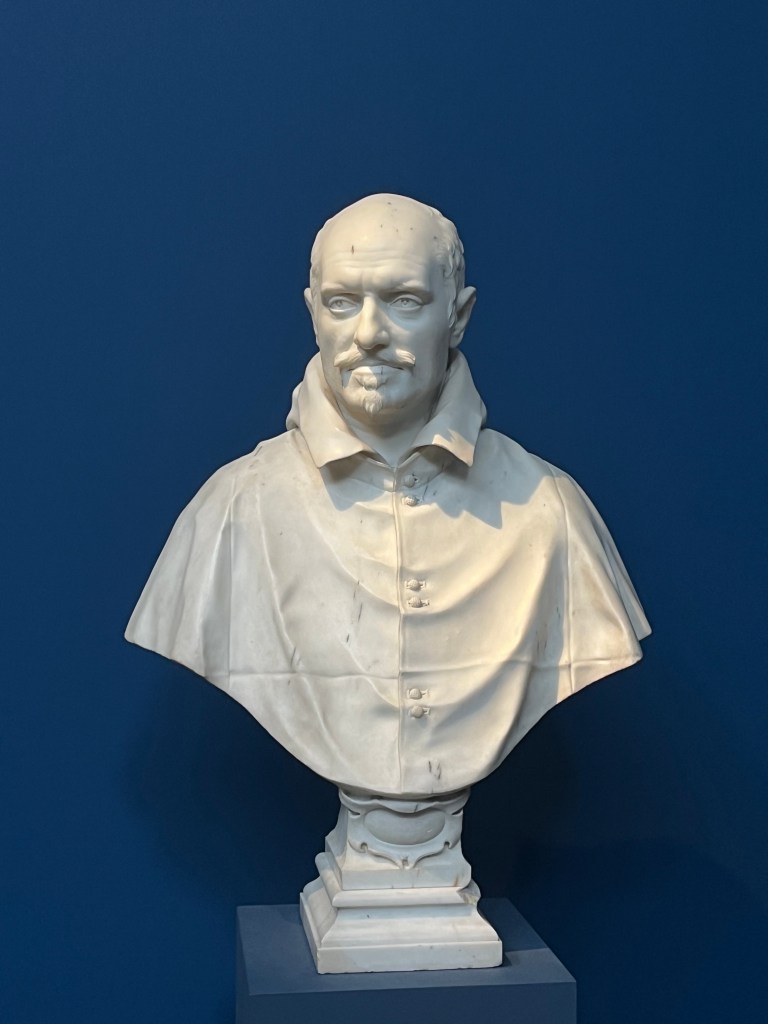
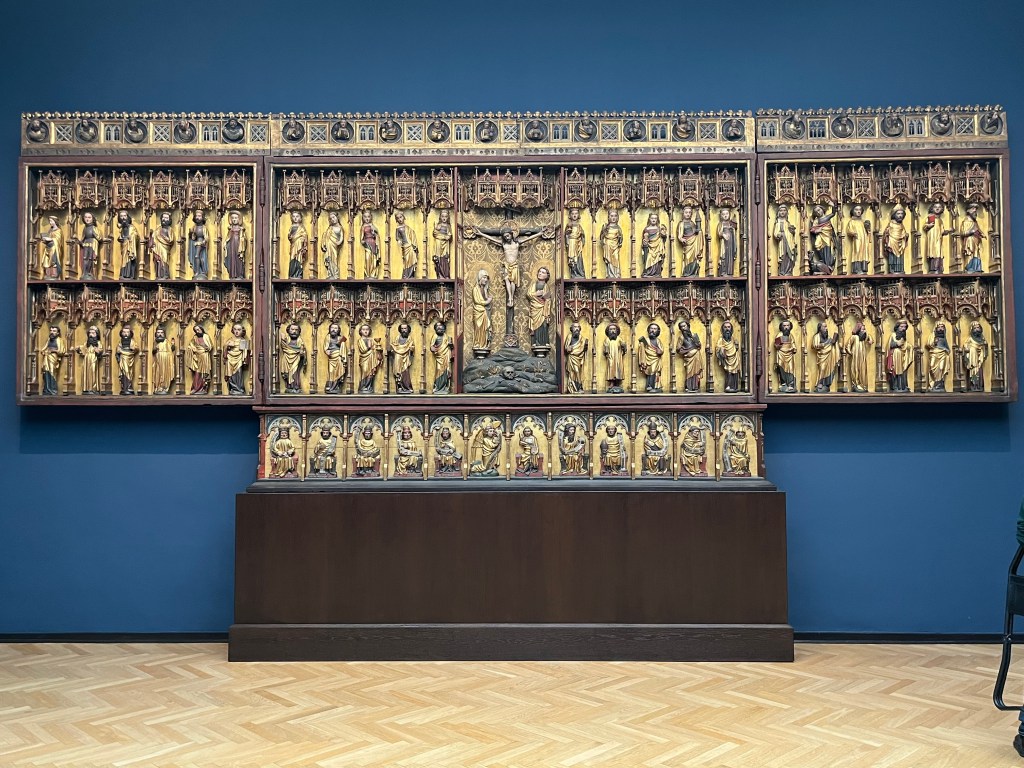
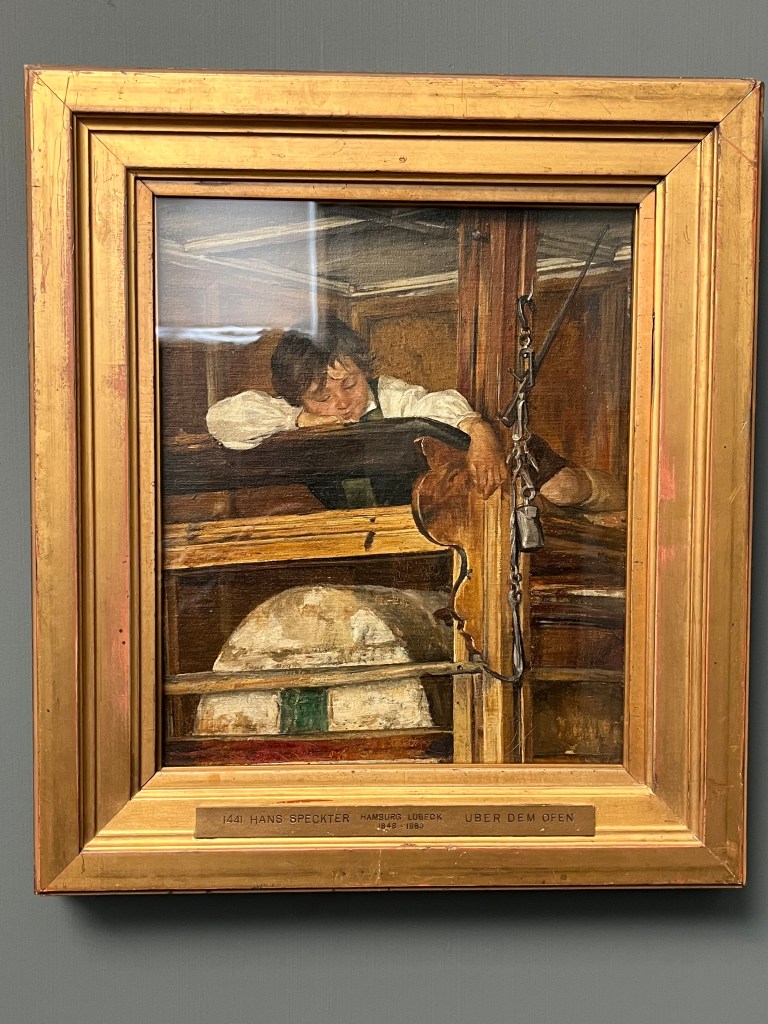
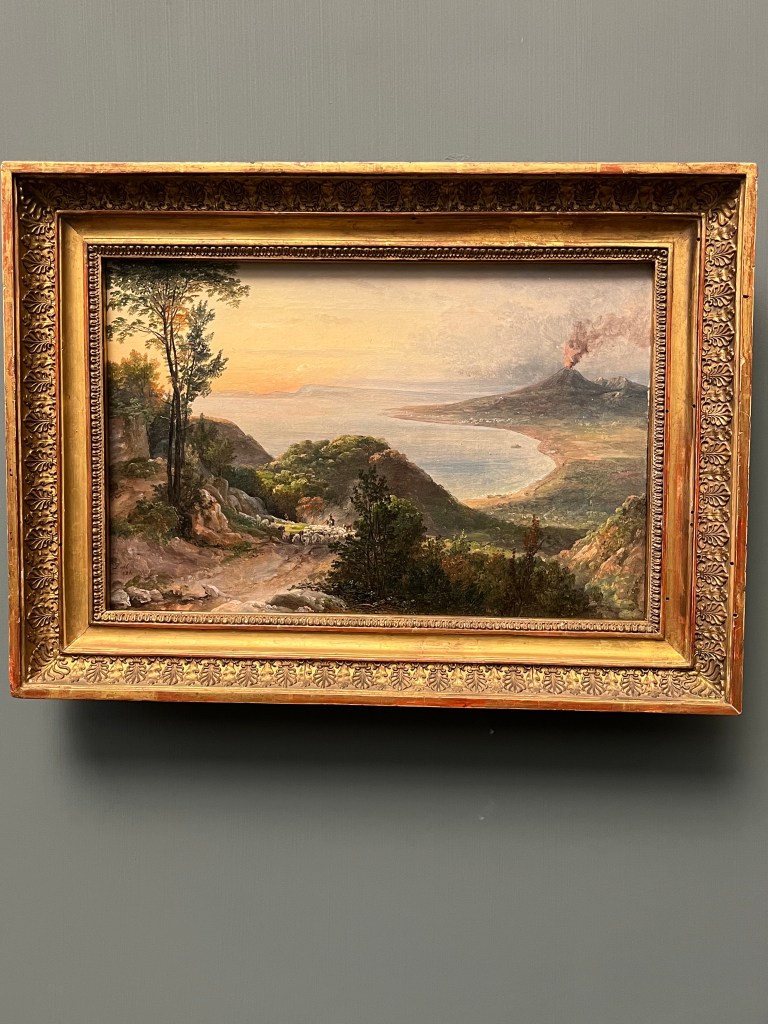
Wanderer Above the FogBernini 1622Medieval Retable Degas “Grand Arabesque” bronze Jacob Gensler Delacroix “Lion and Alligator” 1863Renoir “Riding in the Bois de Boulogne” 1873Gensler “Girls from Probstei” 1844Hans Speckter “Above the Stove”Johan Christian Dahl “View from Pimonte over the Bay of Naples” 1821
After wandering around the St-George retail district, I found an interesting “concept” store for Closed, an Italian brand. I rarely buy anything when traveling, but I bought a cool Oxford cloth striped shirt with a Henley collar, which I’d never seen before. I hadn’t packed any similar shirts, so it will come in handy as the weather warms up over the weekend.
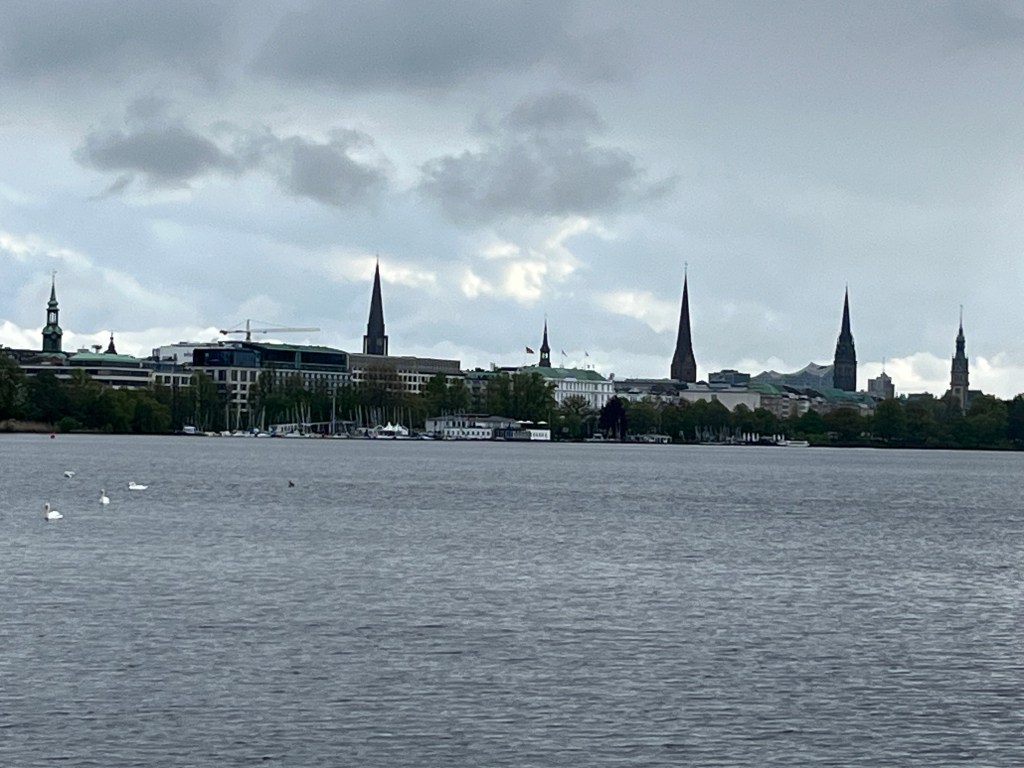
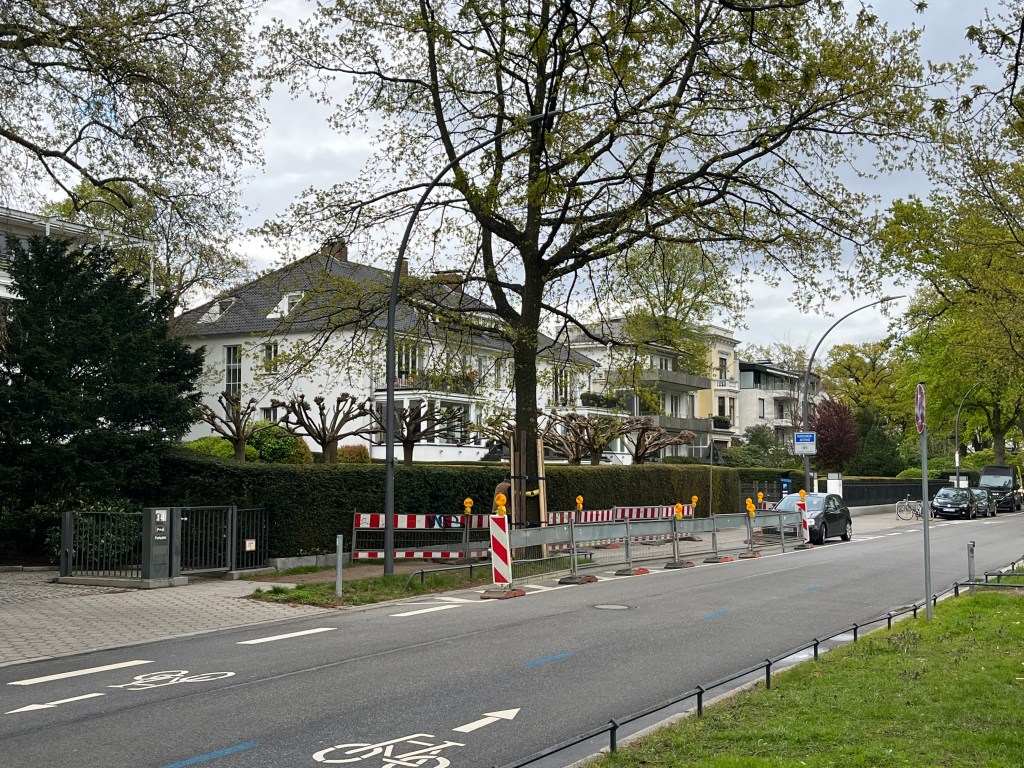
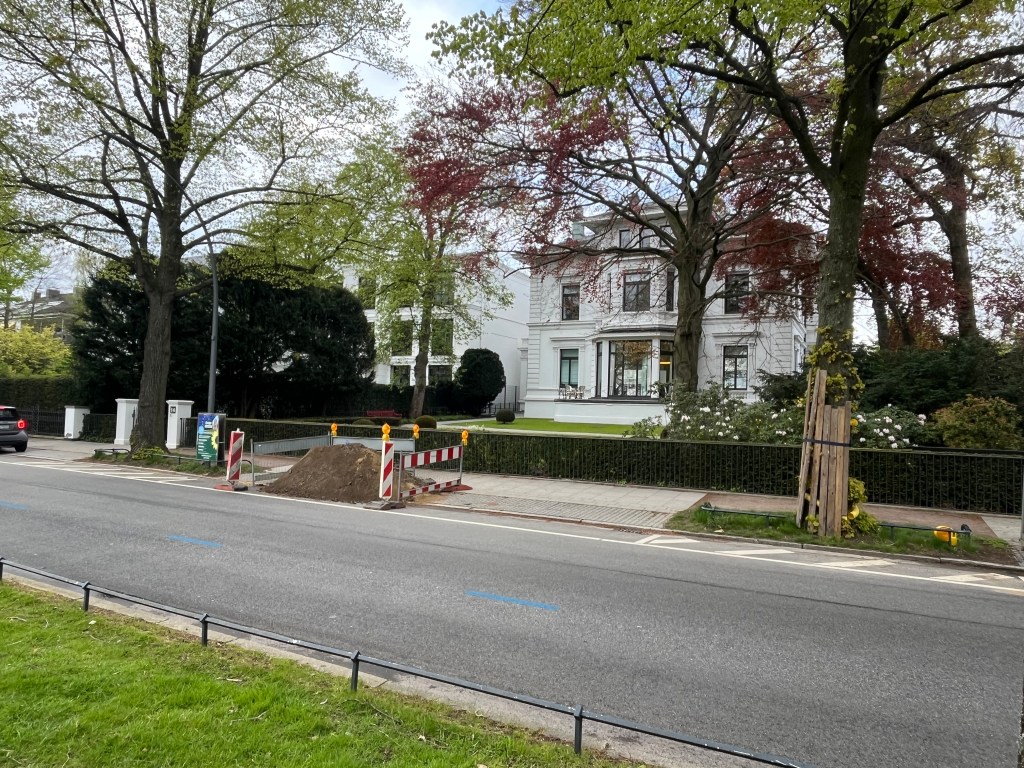
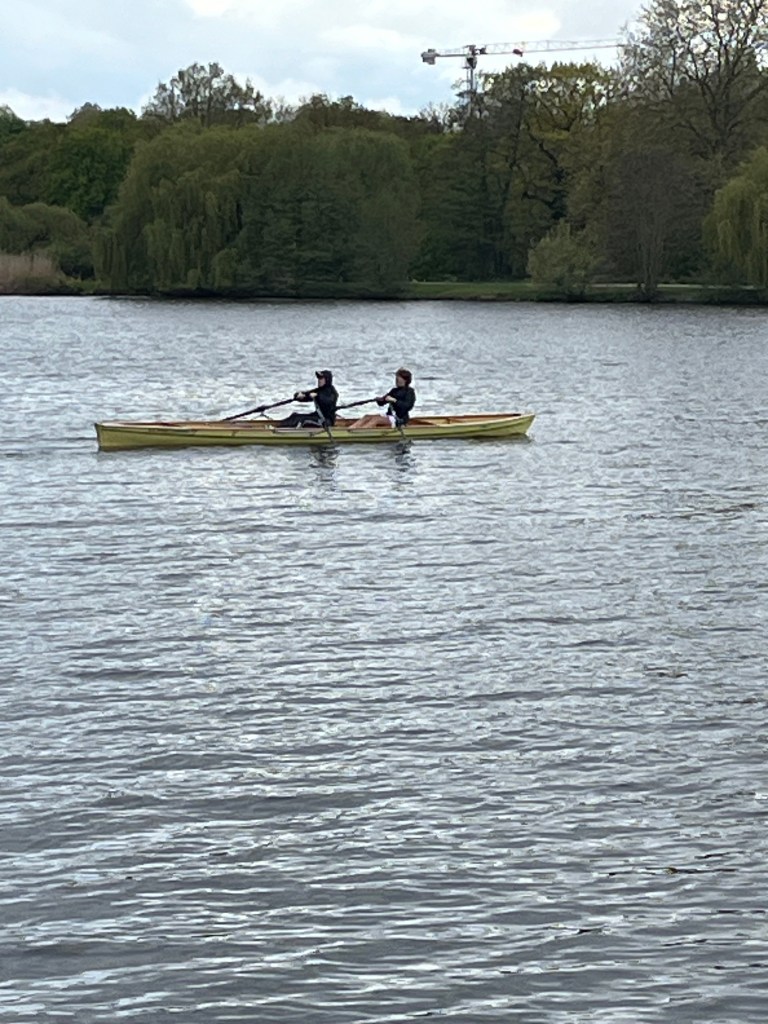
Later in the afternoon, I took a nice walk along the River Alster and enjoyed the upper-end residential district and the views of the city’s spires on the other bank. The rain was on and off, but there were plenty of runners, pedestrians and cyclists along the way. After about a 2.2 mile walk, I headed back to the Airbnb on the S-Bahn from Central Station.
I occasionally enjoy a vegan restaurant when traveling in Europe, so I took a long walk to central Ottensen and had a delicious dinner at Froindlichst, which also has a restaurant in Berlin. Afterwards, I stopped by a hipster bar on the way home and had a nice chat with the bartenders. Joanna had lived in Texas for a while and was planning a trip to LA. Like most younger Germans, her American English was excellent.
PS: I just got a Steps notification that I walked 10 miles yesterday.
In a few hours I leave for five nights in Berlin: my first visit to the capital.
At latitude 53.5, dawn comes early. I didn’t close the drapes completely, so I woke up around 6:00. I ground some beans and enjoyed two cups of coffee. The Airbnb host had an ab roller so I pumped out 4 sets of 20.
I walked about .75 km to the Ottensee S-Bahn station to grab a train to the Jungfernstieg station, where I was to meet my small group city tour at the magnificent Rathaus (City Hall), rebuilt in the 1890’s after the original was destroyed in the catastrophic fire of 1842. It miraculously survived the late July 1943 Anglo-American bombing campaign that devastated the city. I was early, so I bought two amusing postcards for my little grandson and posted them.
Hamburg RathausClose-up view
As I mentioned in yesterday’s post, the late spring weather is unseasonably cold, with highs only in the 40’s. At least we had sunshine until the early afternoon.
The tour guide was an engaging fellow, with a loud voice. There was a family from Minnesota with a precocious 11 year old son, two guys from New York, a young couple from Córdoba, Argentina and a couple from Denver. The Argentines were big fans of their new president. Also part of the group was a recently naturalized Chinese businessman from New York, who was traveling without his family. He and I hit it off and had a fascinating conversation, which I’ll recount below.
Some of the things our guide mentioned stand out. Hamburg is the second largest city in Germany, but has the largest number of millionaires. Like Bremen and Berlin, it retains the historical designation of a Freistadt, or Free City, with its own Senate. Its official name is the Free and Hanseatic City of Hamburg. It’s also the third largest port in Europe.
The Hanseatic League was a centuries-old trade confederation in the North Sea and the Baltic Sea. I’ve visited several of its former members, including Copenhagen, Gdańsk (formerly Danzig), Riga and Tallinn.
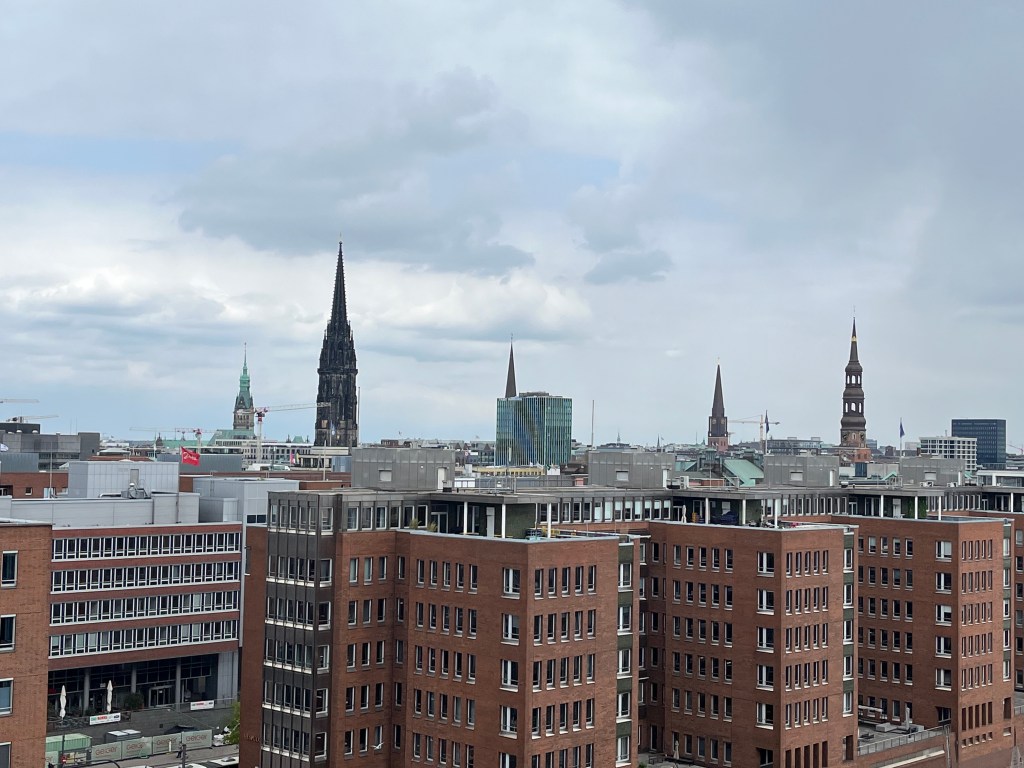
We then headed over to St Nikolaus Church, one of five soaring Gothic Protestant churches in the center (Zentrum). This 14th century church suffered a double-jeopardy: it was destroyed and rebuilt after the 1842 conflagration and then again in 1943’s Operation Gomorrah. It wasn’t rebuilt after the bombing and stands as a war memorial. Since I can read some German, I saw an inscription to die Opfern (victims) of the 1943 raid. Our guide mentioned 700 fighters, but I privately told him that it was over 700 “bombers” that conducted the raid. He was thankful for the correction.
St Nikolaus Church ruinsThe steeple from the harbor area
Operation Gomorrah occurred at the end of July 1943 and lasted for eight days and seven nights. It was conducted by the RAF Bomber Command and the US Army Air Force 8th Bomber Command. It was the first mass incendiary attack on a city and occurred after a spell of particularly dry and hot weather which made for ideal incendiary potential. The bombings led to a disastrous firestorm which was whipped up by hot southern winds which reached speeds of 150 mph. People were literally vaporized. 45,000 people died and many more were injured. Over 60% of the housing stock was destroyed. A number of defense plants were destroyed. It’s amazing how the city was completely rebuilt after the war. Apparently the copper roofs with the characteristic green patina were the ones that survived.
After the tour, the Chinese-American fellow and I had a lengthy chat. He’s a huge soccer fan, so he’s been going to games all over Germany. He left China 20 years ago since he could see the direction in which the country was headed, although he still has family and friends in the Beijing area. He feels that China’s economy is far worse than claimed and that Xi is an ignorant despot. He claims that the Chinese high command understands that they’d lose a war against the US and that no middle-class Chinese would want to fight against Taiwan. He said that their military equipment is sub-standard because of rampant corruption in the defense industry. He warns his family to get their money out of the Chinese banks since they’re already limiting withdrawals and asking what customers plan to do with the money. He’s planning a trip back to China to visit relatives but is afraid to contact some of his old colleagues for fear that they’ll report him to the secret police as a foreign agent. The Ministry of State Security gives tattletales a $75,000 bonus for turning alleged agents in. He plans to keep a low profile and carry a lead lined bag for his computer and cell phone. The way he described Xi’s background made me laugh, and he joined in. When I asked him about the Uighurs, he told me about a high-ranking general who his family knows who was also the regional commander of Xinjiang province. He told me that initially the Uighurs attacked and killed Chinese officials and that they ignored the general’s warnings to desist. When they continued the attacks, the People’s Liberation Army wiped out a number of Uighur towns and even killed all the animals in a scorched earth operation. I wished him luck on his travels and marveled once again at the people and conversations that occur when I travel abroad.
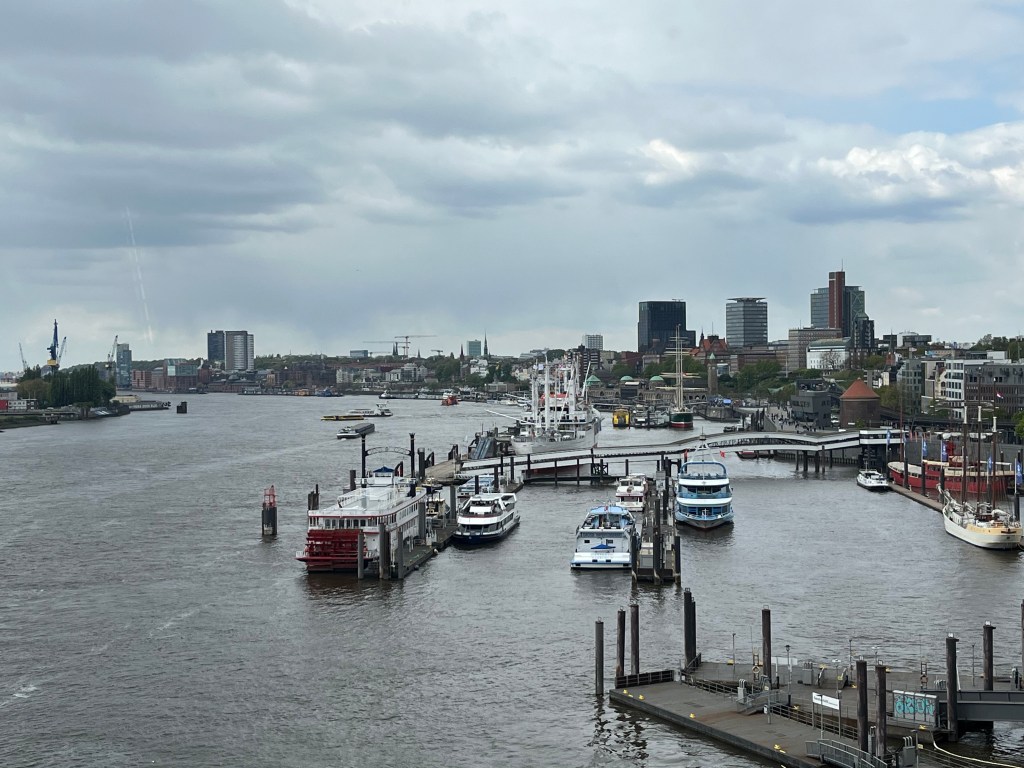
I took my acquaintance’s advice and went up to the viewing deck of the massive Elbphilharmonie and took pictures of the city and the new Hafen City, which will house over 30,000 people when it’s completed in 2030.
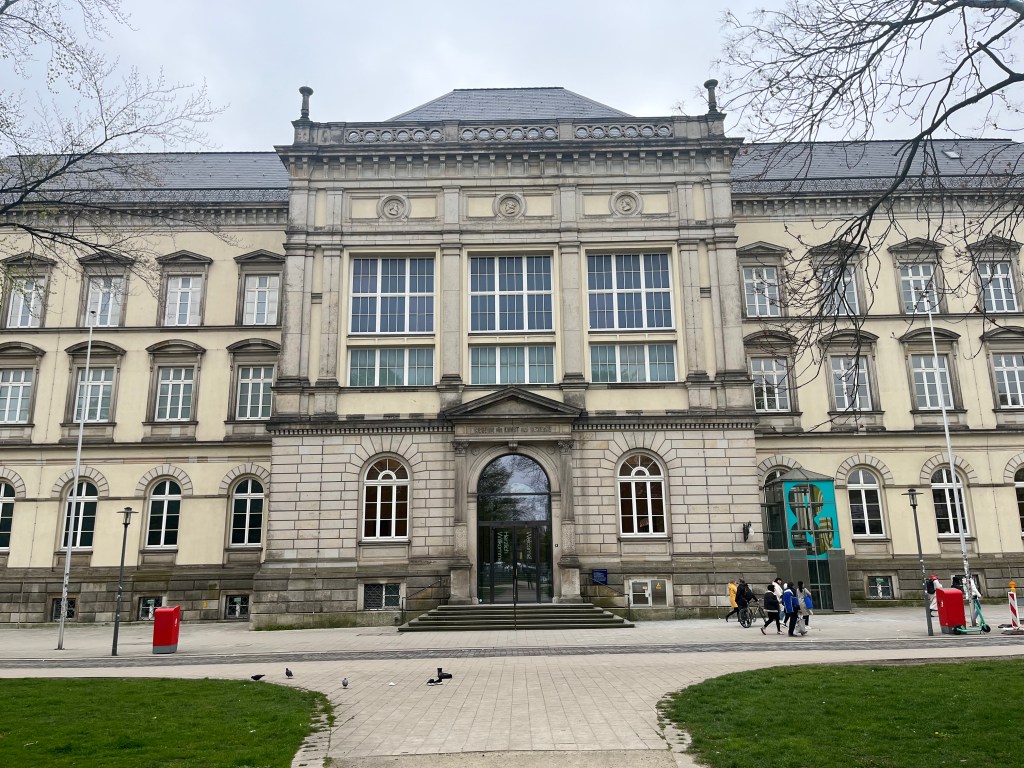
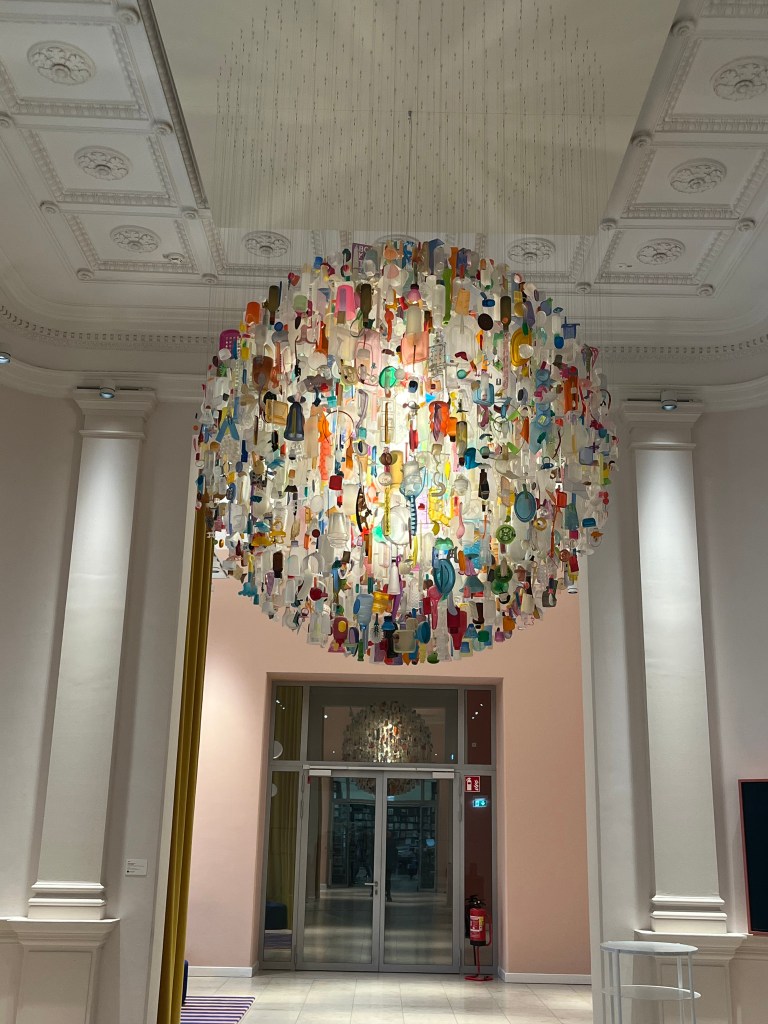
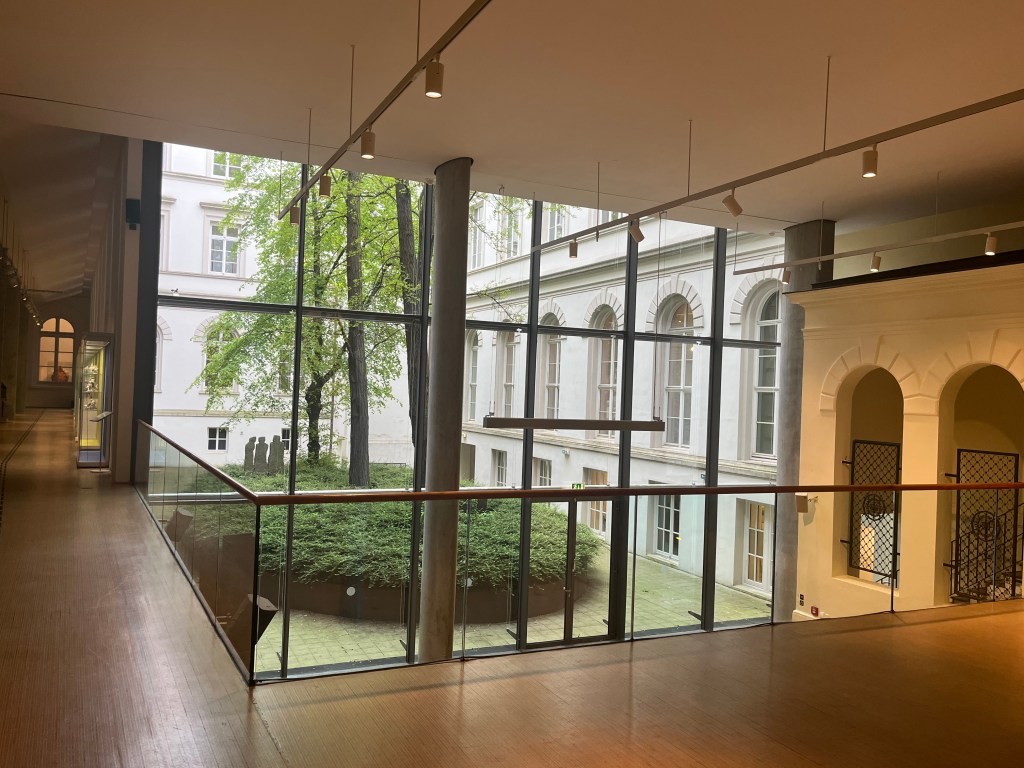
After a late lunch I visited the outstanding Museum für Kunst und Gewerbe near the Central Station. They have three floors of applied arts and statuary from ancient Egypt through the Art Nouveau and Art Deco periods, in addition to a fascinating gallery devoted to water and its conservation. After about 90 minutes I started to yawn, so I went back to the S-Bahn station for a quick return home. Grabbed some takeout and spent the evening at the Airbnb and then slept soundly for over nine hours. It’s currently raining, so I’ll wait for it to clear before heading out.
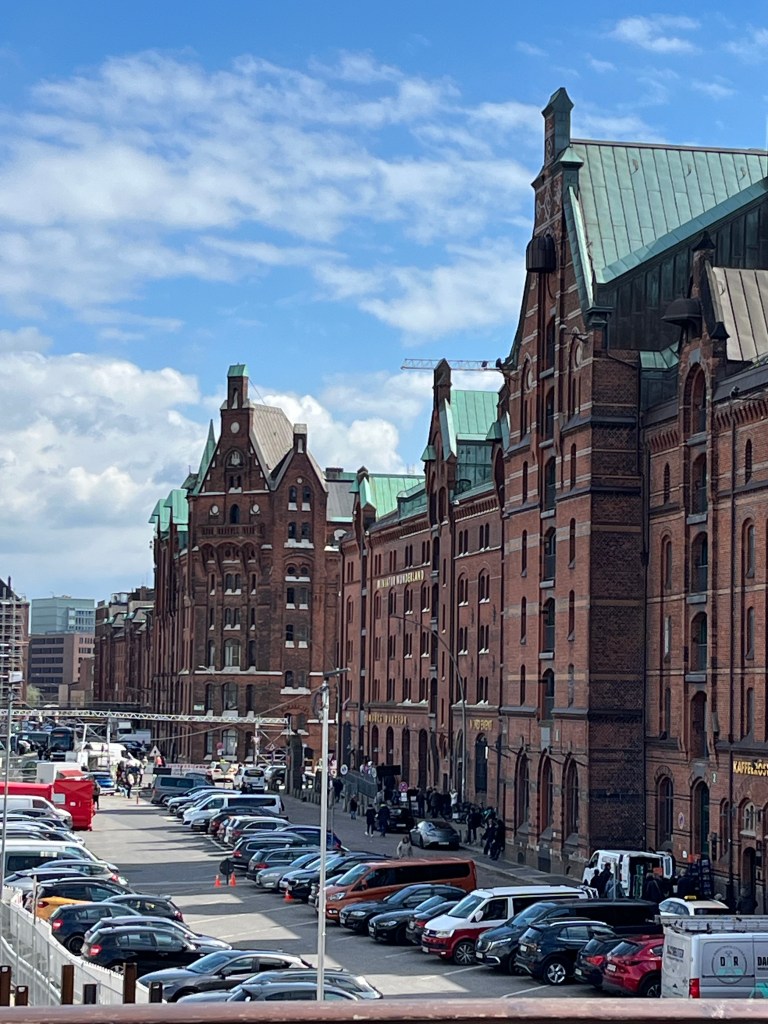
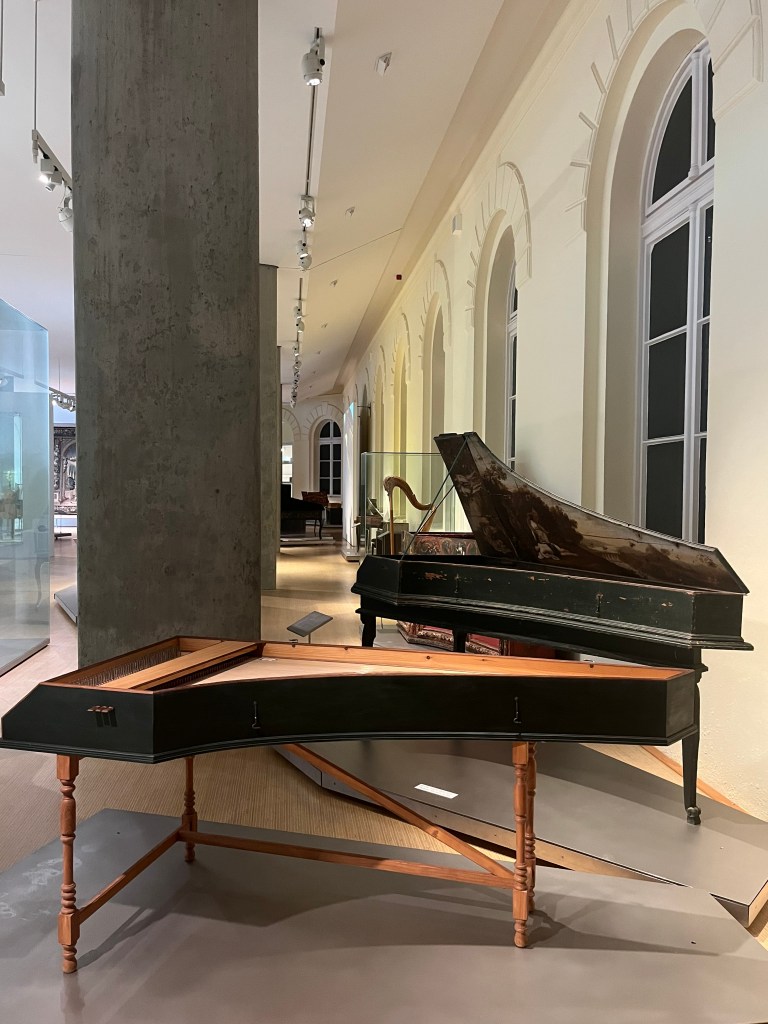
Museum facadeMuseum entryInterior gardenAncient instruments collection Water and the human bodyWarehouse District Warehouse district looking west
I took the fast ICE (Inter City Express) train from Münster to Hamburg this morning, arriving at Hamburg Hbf right after 1:00 pm. Since I had some time to kill before my Airbnb was ready, I had a nice lunch at Mutterland, a delicatessen with a restaurant. After lunch, I took an Uber to my place in the leafy Ottensee section of the city, near Altona. My host met me at the door and carried my bag up four flights of stairs to the apartment. After he left, I got settled and went online and got an HVV (Hamburger Verkehrsverbund) three-day travel pass. Later I found out that the HVV S-Bahn stations don’t have turnstiles.
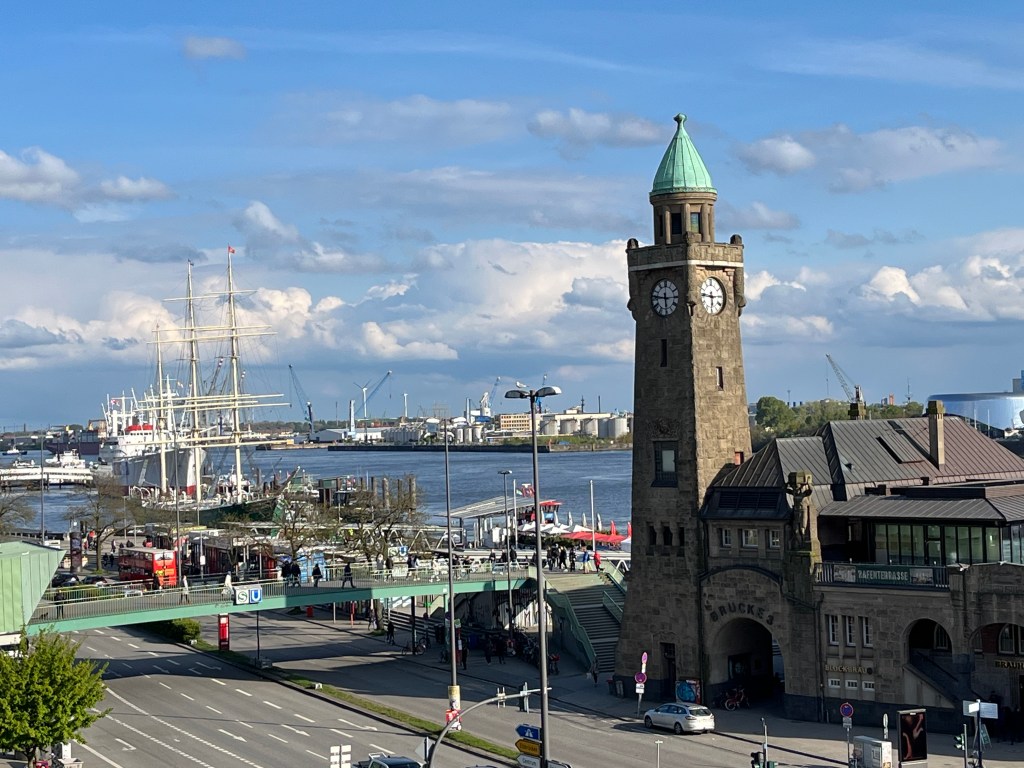
Although the weather was partly sunny, it was freezing cold—in the mid-40s and gusty. I waited for a bus to the center, but decided to walk to the S-Bahn stop in Ottensee instead and take the train to Reepersbahn in the St -Pauli district, where the Beatles famously played before becoming rock stars. By the way, I was never a big fan.
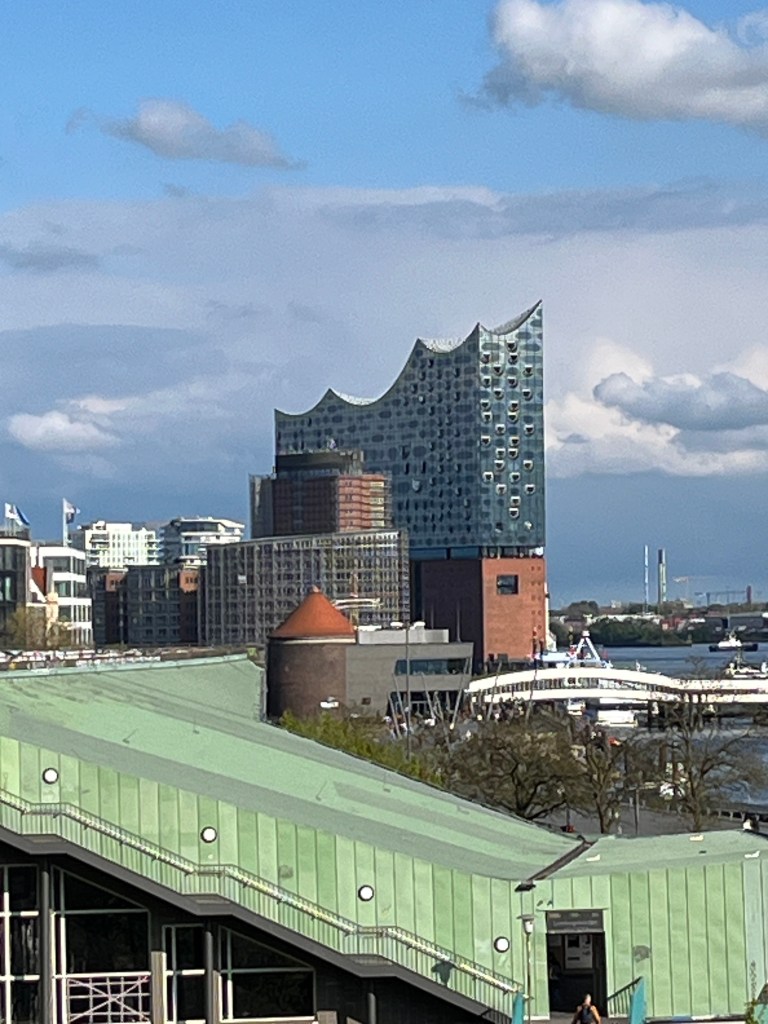
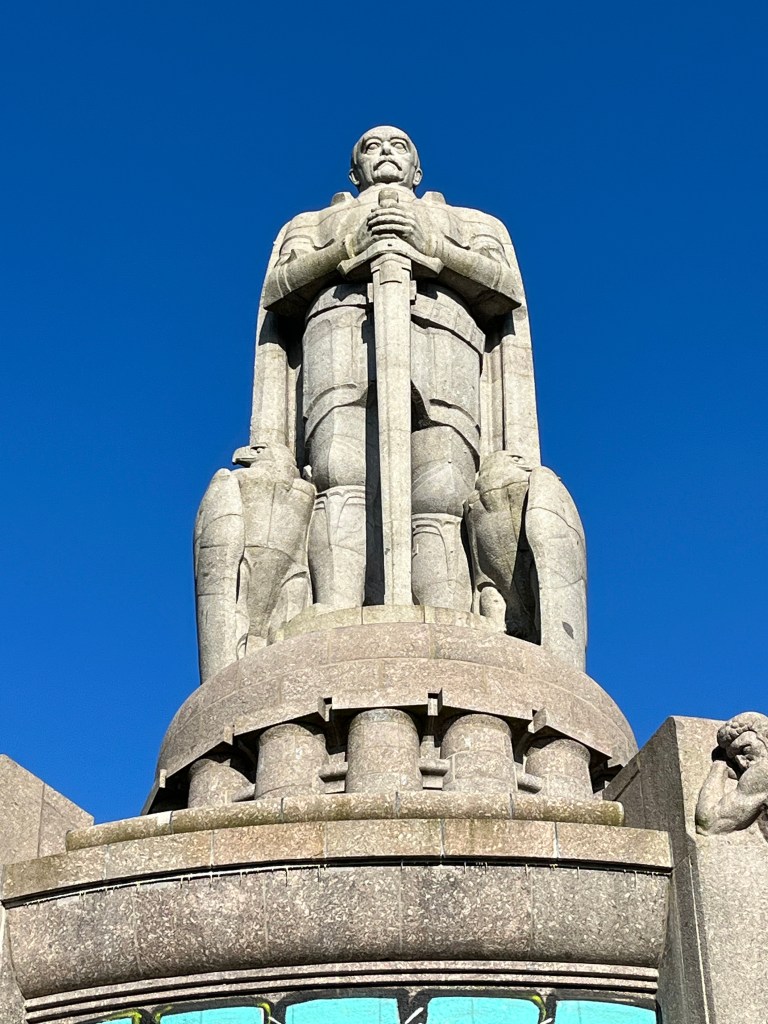
The St-Pauli district is seedy, but adjoins a nice neighborhood with views of the harbor and the iconic Elbphilharmonie. I walked up to a large park dominated by a gargantuan statue of Otto von Bismarck. As the wind picked up, I decided to take the S-Bahn back to Altona, to explore that neighborhood.
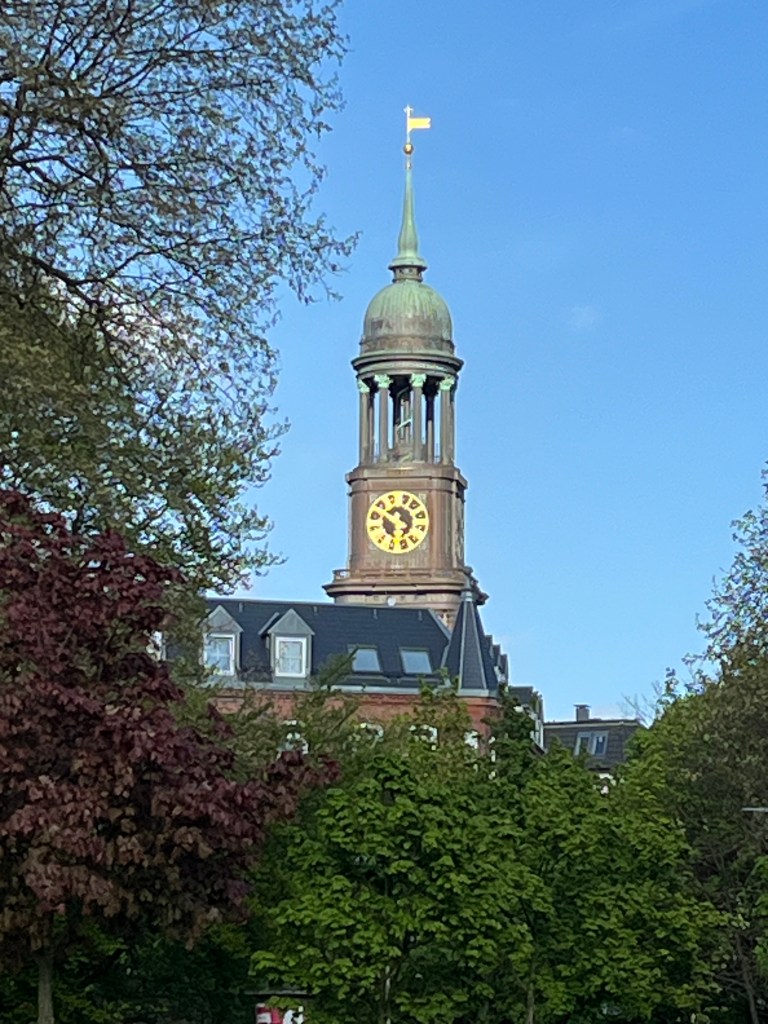
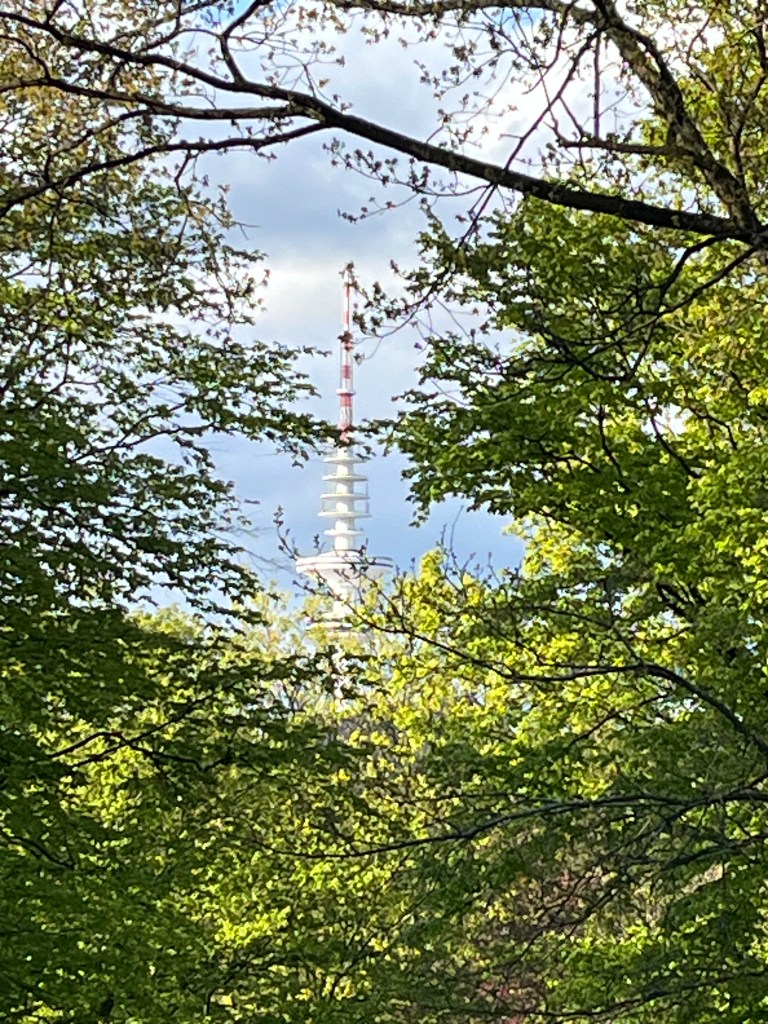
ElbphilharmonieHarbor viewBismarck statueSt Michael Lutheran Church276 meter Heinrich-Hertz-Tower
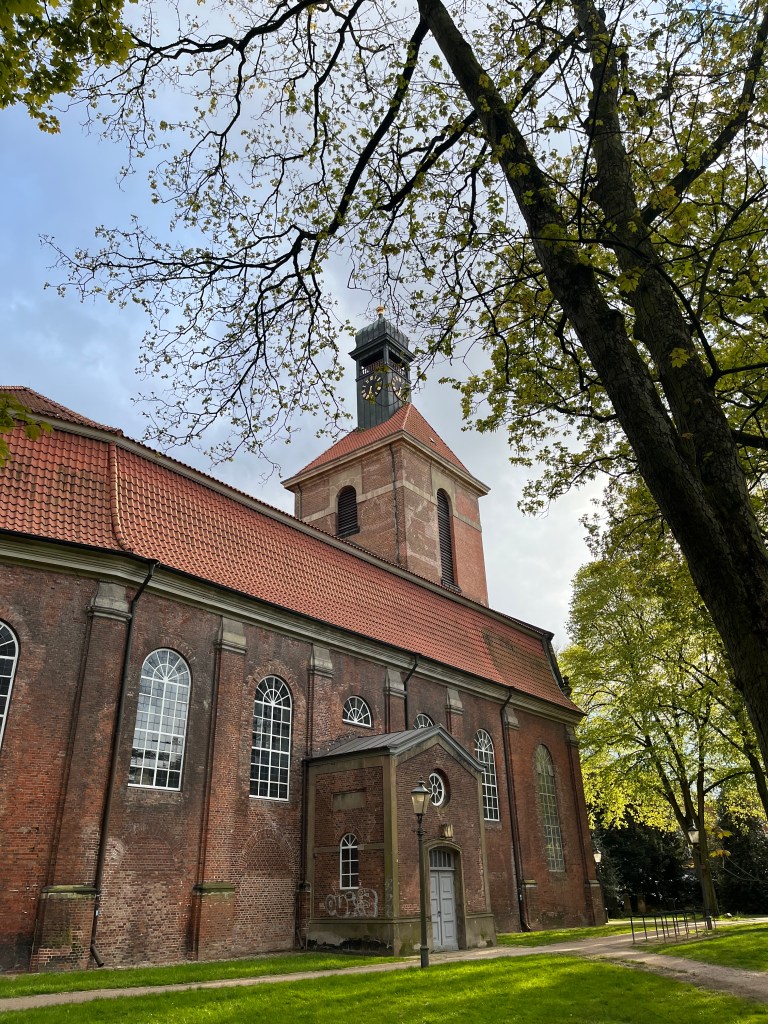
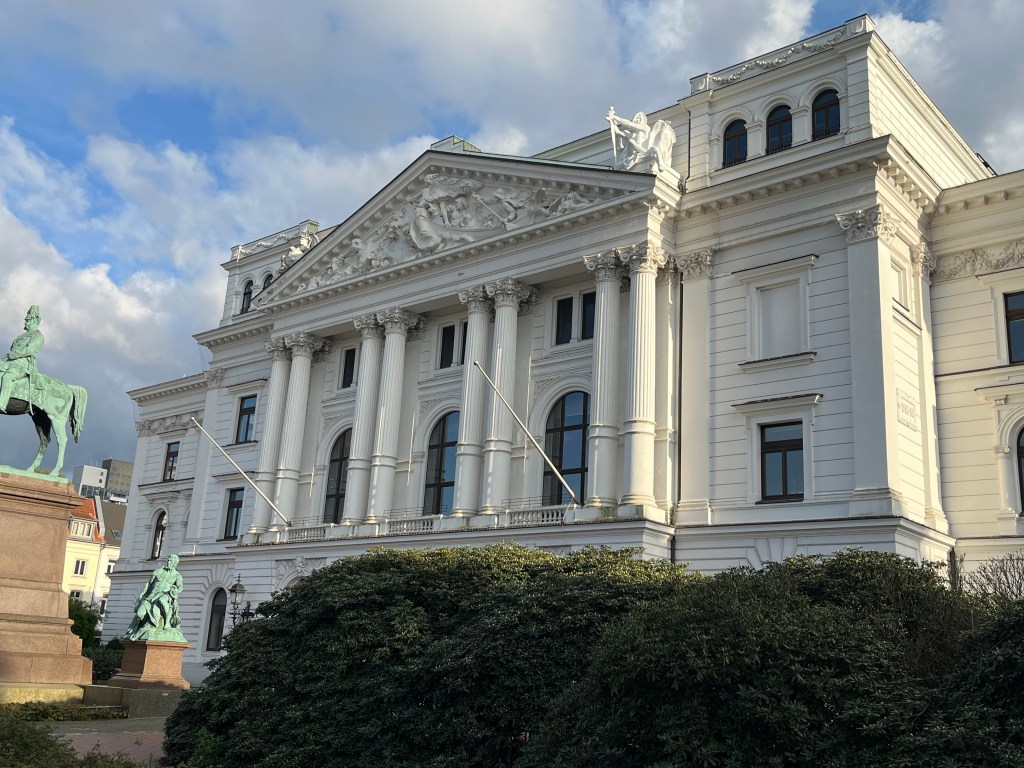
Altona is another leafy district of Hamburg, with attractive parks and a neo-classical City Hall (Rathaus). I walked around a 17th-century Protestant church and graveyard before heading back to the train for the short hop to Ottensee.
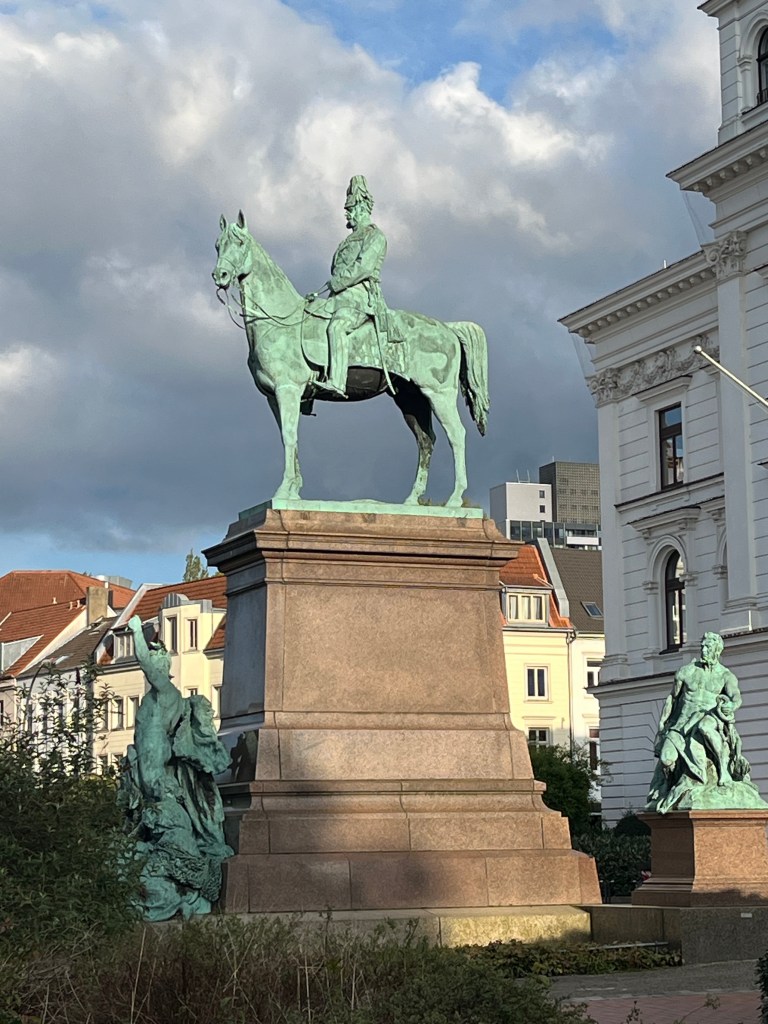
Protestant churchEquestrian statue in front of the RathausAltona Rathaus
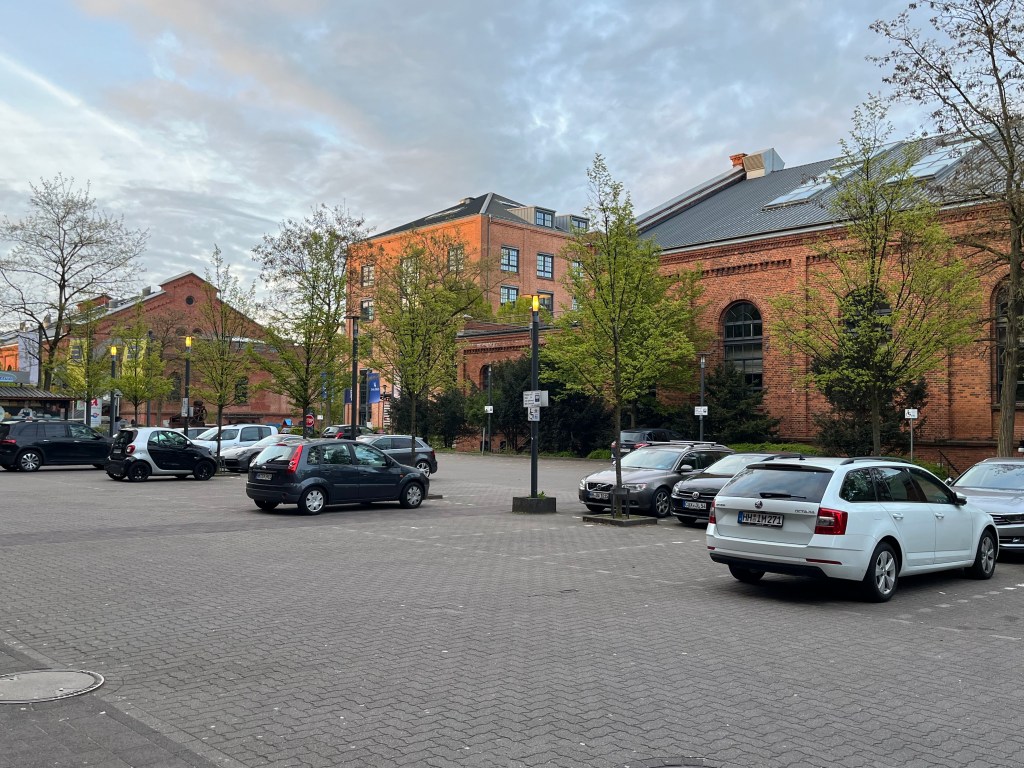
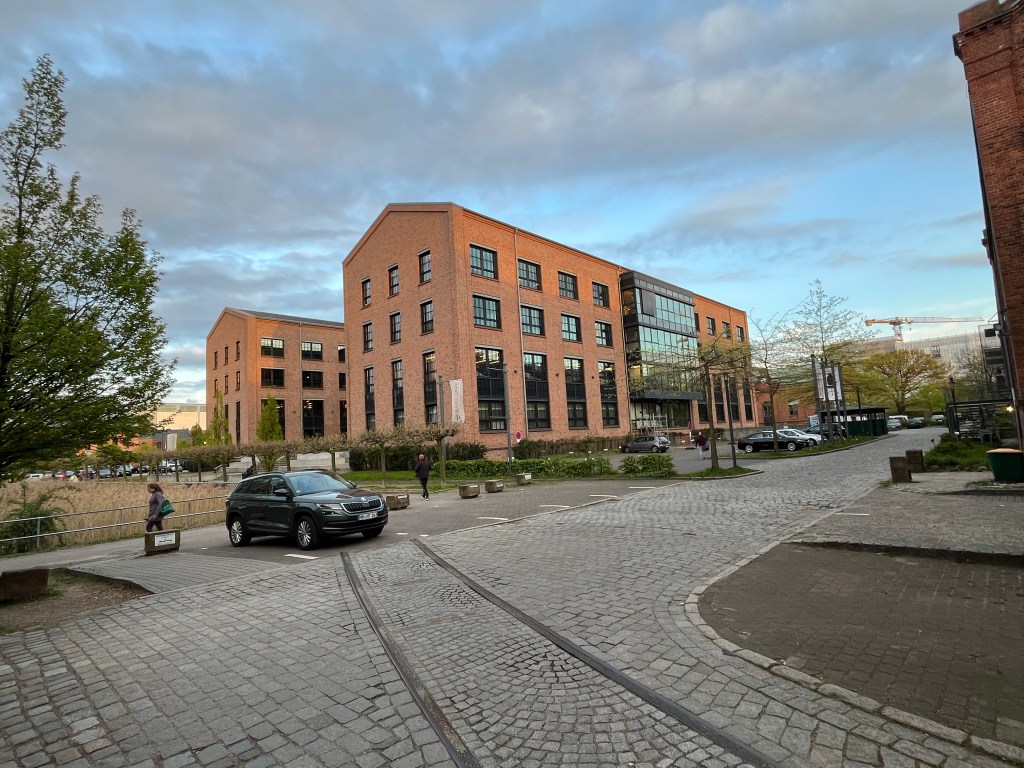
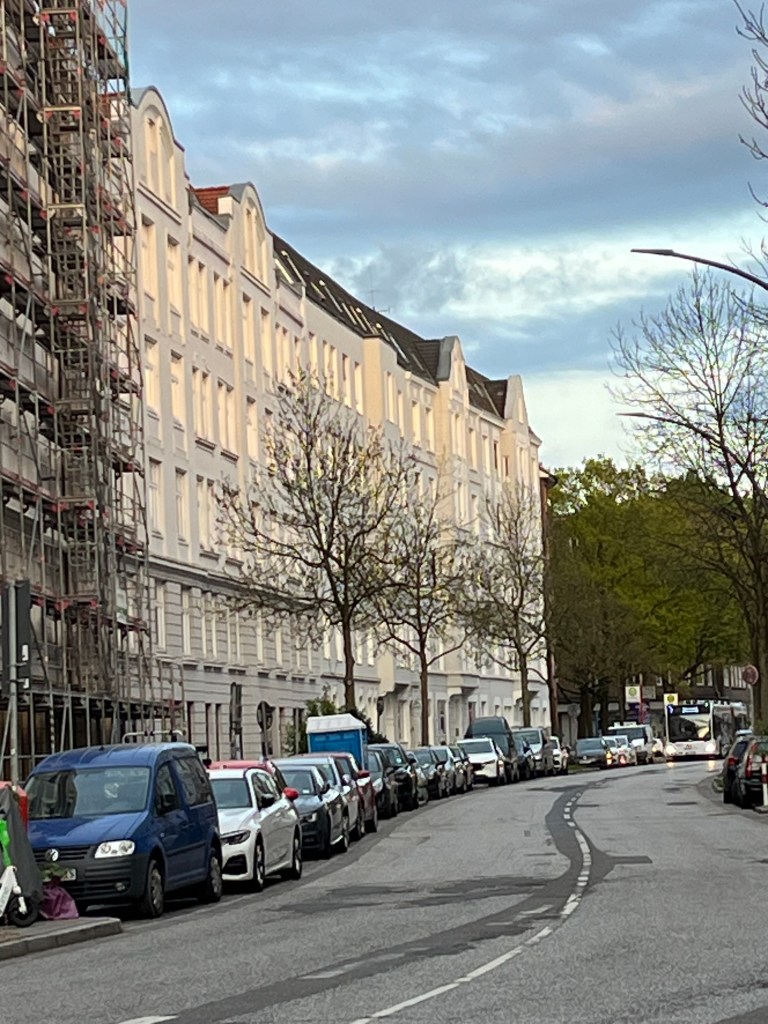
When I got back to my Airbnb after logging almost 8 miles, I looked for a local market to grab some food since I didn’t feel like going out for dinner at 8:00 pm. The E-Center Struwe is a superb grocery story a short walk from my Airbnb situated in a redeveloped industrial space that used to be a gasworks. As is universal in Europe, unlike the US, all sidewalks and open spaces are finished in pavers. I’ve never seen poured concrete streets which are ubiquitous in the US. It always seems that we Americans do everything on the cheap. Asphalt roof shingles are another hideous feature that one never sees in Europe. These are some shots of the redeveloped gasworks. The final shot is of my building.
I had to turn the heat on since it’s going to dip into the 30s overnight. Tomorrow I join a walking tour at the civilized hour of 11:00 am. My host has three coffee machines plus a grinder so I’ll be well caffeinated tomorrow morning. Guten Abend!
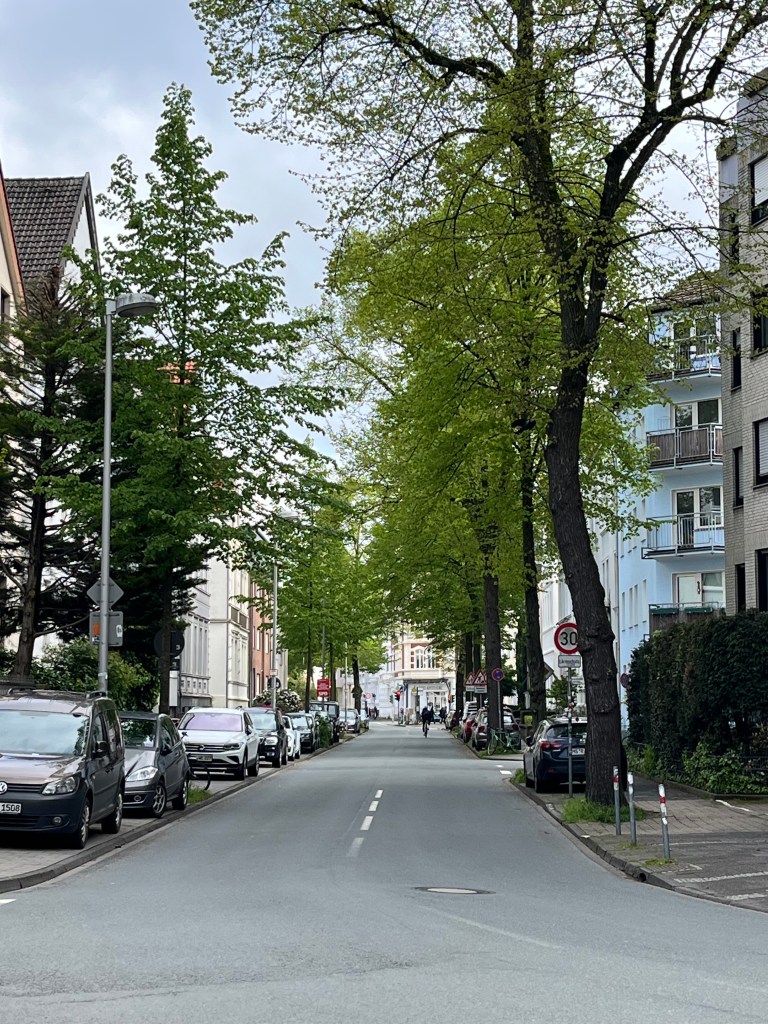
After coffee at my Airbnb, I took a brisk walk through the Altstadt. The weather was sunny and chilly. All retail stores were closed on Sunday, which is common in Germany. I actually went on three long walks today, including dinner with an old American friend and his wife and three young children, which was the result of a morning email. I was pleased that they lived close to Münster. We ate at an Italian place, Mocca d’Oro, one of his wife’s favorite restaurants while she was a student at the university.
The food was excellent. I had the dorado. Again, meeting an old friend was the highlight of the day!
Earlier, I stopped at a cafe for a glass of wine and enjoyed watching the locals walking about. It was a bit chilly but sunny.
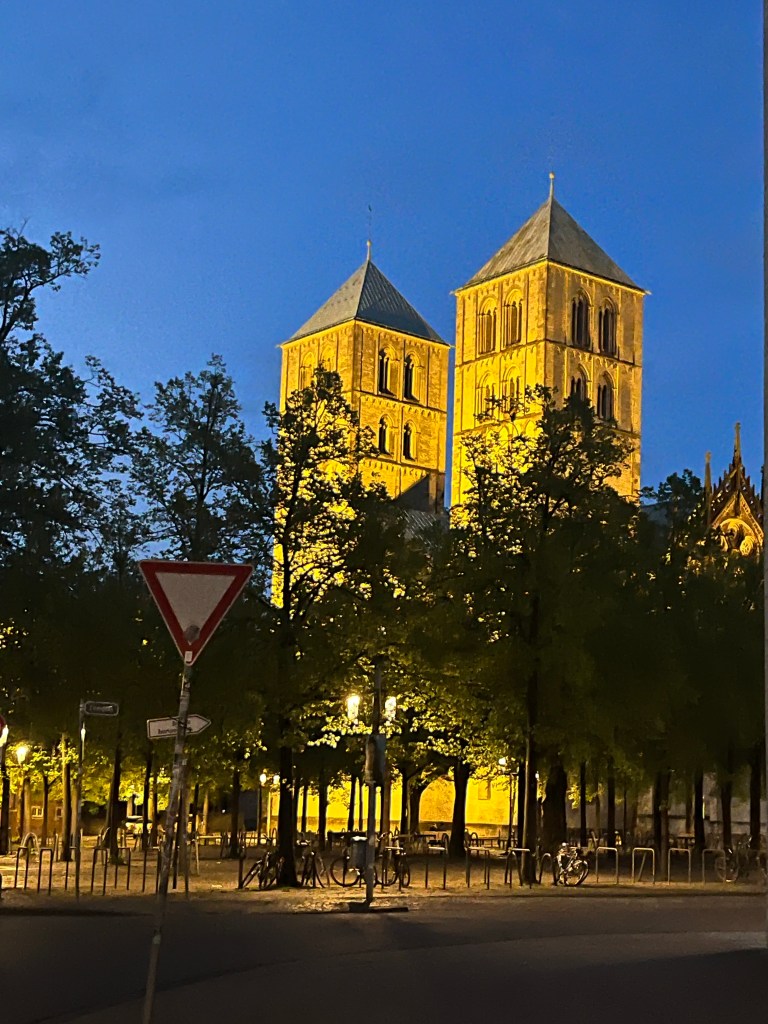
Walking back from dinner, I snapped a picture of the Cathedral in the twilight. Since Münster is so far north, twilight lingers until 9 in the spring.
I’ll be walking over to the train station for my train to Hamburg in a few minutes. As I said in my last post, Münster is really a beautiful city. Its size makes it walkable and there are plenty of sites to visit, including a number of ancient churches. It’s a city worth spending time in.
After a pleasant 3 hour train trip from Amsterdam, with one change in Rheine, I arrived at Münster Hauptbahnhof and walked the short distance to my exquisite Airbnb. Although small, it’s equipped with a brand new kitchen and bath with German faucets, appliances and even a DeLonghi espresso/cappuccino maker. There’s also a Sonos, so I’m listening to some baroque music after a lengthy walk around town.
I’ve had a somewhat morbid fascination with Münster since I read a book about the Hapsburgs in high school, where a number of the students were Mennonites. They were mildly antipathetic towards Catholics, despite their pacifist leanings. After reading the book, I understood why, even if they didn’t.
The Mennonites are Anabaptists, and their origins lay in the German Peasants’ War of the early 16th century. While the revolt was eventually suppressed by imperial forces under the Catholic Hapsburg emperor, radical Anabaptists later seized the Catholic Westphalian city of Münster in 1534 and established a radical theocracy with a proto-communist patina. The churches and monasteries were sacked and the local priests and nobles were executed. The bishop fled and the Anabaptists set up a communal state. Even the Lutherans were appalled and left the city. The imperial Catholic forces besieged the city for 15 months before finally entering the city and crushing the rebellion.
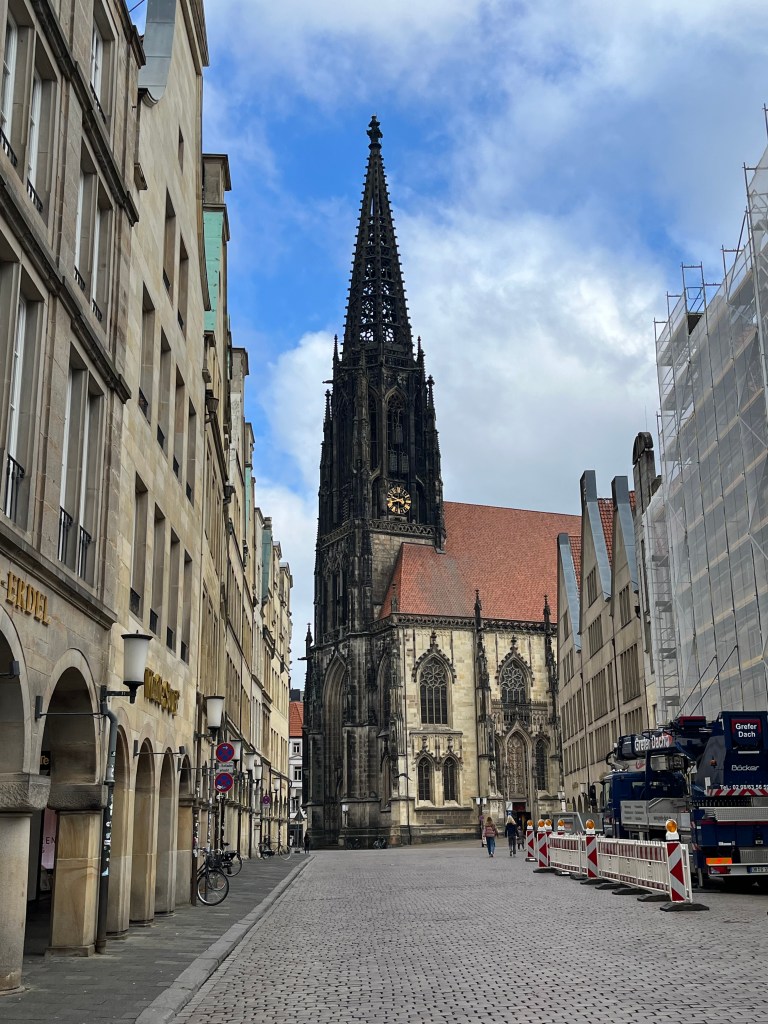
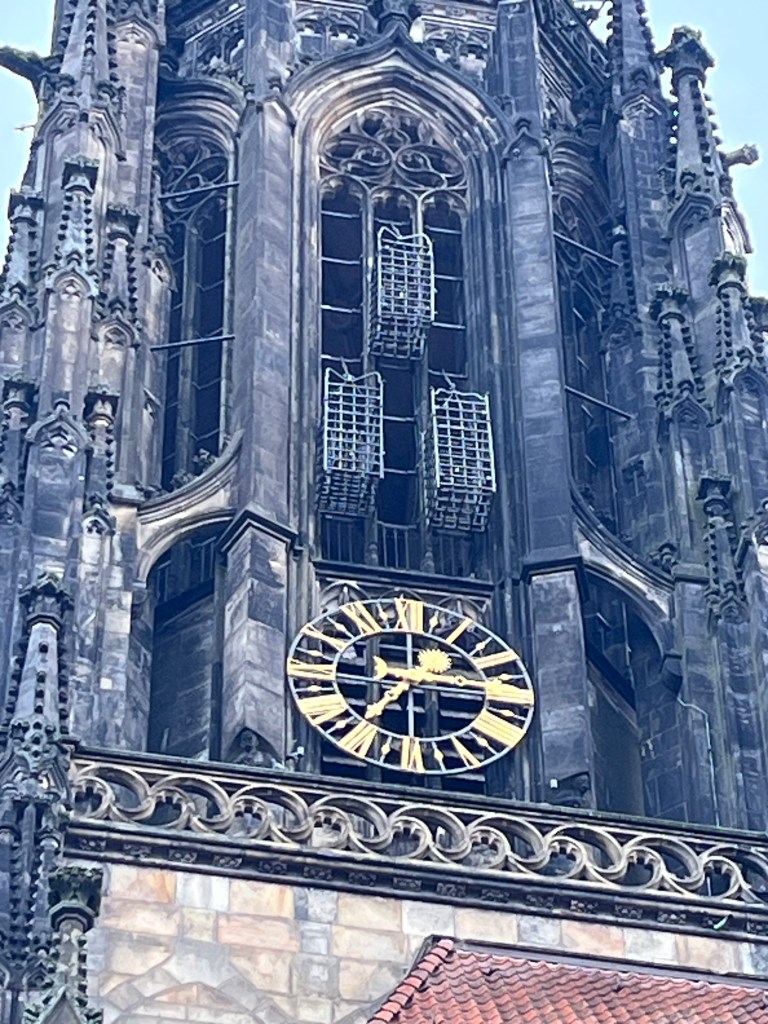
The Anabaptist leaders were tortured and placed in cages that were hoisted up the steeple of St. Lambert’s Church where the carrion birds feasted on their emaciated bodies. The Anabaptists were then expelled from Germany and Holland and fled to Switzerland. There they renounced their radicalism and adopted pacifism under the leadership of Menno Simons, who helped organize their emigration to Pennsylvania in the early 18th century. I occasionally told Mennonites about Münster, much to their consternation!
Side view of the cagesSt. Lambert’s ChurchFront view of the cages
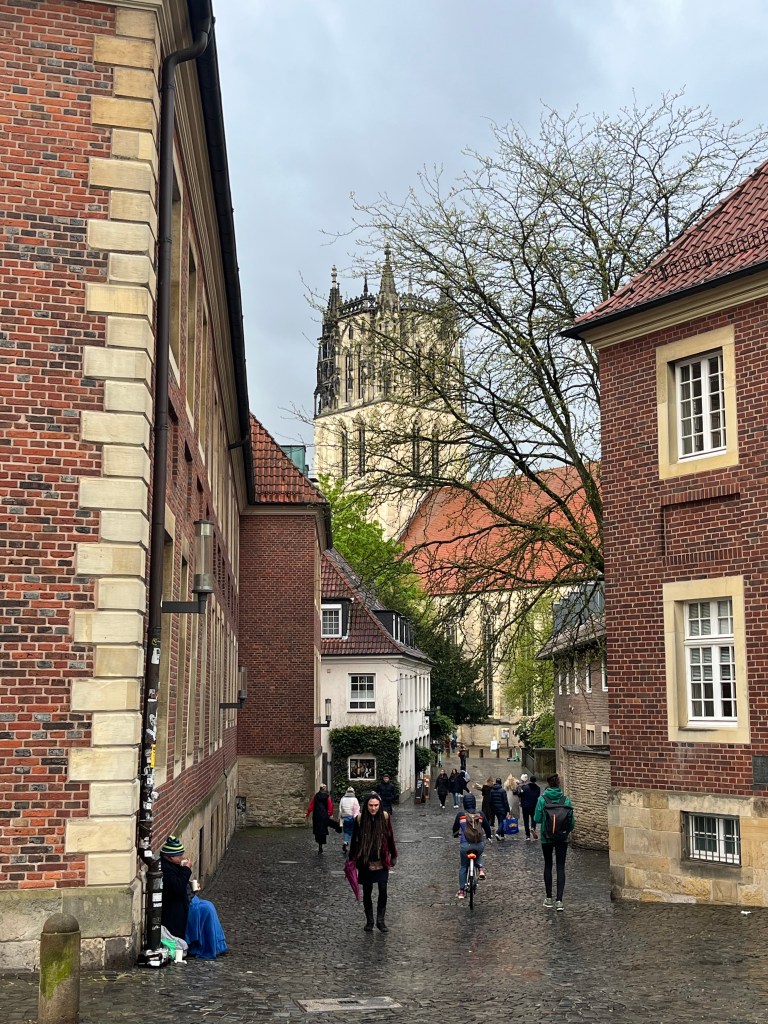
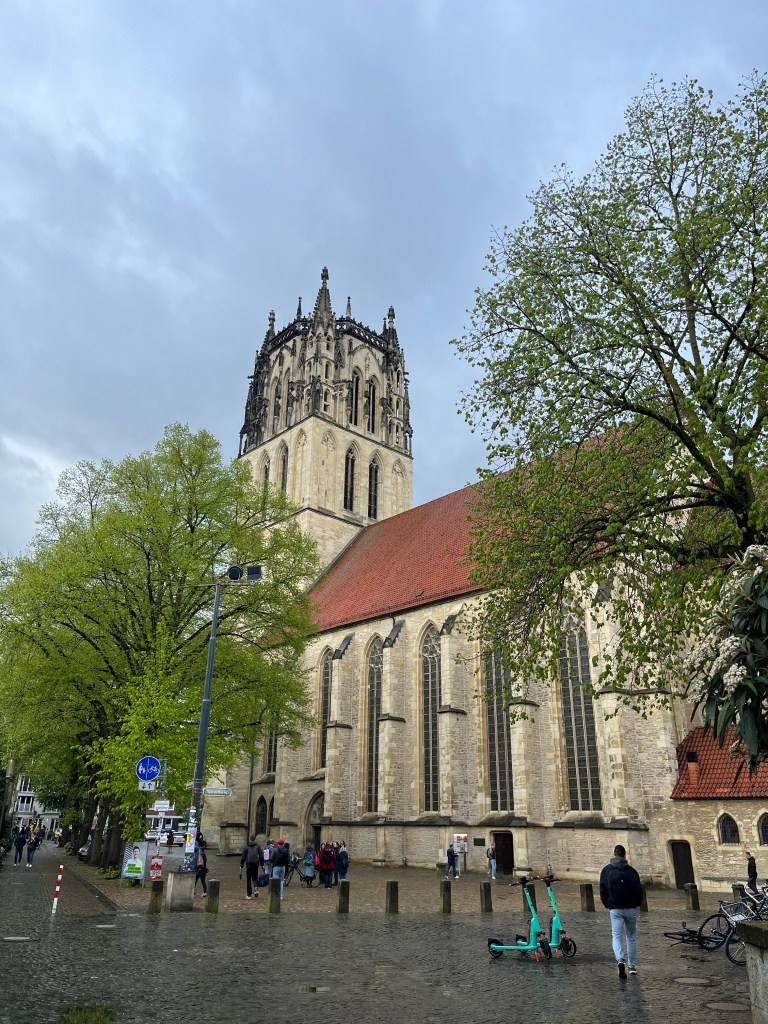
Like Vilnius in Lithuania, Münster is a fascinating city that is still somewhat unknown to the tourist crowds. It’s full of lovely medieval streets and churches and beautiful parks and residential areas. It’s the kind of city to meander about in.
Its citizens are also friendly, perhaps because it’s also a university town. I stopped by a chic little cafe and had a pleasant conversation with a young woman who was the server that day. I was even able to recall some German, even though her English was perfect.
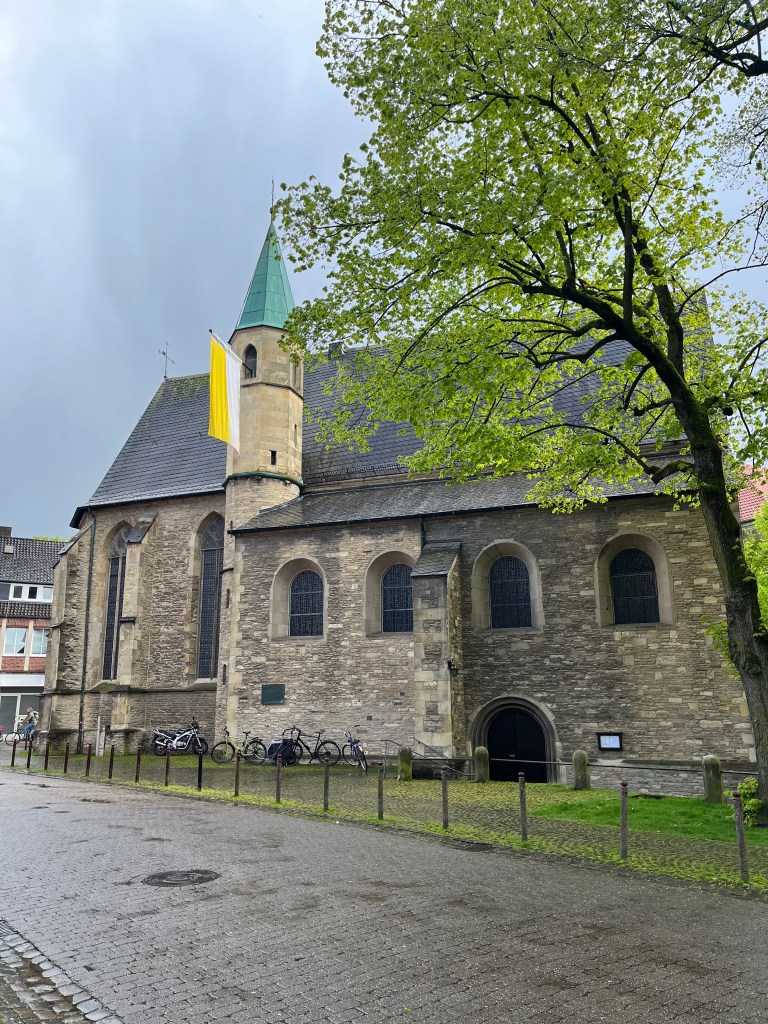
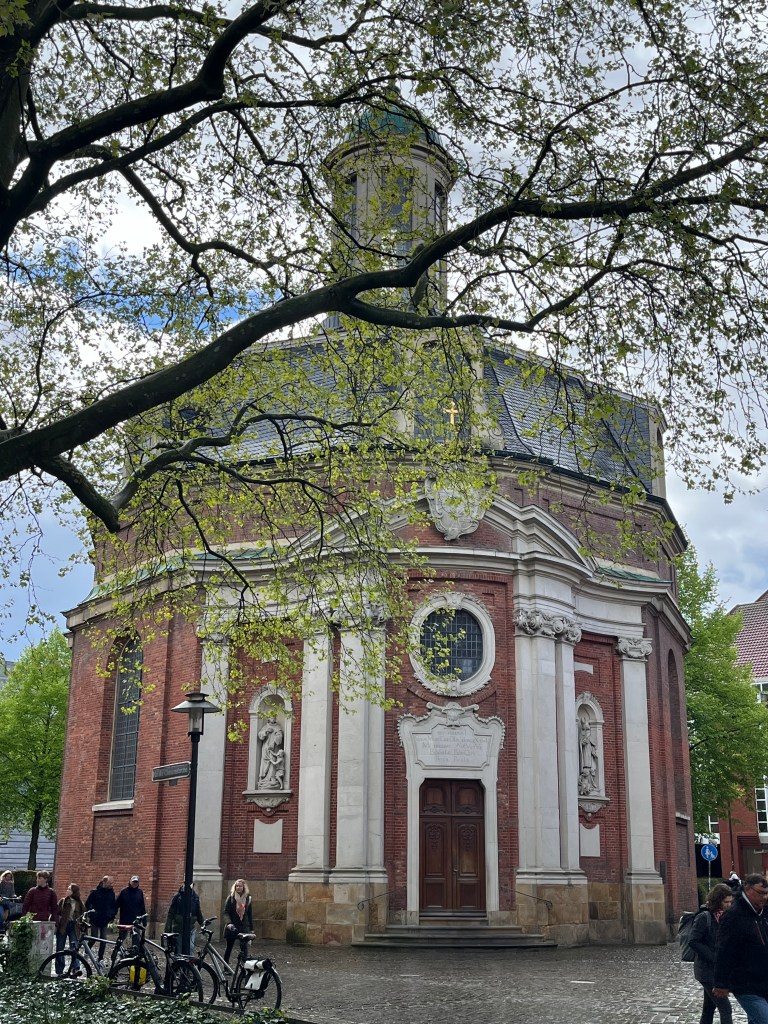
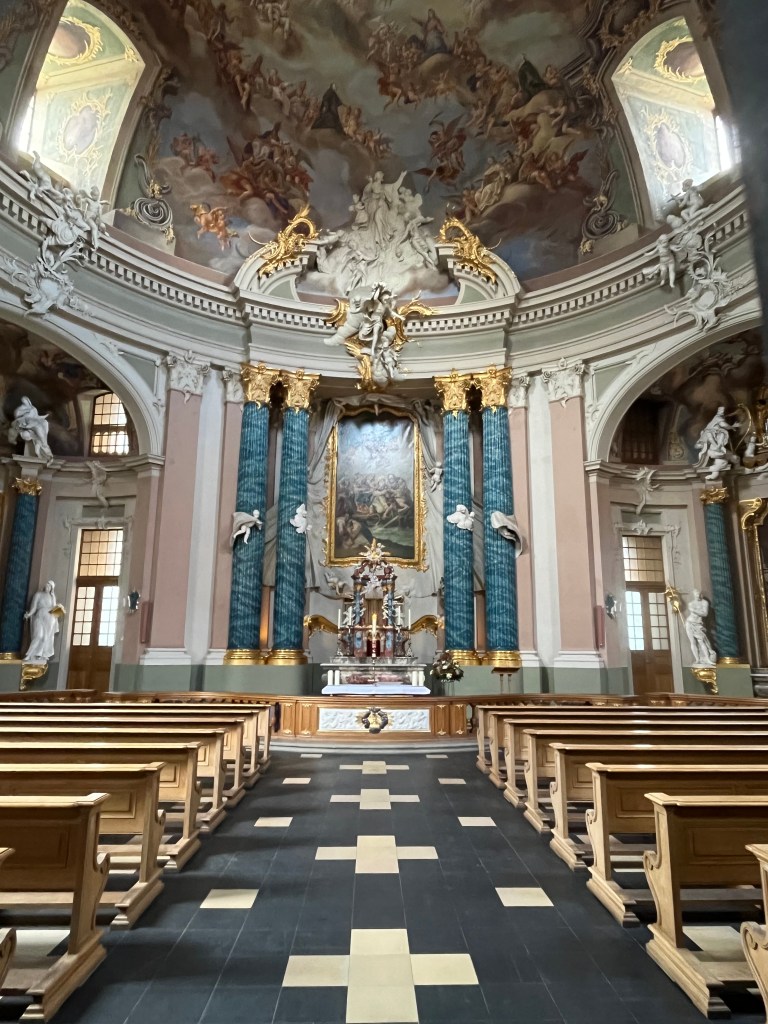
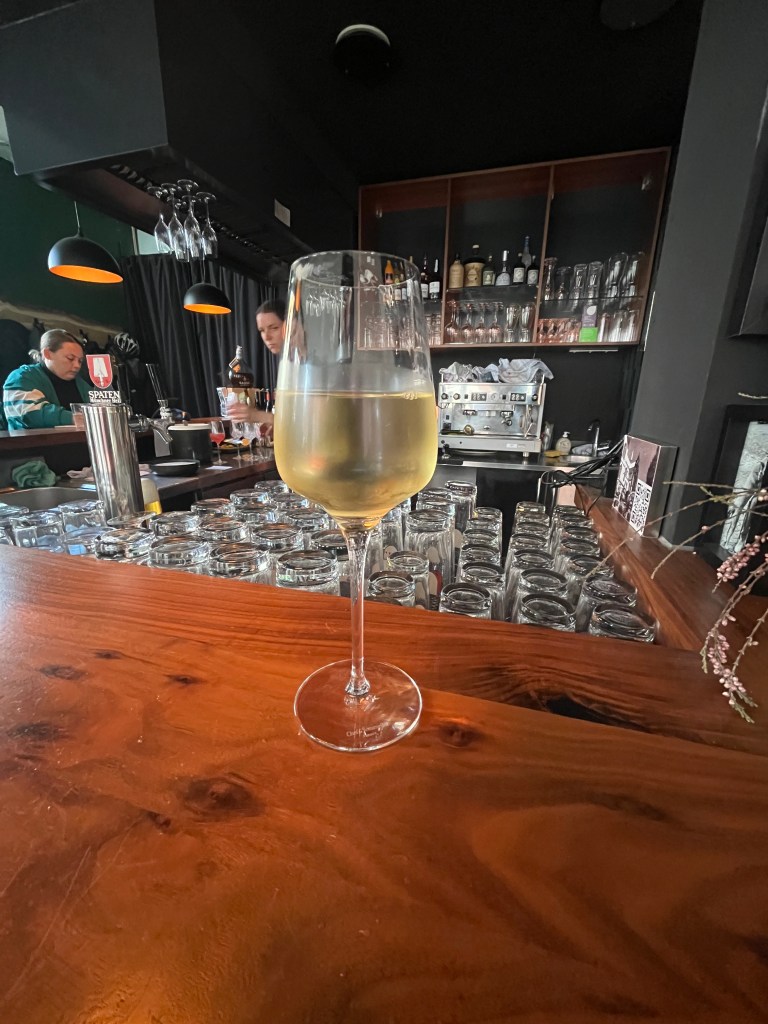
Entering the Altstadt (Old Town)Servatii-Kirche 1230St Clement’s Church 1745St Clement’s interior A German Sauvignon Blanc at Noennekens Bar
After the wine stop, I walked through a cold rain to St. Lambert’s to view the infamous iron cages. From there, I made my way to the St Paulus Dom (Cathedral).
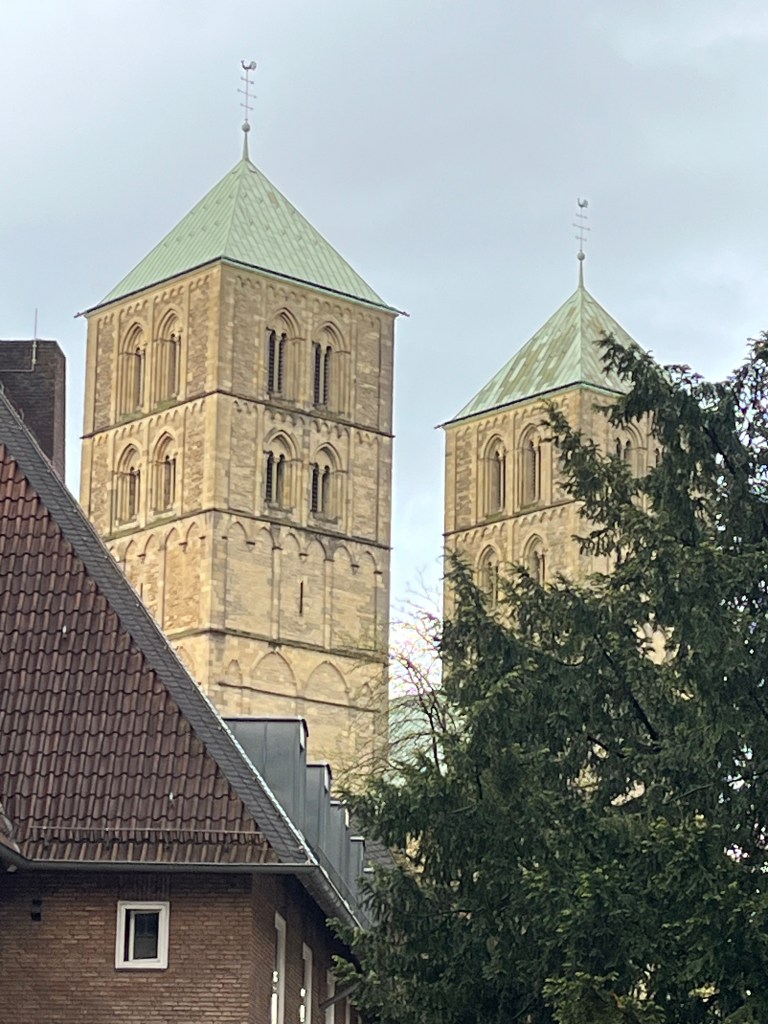
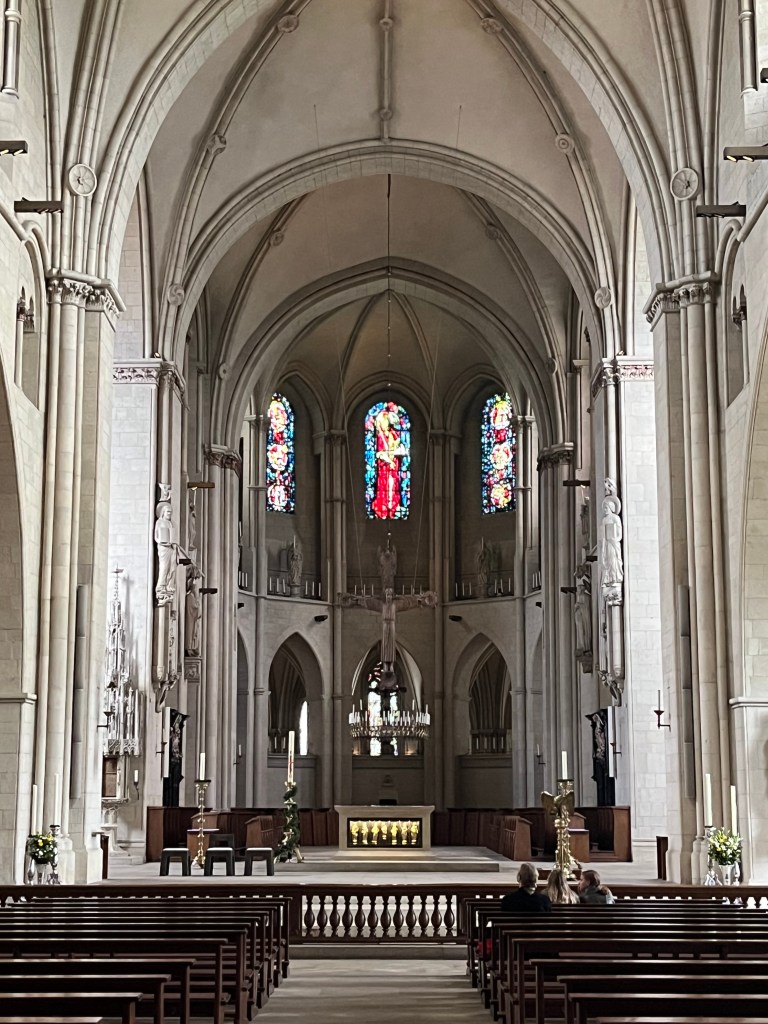
Cathedral 1Cathedral 2Cathedral 3Cathedral interior Cathedral towers from the pocket park
A docent at the cathedral invited me to come by around 6:30 for an organ concert. After another bout of rain, I took her up on her offer and stayed inside for about a half-hour enjoying some Bach and Liszt works before heading back to my Airbnb and grabbing a quick dinner at a cafe. I’m looking forward to perhaps renting a bike and exploring more tomorrow.
I awoke to a rainy, chilly morning after a deep sleep. The host had a Bosch induction stove and a metal Moka coffee vessel. I couldn’t figure out how to work either until I Googled them.
My three-hour bike tour of the city was scheduled for 10:00 am. Luckily, I called an Uber in time since the traffic was awful. The tour was just about to begin.
Our guide was a tall Dutchman named Jasper. Our group consisted of five Americans and two Aussies. Jasper, a guy from Cincinnati and I were the only guys. Two women from Connecticut, two from Sydney and a freshman from NYU filled out our group. Thankfully, I brought my foul weather gear so I was ready for a rainy, windy ride.
With the protected bike lanes everywhere, I never worried about cars. Jasper said there were about 3 million bikes in the city. As noticed yesterday, no one wears helmets, so neither did I. Touring the city by bike was wonderful, offering a different perspective from the previous night’s river cruise. We stopped at a cafe in beautiful Vondelpark where I had a cappuccino. The rain stopped until we jumped back on our bikes, of course. Jasper pointed out the sights, including the Anne Frank House from across a canal. There was a huge line awaiting entry. A visitor is advised to make reservations at least a month in advance. I wasn’t interested in waiting in line with tourists.
Jasper informed us that next year Amsterdam will be celebrating its 750th anniversary. I can’t imagine the crowds visiting next year.
After the tour ended, Anna, the NYU student, and I decided to grab some lunch. On the way, she mentioned that her mother was taking her to spend a week visiting an Orthodox Christian monastery in Romania in July. Her mother’s family fled the Soviet Union in 1945; her father’s from Romania. I didn’t ask about their political affiliations, although I suppose they may have been anti-Communists.
Over lunch, Anna shared her views on the students at NYU and the frustrations of Zoomer social life. She said that her fellow students are obsessed with Instagram and that she only made one friend. She claimed that half of the male students are gay and that the rest are largely incels! She’s met older guys at the bars near NYU, but they usually ghost her after a brief date. She feels that Canadians are nicer, but was frustrated when she and a friend went to Montreal and played pool with two Canadian guys who never asked how they were doing and simply smiled and left after the game. The bright spot in her life however is an Irish lad who she met in Dublin last summer. Liam wants to hang out with her in Dublin in a few months. Since she’s taking a semester off, she can travel whenever she likes. She’s really a very bright girl and I wished her well. She asked for my number and asked me to let her know whenever I’m back in New York. I haven’t been there since December 2014 and am unlikely to ever return; however, it’s always nice to meet a bright young person to enliven a random lunch!
By this time it was 2:30 and it was unlikely that I’d be able to grab a train to Haarlem and then wait for a bus to take me to my scheduled bike ride through the tulip fields. Besides, the weather was still unstable with high winds, so I decided to go for a long walk. It would have been a nice excursion in fair weather. At least I saw the thousands of tulips all around the city. To paraphrase a disgraced former US Vice President: “if you’ve seen one tulip, you’ve seen them all.”
The 17th century Westerkirk, the tallest church in Amsterdam
As the pouring rain resumed, I popped into an Amstel bar for a drink and watched the pedestrians and cyclists battle the rain before calling an Uber for the ride back to my place.
I’m glad that I packed so much into my two-day stay in Amsterdam. I’m not sure I’d want to spend more time there. Although it’s a lovely and historic city, the crush of tourists is a bit much for my traveling soul. I’m looking forward to my train trip to Münster, Germany tomorrow.
Amsterdam is one of the few cities in Europe that I haven’t visited. Although I’ve made connections through Schipol, I’ve never had a strong desire to visit Netherlands, mainly because it’s become such a tourist destination, as have a number of Western European cities. A few months ago, I found a great deal for a round-trip business class trip BNA-AMS/PRA-BNA, so I booked a three-week spring trip to Europe. After two nights in AMS, I’ll spend most of my time in Germany, visiting new cities, before ending up in Prague for my second time since visiting in September 2001.
The flights from BNA-MSP and then to AMS were on time and pleasant. The segment from MSP to AMS was in KLM business class on an older 777, but at least had seats that could be placed in a flat position for sleeping, although I doubt that I slept for more than an hour. My seatmate, an older woman named Tracy, was a pleasant conversationalist. She clearly was leading a comfortable retirement, living in Whitefish, MT with a summer house on Fire Island and a flat in Amsterdam, where one of her four kids previously lived. Coincidentally, she was born in Philadelphia, so we were born within a few miles of each other. Perhaps I’ll get invited to her summer house? She also showed me her boat, which she keeps on the South Shore of Long Island.
We arrived at AMS a few minutes early at the ungodly hour of 5:55. Since my Airbnb wouldn’t be available until 3:00 pm, and my reservation at the Rijksmuseum wasn’t until 10:30, I took the train from AMS to Centraal Station and grabbed a cappuccino at an Illy and hung out reading for an hour. The day was brisk and sunny, so I walked about 2 km. to a place near the museum where I could store my luggage, a great place recommended by my AirBnb host.
I was impressed with the expansive bike lane infrastructure of Amsterdam. Unlike the US, they have built protected lanes throughout the city, with their own curbs. One must be careful crossing streets since there are thousands of riders who don’t stop. They truly own the streets. I noticed that not one rider wore a helmet. An Uber driver told me that was the Dutch way.
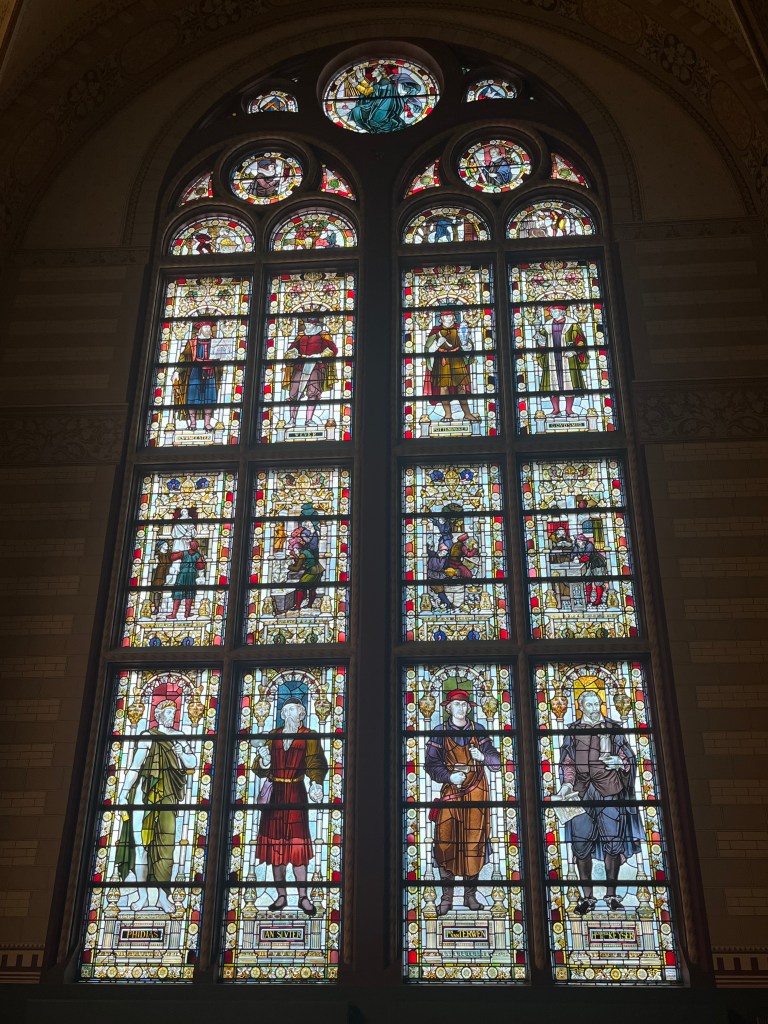
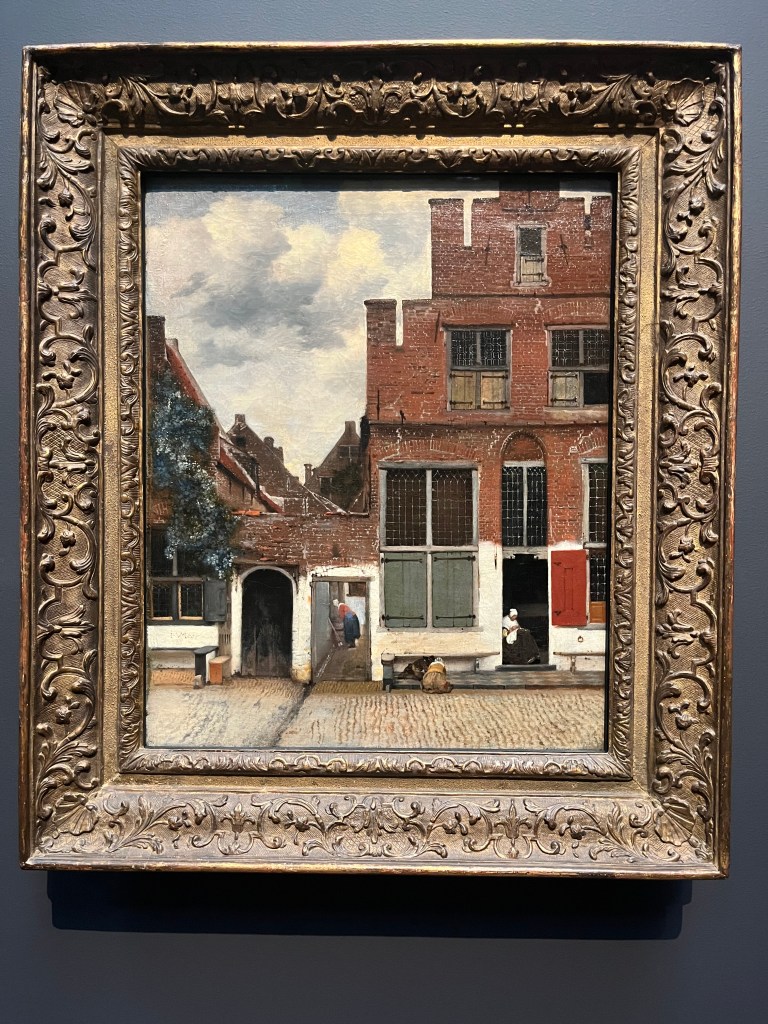
The Rijksmuseum was only a short walk from the luggage storage space, so I got there within minutes. The museum is vast. Aside from the huge selection of famous Rembrandts and Vermeers, there is also a whole section devoted to The Hague Impressionists, which was the Dutch version of the French movement. Another floor of galleries was devoted to the Dutch overseas empire, dominated by the mercantile activities of the VOC (Dutch East India Company) and the WIC (Dutch West Indies Company). The Dutch colonized not only parts of India and South Africa; they also had, and still do maintain colonial islands in the Caribbean. Until 1946 they also had Indonesia. They also had a colony in Brazil for a few decades in the late 17th century.
Rijksmuseum from the southInterior stained glassRijksmuseum from the northVan Gogh “Self Portrait”
After two hours in the Rijksmuseum, my exhaustion started to take its toll. The crowds were building, including a large crowd of Chinese tourists with selfie-sticks photographing everything in sight. I made my way down five flights of steps and headed outside to the adjoining gardens and sat down to enjoy the sun and briefly dozed off. I then walked across the Museumplein past several more museums, including the Van Gogh Museum, to look at the neo-classical Concertgebouw Orchestra.
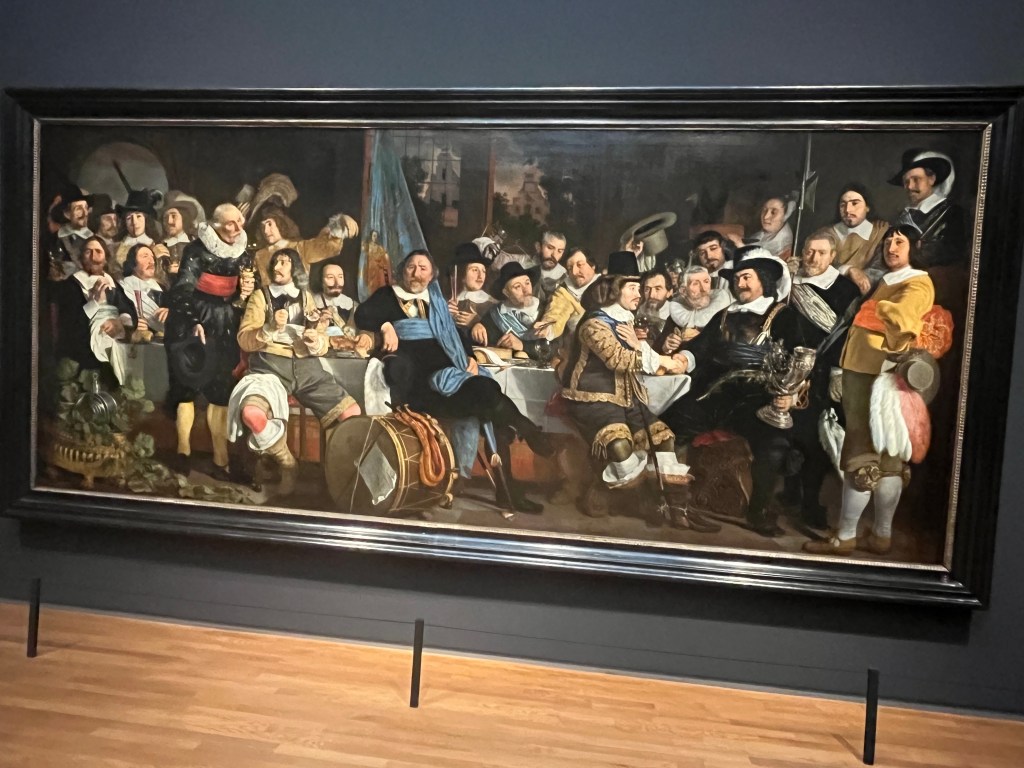
The Peace of Münster Rembrandt Museumplein gardensConcertgebouw Orchestra
After a late lunch, I walked down posh Pieter Cornelisz Hooftstraat where Hermés and the usual luxe brands are located before retrieving my bags and heading over to my AirBnb to check in.
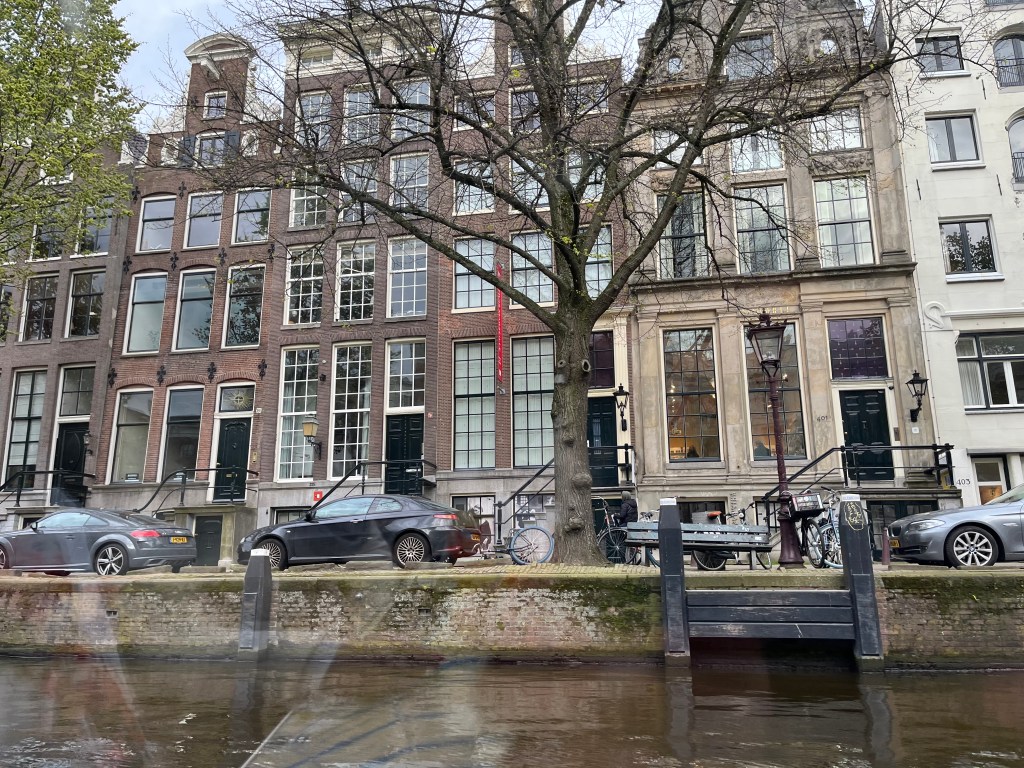
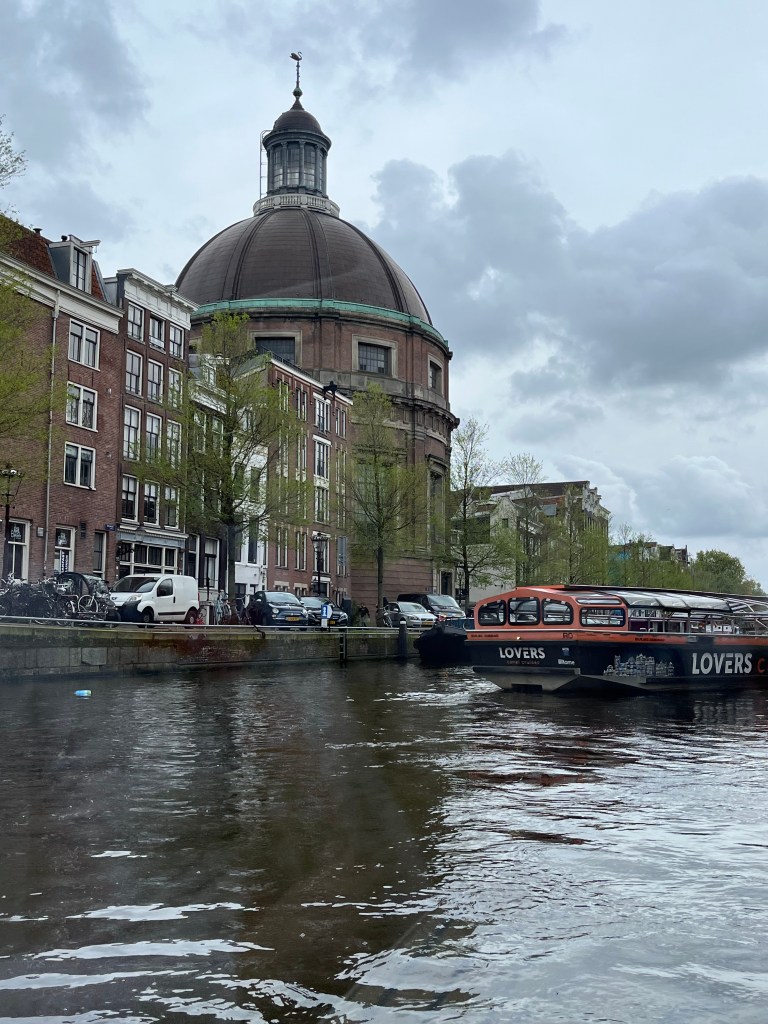
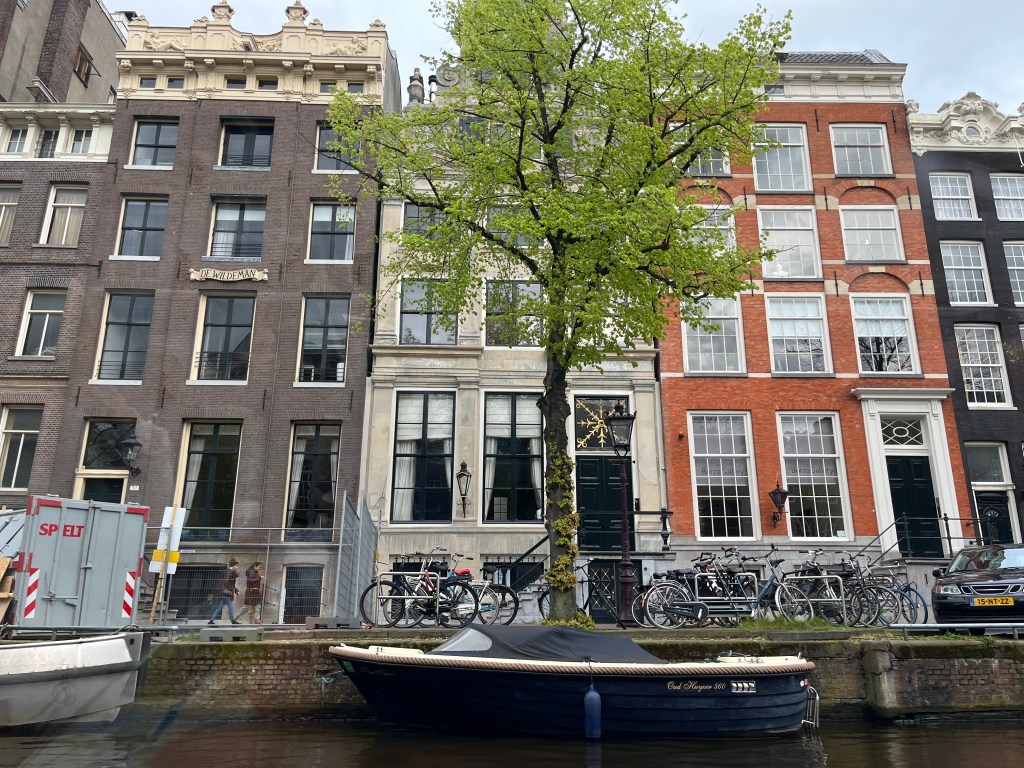
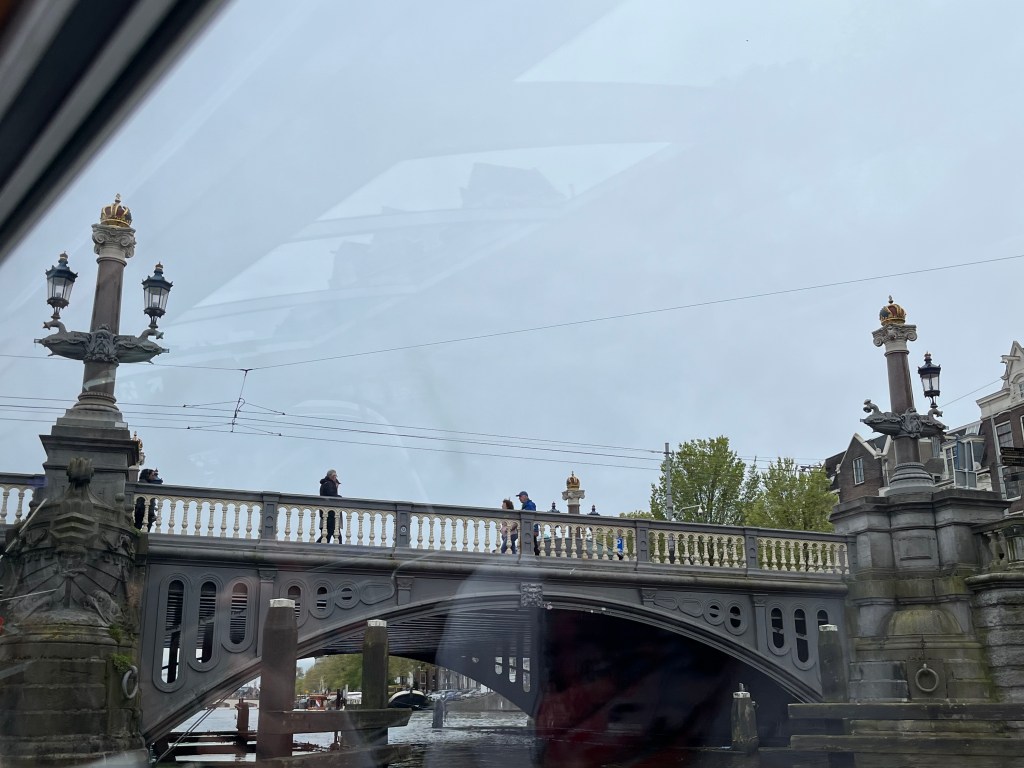
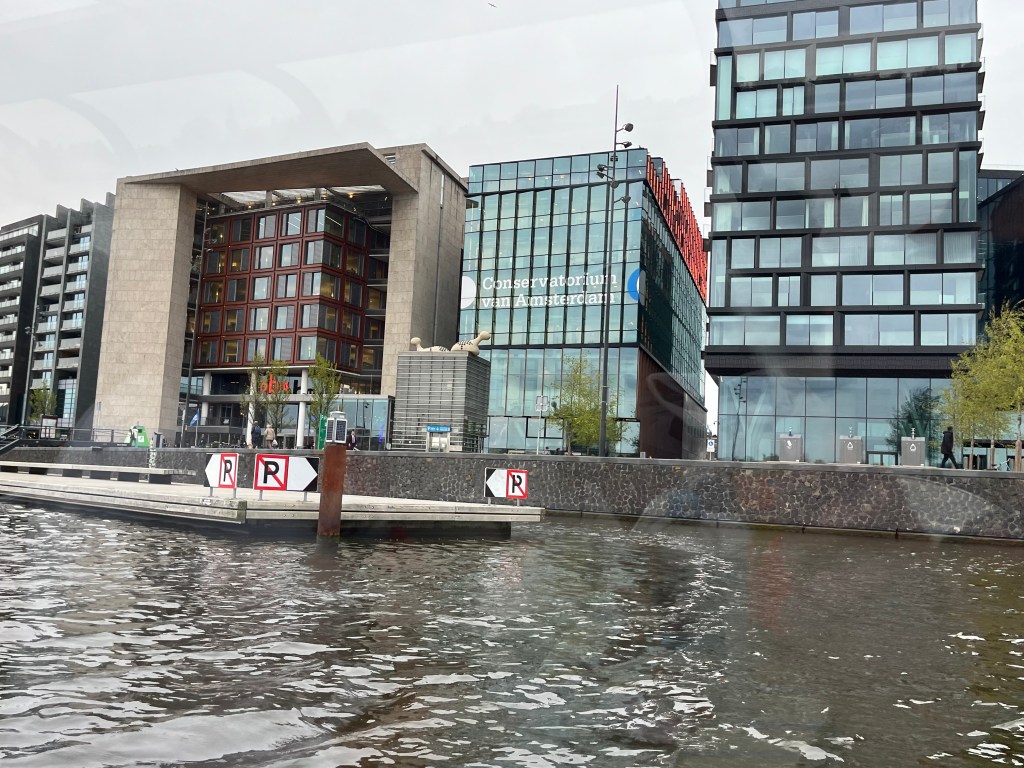
That evening, I booked a 90-minute boat tour of the rivers and canals of Amsterdam which was well worth it for the maritime perspective. The city is uniformly perfectly preserved and maintained. All of the 17th century warehouses have been converted into high-end residential housing overlooking canals and tree-lined streets. The cruise included a trip out through the River Amstel to the port areas and reclaimed industrial land.
By this time I was nodding off, so I headed back to my flat and fell asleep for nine hours. An exhausting day!
It’s hard to believe how terrified Americans were just three years ago. I’m currently at my summer refuge on Whidbey Island and I recall that my town had painted yellow lines every 6’ to make sure residents and tourist literally “toed” the line.
Americans have historically low levels of tolerance for difficult and coercive times. We recall the end of the Great Recession when Americans had had enough and began buying iPhones and iPads en masse and ended the recession. Nonetheless, there is a hard-core “bitter ender” remnant that continues to mask even astride bicycles on country roads. I don’t presume to analyze them, but is does seem neurotic.
Another terrified demographic is the elderly driver population on the island and in the Seattle area in general. A road that I often take has a posted speed limit of 45 mph through a scenic winding and wooded stretch. I swear that many of the drivers I’ve followed have set their cruise control at 37 for fear of a disaster. Then, as they make the gentle descent towards Bayview, they apply their brakes for the entire mile-long stretch. I simply take a few deep breaths and, exhaling and climbing the voice register, say “Terrified” in my best Frankie Valli impersonation.
































 Curated Carlos