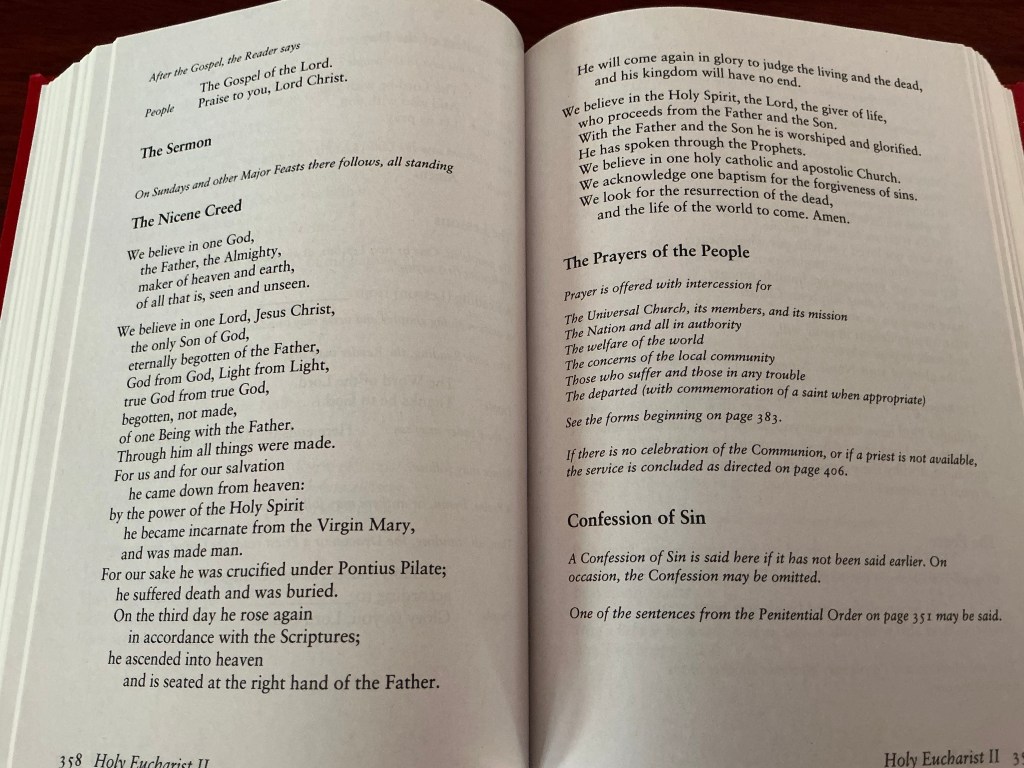
Several years ago, I was speaking with a Southern Baptist couple about Catholicism and, to my dismay, they asserted that the Roman Catholic Church wasn’t “Christian”. Although I left the Catholic Church as a teenager, I still remember its catechism and teachings clearly. I challenged their assertion and asked them if they were familiar with The Nicene Creed, formulated at the Council of Nicaea in 325 AD under the aegis of Emperor Constantine, who sought to create a unified Christian theology after decades of heresies and schisms. I was mildly shocked to learn that they were unfamiliar with perhaps the most well-known confession of orthodox Christianity (not Eastern Orthodox…small “o”).
When I recited the creed they were baffled since the agreed that they believed the same trinitarian confession.
It’s remarkable that the bulk of American Protestantism, riven as it is into tens of thousands of sects ranging from the Baptists to the Pentecostals, non-denoms and others, are unfamiliar with the Nicene Creed and do not incorporate it into their worship. Even more surprising, I’ve learned that most don’t even recite The Lord’s Prayer. The few times that I’ve been to non-denominational churches, I’ve been struck by not only the lack of liturgy, but even more so by the lack of reverence. The services always begin with praise music and an invocation by the praise minister. Then, the “preaching pastor” makes his (always a man) entrance, with a 45-minute sermon accompanied by a PowerPoint presentation. The congregation, lattes in hand, purchased at the coffee bar outside of the sanctuary, takes notes of the message. To me, these worship services recall the corporate sales and marketing meetings I’ve attended.
Today, the Nicene Creed is mainly recited in the Roman Catholic and mainline Protestant denominations. Given the antinomian bent of American Protestantism, I’m surprised that it still is used at times by Presbyterians, Lutherans, Methodists and some Reformed churches. Of course, it’s recited weekly at my Episcopal church.
Although I’ll be entering Vanderbilt Divinity School this fall, I’m certainly no theologian and am writing this without any research. Given the subject, however, it’s worth revisiting this magnificent creed and its precepts.
The opening sentences reaffirm the beliefs of the prophets in the omnipotent God the Father.
“We believe in one God, the Father, the Almighty, maker of heaven and earth, seen and unseen”.
These words affirm the beliefs of not only Christians, but would not seem alien to Jews or Muslims, or even Mormons.
“We believe in one Lord, Jesus Christ, the only Son of God…”
“For our sake, he was crucified under Pontius Pilate; he suffered death and was buried. On the third day he rose again in accordance with the Scriptures; he ascended into heaven and is seated at the right hand of the Father. He will come again in glory to judge the living and the dead, and his kingdom will have no end”
These words are accepted by all duophysite Christians.
And finally, the efflorescence of Trinitarianism and the New Covenant:
“We believe in the Holy Spirit, the Lord, and giver of life, who proceeds from the Father and the Son. With the Father and the Son, he is worshipped and glorified. He has spoken through the Prophets.”