-
Tomar: 22 September
The train from Santarém to Tomar was pretty empty and rolled through rich farmlands, interspersed with the occasional vineyard. Listening to the automated station directions, I was able to get a better sense of the Portuguese pronunciation.
I grabbed a cab at the Tomar station for a quick ride to my hotel, Hotel Dos Templarios (pronounced Tem-plar-ee-oosh, with the stress on plar) which was surprisingly large and fancy. Given the prominence of the Knight Templars’ massive Convento de Cristo on the heights above, the whole town echoes the Templar theme. Since I had two hours to kill before the 15:00 check-in, I left my luggage in the care of the front desk and walked up the steep path to the famous Convento.
Founded in 1160, the fortress underwent successive additions through 1587, during the height of the Templars’ power. As I wrote in the Sintra post, they became so powerful that the French Pope Clement IV demanded their disbandment; however, Dom Denis simply changed the Templars’ name to Ordem Cristo, the Order of Christ. They largely funded the Age of Discovery and subsidized Henry the Navigator. They also played the leading role in expelling the Moors from Portugal in the late 15th century.
The place is massive and lavishly decorated. They even built an aqueduct to bring fresh water to the cloisters. In particular, the hexagonal main chapel is unique. It’s said that the knights attended Mass there on horseback. The Convento is the main draw in Tomar. Unlike Santarém, there was a significant tourist presence.
After checking in, I headed to the large outside pool for a swim. Although hot, this area is inland enough to maintain low humidity and dew points, so it’s not uncomfortable at all. After the pool, I popped by the bar for a large sparkling water and struck up a conversation with Francisco, the bartender. He said that the summer wildfires had raged nearby, though there was no evidence of them in the immediate vicinity of Tomar. His last name, Pinha (peen-ya), I found interesting, and he told me that it was a derivative of “pine cone”. The etymology of surnames is an interest of mine, so we talked for a while about Portuguese names. Some common Portuguese names: Silva from blackberry bush; Perreira from pear tree; Figuiera from fig tree; and Pineira from pine tree. He said that some of these names associated with trees and plants derive from the Moorish occupation era. The area just to the north of Tomar marked the limit of the 4-century Moorish conquest. Looking back in time, the earliest settlers were the Lusitani tribe. They were conquered by the Romans, who were eventually displaced in the 4th and 5th centuries by the Visigoths, who Francisco explained were fleeing from Attila the Hun. He said that explains the genetic diversity of the people who range from olive complexions to blond and light-eyed.
For dinner I chose Landeira, a traditional Portuguese restaurant in the charming old town. Since I was the only diner sitting outside at 7:15 (Portuguese eat around 9) I had a chance to chat with the server, Marta, and the manager, Fabio. They suggested I start with the vegetable soup, which was tasty, followed with the chicken cooked in a clay pot. The meat fell off the bone. Fabio used to work in Porto, so he wrote down some suggestions for traditional Francesinha restaurants. That is a regionally well known Portuguese sandwich. After finishing, and as the place started to fill up, I wandered through the cobblestones alleys and enjoyed the suddenly cool air, gazing up at the floodlit Convento above. On the short walk back to the hotel, I passed through a beautifully lit public garden.
At the hotel bar, I asked Francisco for some port recommendations. He had four bottles from the producer Messias. I tried the Tawny followed by the vintage. The after-dinner drinks served as a fitting coda for a most enjoyable day.
-
Santarém Day Two: Sept. 21
Often when traveling, I don’t like to overplan my day. This morning, I had some coffee, hit the rather mediocre hotel gym, and then showered and had breakfast. I decided to just wander around the extensive historic district for the day.
One thing I’ve noticed while traveling here and in most of Europe over the years is that there is no visible homeless problem. Also, I’ve seen little litter. Even though Portugal has one of the lowest per capita GDPs in the EU, the people seem well dressed and able to enjoy a decent standard of living, although fairly in-depth conversations with younger Portuguese today belie that statistic. I’ll include a recap of those conversations at the end of today’s post, which I will finish on Thursday morning. Now it’s time to finish the Portuguese Nobel Prize winner Jose Saramago’s classic, Blindness.
Santarem is not a well-visited city, since it’s in the Ribatejo and off the beaten foreign tourist route, although the Portuguese themselves are interested in this important historical town. It is the birthplace of Pedro Cabral, the Portuguese who discovered Brazil in 1500 and claimed it for the king. He’s buried in the Convento da Graça, one of several Gothic churches in Santarém. I wandered into about 7 churches, built between the 12th and 16th centuries. The styles include Gothic, Mannerist, Manueline and Baroque. The Manueline churches were funded by the lucrative spice trade with India and the East, and this style is named after King Manuel I. The latter style churches are quite ornate, including the cathedral. The Gothic churches are pretty spare, since, according to one staffer, many of the churches and monasteries fell into disrepair and the interior statues, etc. were removed for safekeeping and restoration but were never returned.
For a small city, Santarém boasts a large and busy old town. As I mentioned, there were few tourists and in some of the museums and churches I was the only visitor. One of the jewels of the old town is the Jardim das Portas do Sol. I spent some time there looking at the superb collection of trees and viewing the vast agricultural lands watered by the Tejo from the crenelated heights of the medieval walls. The gardens featured a large outside aviary with exotic birds, including some vivid green and blue ones.
One of my favorite things to do while traveling overseas is to casually chat with locals to gain a better understanding of the area in which I’m traveling. Sometimes I wonder if, after our conversations, they imagine that I may have been an agent of an intelligence agency!
At the Convento da Santa Maria Graça, I chatted with the young staffer, Ricardo, about his thoughts on Portugal. He said that the economy was a total mess and that the current government was utterly corrupt. As I was to hear later in the day, the younger people are quite worried about their futures. He said that the economy was better in the 60’s and 70’s, when Salazar’s Novo Estado was in power. Interesting, since the Novo Estado was authoritarian. I remember hearing the same wistful thoughts about Tito in the former Yugoslavia. Now, much rich agricultural land, especially in the south near the Algarve, lies dormant. Many of the industries have left, including the fashion sector, which manufactured shoes and clothing for many famous French and Italian brands. Now, only tourism really drives the economy.
One interesting detail I uncovered is that the leader of the 25 April 1974 coup against the dictatorship, Sergeant Salgueiro Maia, was from Santarém and it was he and other junior officers who marched on Lisbon from Santarém as members of the Armed Forces Movement. In Portugal, it’s often called the Carnation Revolution since jubilant crowds placed red carnations in the barrels of the soldiers’ carbines. Ricardo showed me on my map where Sgt. Maia’s statue was and I took a photo on my way back to the hotel.
The oldest site I visited was the Convento de Saõ Francisco, built in the early 13th-century. Some of the original building has collapsed, but much of it has been restored. I noticed pigeon droppings so there must be a rookery in the ceiling.
Finally, I popped into the Convento da Santa Clara, built in the Gothic style. There were two university students associated with Santarém tourism staffing a table inside. We had a lengthy chat about several subjects, as they were eager to share their opinions. As Ricardo mentioned early, they didn’t see much future in Portugal given the rampant corruption and dismal economy. They were both in their final years of university.
They shared that the educational system was rigorous, too rigorous in their opinions. They also mentioned something that I’d heard before, that the Portuguese language was one of the most difficult idioms to learn.
Even nurses and doctors were underpaid, they said, and the nurses, in particular, often left for the UK and Germany to earn much higher wages. They weren’t sure what they were going to do, but expressed interest in crypto currencies and finance. Most Portuguese are encouraged to save in banks that pay very low interest rather that in stocks and bonds, as in the US. They stated that it’s hard to learn about these investment strategies, with instructions along these lines running about 250 EUR out of a typical monthly salary of 750 EUR.
The theme of government corruption is a widespread complaint among the younger generation. Spain, with almost four times the population, has fewer members of parliament. The Portuguese go into politics to get rich. They claimed the people are complacent and that the aging population simply expects the government to raise pensions and continues to elect the same crooked politicians. Surprisingly, many of the young support the Right, unlike the US. They mentioned a young politician named Andre Ventura, the head of the Chega party. Coincidentally, I saw a Chega billboard on my way back to the hotel. They seem desperate for some kind of change, although it’s not clear how that will happen.
Even though the day was hot, in the 80’s, by the time I walked back to the hotel, it was much cooler and breezier.
I’m looking forward to grabbing the train to Tomar later this morning to see the city famous as the headquarters of the Knights Templar. I’m glad to have spent two nights in Santarem, a really historical and attractive town.
-
Óbidos to Santarém
After coffee, I found a nice trail that ringed the walled old city and wound through a forested area. I saw one guy walking his dog and a woman running. I headed back to the hotel to catch up on emails and other tasks before checking out and walking across the street to the bus stop for the 10-minute ride to the terminal in Caldas da Reinha. I had about 40 minutes to kill before the bus to Santarém, so I walked into a grocery store and bought a package of sliced cheese to snack on. A 200 gram package was 1,59 EUR. In the US it would’ve been 3 times as much.
The bus ride to Santarém was clearly a local. It took an hour and 15 minutes. The Mercedes Benz buses are new and air-conditioned and not crowded. It sure beat taking the train back to Lisbon and then heading north on another train. In the hinterlands the people are mostly native Portuguese. You can see the facial characteristics of the 16th-century explorers in their faces, especially the younger ones. They’re good-looking people. They’re quieter than Americans and aren’t constantly looking at their phones. I always notice the details when I travel.Santarém is in the Ribatejo, along the Tagus River. It was in the low 90’s when I got there mid-afternoon, but very dry, unlike the more humid areas near the Atlantic. After checking into the hotel, my first “luxury” accommodation, I went to my top-floor room to plan the late afternoon activities. Around 5, I headed into the historic center. Although it was 90, the humidity was low, so the 30-minute walk into the historic core was tolerable. I walked by several 400-year old churches and found one that was open, the Church of Misericórdia, built in 1552 and rebuilt after the 1755 earthquake. Its organ, built in 1818, is quite well known in musical circles. The church is now a municipal property and the sacristy is open for tours. It’s really stunning.
As the thunder started, I walked into a covered cafe for a water and a glass of wine. Although threatening, the storm never really arrived as predicted, though the temperature dropped to a comfortable 75. I made an online reservation at one of the renowned restaurants in town, Taberna Ó Balcão, run by chef Rodrigo Castelo. I arrived as they opened, at 7:00 pm. Of course, at that hour, I was the only one there, but the staff were fantastic. I had a local soup and small river shrimp dish to begin, and an exquisite cod main course. The server explained all of the details of the preparation, which I can’t fully recall, but it was incredible. The ambience was country chic, with a full view of the kitchen. After a leisurely 90 minutes, I walked 15 minutes back to my hotel under a gentle sprinkle.
-
Óbidos
Comboios de Portugal trains run on time, unlike Amtrak. The train to Óbidos from Lisbon’s Santa Apolónia station was pretty empty. The two-hour ride through the countryside and vineyards was pleasant. When we reached the small Óbidos station, it was raining. Since the station is about a kilometer downhill from the fortified hill town, one needs to call a taxi, which I did. There were about 5 other passengers who were perplexed. They were from Spain and spoke little English and no Portuguese, so I chatted with them in Spanish and invited them to ride with me. The taxi arrived within seconds and we were in the center in a few minutes and split the modest 6 EUR cost.
My hotel, Josefa d’Óbidos, was right there, so after checking in I walked up the hill to the historic walled part of town. The rain had ended and the weather turned sunny and humid. I was drenched by the time I got through Port Da Vila, the main gate into the walled town, established by the Moors before the 12th century and reclaimed by the Portuguese in 1228. I walked on top of the wall, a distance of almost 1600 meters, up and down. By this time, the sun was broiling. I found a shaded open-air esplanade, Esplanada Santa Maria, where I grabbed a tuna salad and some mineral water. The majority of the patrons, indeed most of the tourists, were retired people from Spain and France, with a few Britons, Americans and Canadians sprinkled among them. After a nice respite in the shade, I visited the historic Igreja (church) de Santa Maria, built in the XVI century. The tiles (azulejos) were magnificent, along with a Renaissance tomb in the style of the Pieta and paintings by Josefa de Óbidos, a 17th-century painter.
The main street was pretty kitschy and thronged with slow walkers. Those of you who are familiar with my pace know that I like to move quickly, so I was happy to be outside the walls again.
The town also has a 3 km aqueduct, which I walked along later in the afternoon.
I’d really hoped to eat at Tasca Torta, but, alas, it was small and all the tables were reserved. So I walked into a little place and had the freshly grilled sea bass. The service was painfully slow, but the fish and vegetables were fine.
One of my favorite things while traveling is to chat with the front desk people, who always know all the local lore and things like bus schedules. I was concerned about how to get to Santarém from Óbidos, but the receptionist showed me how quickly one could get there by bus and printed out the schedule. Happily, the stop is right outside of the hotel. She also was telling me about the nationality of the tourists who were most annoying. We both laughed about that.
Although a charming and ancient town, one night is sufficient. The hotel was excellent and the atmospheric village was great to see.
-
Cascais with new friends
Yesterday Yan (Ian in English), Emily and I agreed to meet around 10:00 AM at the Cais do Sodre terminal for the train to Cascais. After my obligatory coffee at A Brasileira in Chiado, I walked down to the station to meet my new friends and we boarded the 10:20 train for Cascais, a 40-minute ride. The ride was along the Tejo and then the Atlantic, passing under the 25 de Abril Bridge, built in 1966 and very similar to the Golden Gate Bridge. We also passed the upscale resort and community of Estoril. When we walked out of the Cascais station, Joanna was there to meet us and we jumped into their venerable 2000 Audi A4 wagon with 300,000 km under its belt. Pedro grew up in Cascais so we really were in store for a guided tour with true locals.
First stop was a magnificent beach inaccessible to tourists without a car. The sand was white and clean and the waves were just right. Ian, Pedro and Joanna waded into the surf, but Emily and I dove right in. The water was cool but refreshing. We spent about 15 minutes diving under the waves and then it was time to head to our next destination. Pedro drove us up a mountain road to a viewpoint with 360 degree views of the Atlantic, Sintra and much of Lisbon. The Serra de Sintra runs 16 km from Sintra to Cabo da Roca on the Atlantic and is said to be the ancient hunting grounds of the Roman goddess Diana. From the mountains, we headed back to town to the Lidl supermarket, since we decided to forego a restaurant meal and grab picnic foods instead. Again, I was amazed at the huge selection of superb bread and rolls, most of which were under a Euro.
From Lidl, we headed to a great spot in the forest overlooking a lake and laid out blankets and enjoyed a great picnic lunch, sharing regional ghost stories. We then drove to another peak in the Serra for more panoramic views and photos before heading to the city of Cascais.
Our fantastic hosts walked us through the marinas and a lovely city park. We then walked along the waterfront past 800 Euro per night hotels and estates to the historic town center, where we stopped at Santini, which is said to be the best ice cream in Portugal. No one argued against that claim. I had a small cup with a scoop of Framboise and Vanilla. If I lived there, I’d gain 20 pounds!
Pedro showed us the yacht club for which he sailed competitively for years. His team came in third in an international regatta. He’s still a member, which makes his sailing father happy since the initiation fee is quite steep.
It was finally time to drop us off at the train station so we could catch the 8:40 train back to Lisbon. I spent almost ten hours with new friends and was grateful to have befriended locals who graciously spent their Sunday showing us Cascais and its environs. Fortunately, I’ll see Pedro and Joanna in three weeks when I’m back in Lisbon. Ian heads back to Montreal tomorrow and Emily flies to Italy for a few days in Cinqueterra tomorrow.
On the train ride back, we discussed the electoral systems of Canada, the US and Australia. I think they finally understood our Electoral College system, which baffles most non-Americans. We bade each other good-bye at the station and headed back to our respective places. Quite the marvelous day!
-
A Day In Sintra
Sintra is known as a “must see” while visiting Lisbon. It’s a 30-minute train ride from Lisbon Rossio Station, a 6 minute walk from my AirBnb. I bought a round-trip ticket and jumped on the 10:01 train 3 minutes before departure. The train was standing room only. I was surprised to see how large the metro area was. Lisbon has a number of satellite cities with large numbers of high-rise condos and freeways. as we got closer to Sintra, it became more wooded and mountainous.
Upon arrival, I walked a few meters to a monument where two women were standing with “free tour” signs. I asked Claudia, the English-speaking guide, if she had any spots left and she said she did. So I registered on the site and we were off at 11:00.
As we started the tour, I met a couple from the Poconos and I mentioned that I was from the Philadelphia area and went to Franklin & Marshall College. Immediately, I heard the woman behind me exclaim that she, too, was an F&M grad; in fact, a member of the first coed graduating class. Nicoletta graduated in 1973 and she and her husband were visiting from Manhattan. She told me that she often meets fellow grads on her travels, which is amazing for a small liberal arts school.
Claudia, like most younger Portuguese, spoke English fluently, with an American accent. I was told that American movies and TV shows are subtitled, which helps them with the pronunciation. They also have the option to study English in primary school, which most do.
Her command of the history of Portugal and Sintra was superb. When visiting one of the few churches in Sintra, she invited us to wander in and then tell the group what we found unusual. Several odd things were reported: the church had no windows, just painted ones, there was a Masonic triangle with golden rays and a pulpit high on the wall with no visible door. This led to her explanation that the church may have been founded in the 13th century by the Knights Templar, thus the imagery. She explained that the Pope at the time demanded that all realms dissolve the Knights since they had grown too powerful for Rome’s liking. The Portuguese king demurred: they simply told the Pope that he had obeyed. What he actually did was change the order’s name to Ordem Christo. We all shared stories of Freemasonry and had a great time finding out that we all shared a similar fascination. I told them that the old East German Communist flag featured a Masonic symbol in the middle.
We continued toward several palaces and grand houses.
Sintra has fascinated writers and poets for centuries. Lord Byron and Hans Christian Andersen were among the enraptured visitors. The city is now a UNESCO site and was a favorite of royals and the elite for centuries. Its location high above the Atlantic provides a much more temperate climate than Lisbon, and the vast forests and misty mountains give it a mystical air.
As the tour ended, we all tipped Claudia and thanked her for a fantastic afternoon. Of course, many of us started introducing ourselves and six of us decided to have a late lunch at a wonderful place called Romaria de Baco. I ordered a recommended cod dish made with sweet potatoes and spinach, which was amazing. Among our group were a Portuguese couple, a Canadian from Montreal, a nurse from Australia and a Welsh nurse practitioner from Southampton, England. We started guessing ages: they ranged from 22 to 32. They were shocked to hear my age. We love compliments! The two nurses left for a tour of the Palacio Nacional da Pena, while the Portuguese couple, Joanna and Pedro, and the young Canadian, Yan, and I went by car to tour the Palacio & Parque de Monserrate, which was beautiful. Afterwards, Pedro and Joanna drove Yan and me to a train station by their house and we grabbed a train for the very quick ride back to Rossio station.
At lunch we made plans to take the train to Cascais, where Pedro and Joanna will meet us and give us the locals tour, since they lived there.
Meeting this wonderful group of young people is one of the great joys of travel and being engaged with fellow tourists and locals. It demonstrates the innate goodness of most people and the human desire to make new friendships and explore countries as a group. We all exchanged Instagram information and Pedro set up a group WhatsApp. Now I’m off to the station to meet Yan and Edith for the train to Cascais!
-
Day Two: September 16
To start off, it’s frustratingly difficult to pair WordPress with a MacBook. After online research, my frustration appears to be common. It’s almost impossible to export photos from a Mac device to WordPress, so I’m going to wait until I do more research. As with many Apple devices, they don’t play well with PC-oriented apps.
I visited the Lisbon Botanical Gardens and the attached Museum of Natural History. Although nothing like Longwood Gardens, it was worth the 4 Euros. It is built on a steep hill, so plenty of climbing. The museum was really excellent. The collection of minerals and metal ores, in particular, was fascinating. It also featured a comprehensive collection of the flora and fauna of Portugal. One section was dedicated to the medicinal plants collected from the colonies in Angola and Mozambique, including quinine.
After the museum tour, I walked down the avenue to a Portuguese restaurant and was seated in the terrace. I had the cod, in Portuguese “Bras” style. It was a bit different from the night before, but equally delicious. I couldn’t finish it. Of course the roll that was served would have been classified as “artisanal” in the US. Any readers who have traveled in Europe know that we Americans have to pay dearly for bread that merely equals everyday bread in Europe.
I had booked a three-hour “Seven Hills” e-bike tour that began at 3:00 PM, so I walked downhill to the riverfront and headed east to the Alfama district. The early afternoon heat was intense, with humidity, so I rushed into the Museu Militar to escape the sun for an hour before the ride. It was worth the 2 EUR admission. There were 27 large rooms chronicling Portuguese military history from the Crusades through the colonial wars that raged from 1961 to 1974 in the African colonies. I had understood that Portugal had remained neutral in both world wars; but, apparently they sent an expeditionary force to France on the Allied side in World War I.
It was a short walk to Lisbon Bike Tours where I was among the eight riders. The lead rider was Antonio, assisted by his associate Sara. We were pleased that they had fairly new e-bikes. My fellow riders included two Americans, two Nederlanders and two Austrians. The three-hour tour was excellent and the weather turned more moderate as we rode. We saw most of the sites on the eastern side of the historic core, much of which I’d walked the previous day. Antonio and Sara helped me with the difficult Portuguese pronunciation and complimented me on my accent. Since I have friends from Nashville and Dallas coming in October, we agreed to set up a custom e-bike tour for them. We ended the ride with shots of a Portuguese cherry liqueur.
I headed back to the Central Market since I was too lazy to research restaurants in my neighborhood. I enjoyed braised pork cheeks with mushrooms and mashed potatoes and worked that off on the steep climb back to Chiado. I had a drink at a neighborhood bistro and slept nine hours.
-
First Day in Lisbon: 15 Sept
After a restful sleep, I went out for coffee and grabbed two cappuccinos to go from around the corner and headed back to the apartment to plan the day. I walked down from Chiado, my neighborhood, to the Baixa, along the riverfront. I walked along the Rio Tejo to the atmospheric Alfama district and then started climbing. My first stop was the Pantheon, modeled after its namesake in Paris. There were monuments to many of the great Portuguese explorers, statesmen and writers, including Vasco da Gama and King Henry the Navigator. It’s impressive that little Portugal once controlled a vast empire, starting in 1500. They established forts in India, the Persian Gulf and China. The Jesuits made contact with the Japanese in Japan and it’s said that the Japanese arrigato (thank you) is derived from the Portuguese “obrigado”. They also colonized Brazil and vast areas of Africa, including Angola and Mozambique. They fought a long war against Marxist guerrillas in their African colonies until the Revolution of 1974 and the overthrow of the Caetano regime by the military. The views from the terrace of the Pantheon were stunning.
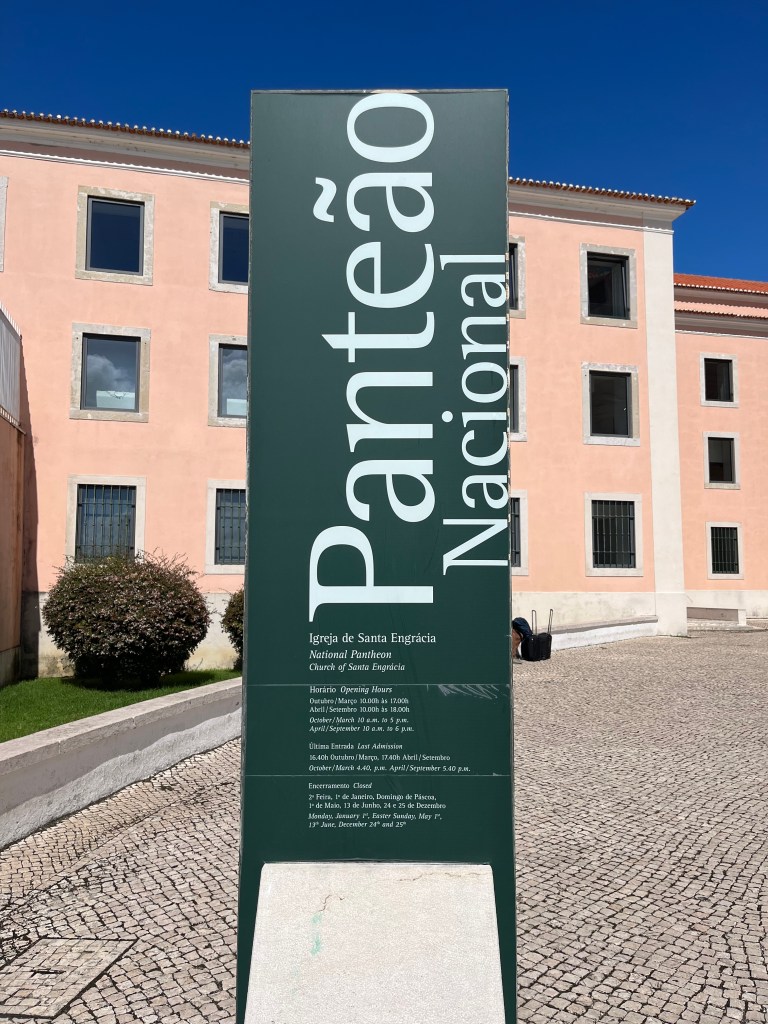

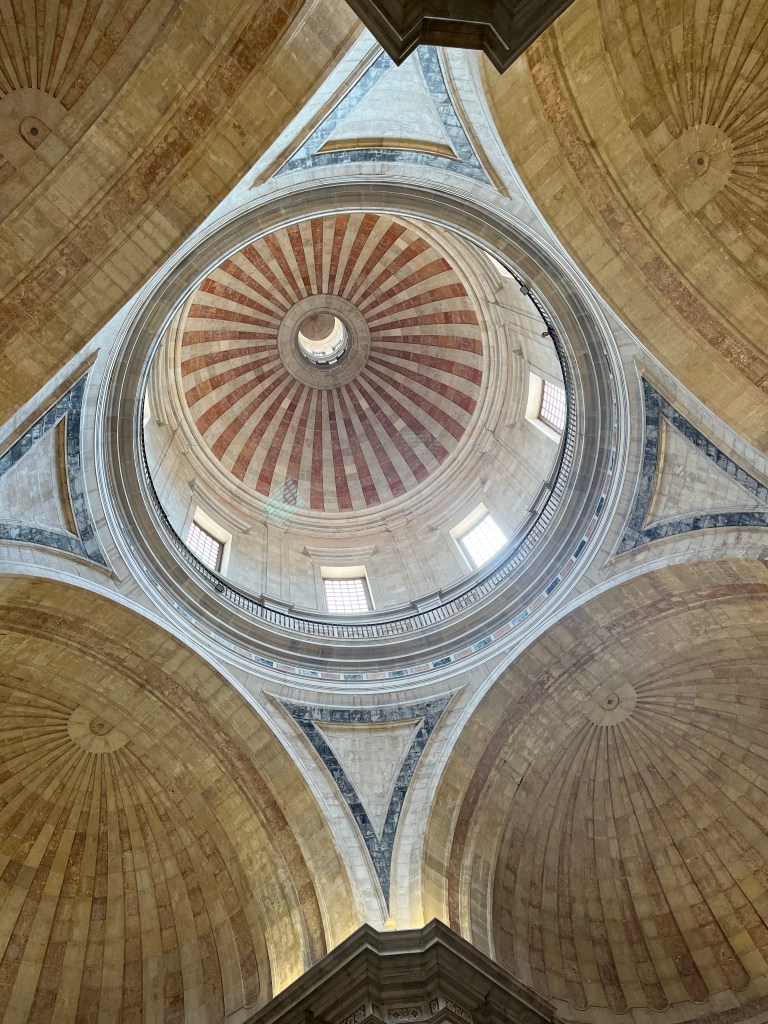
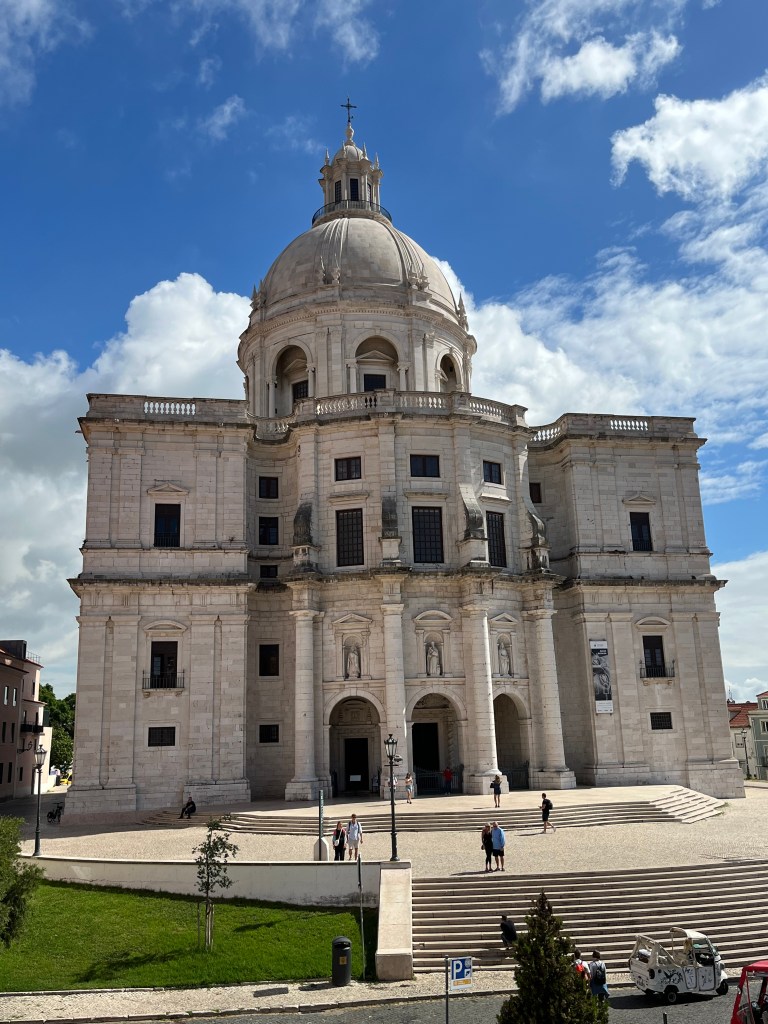
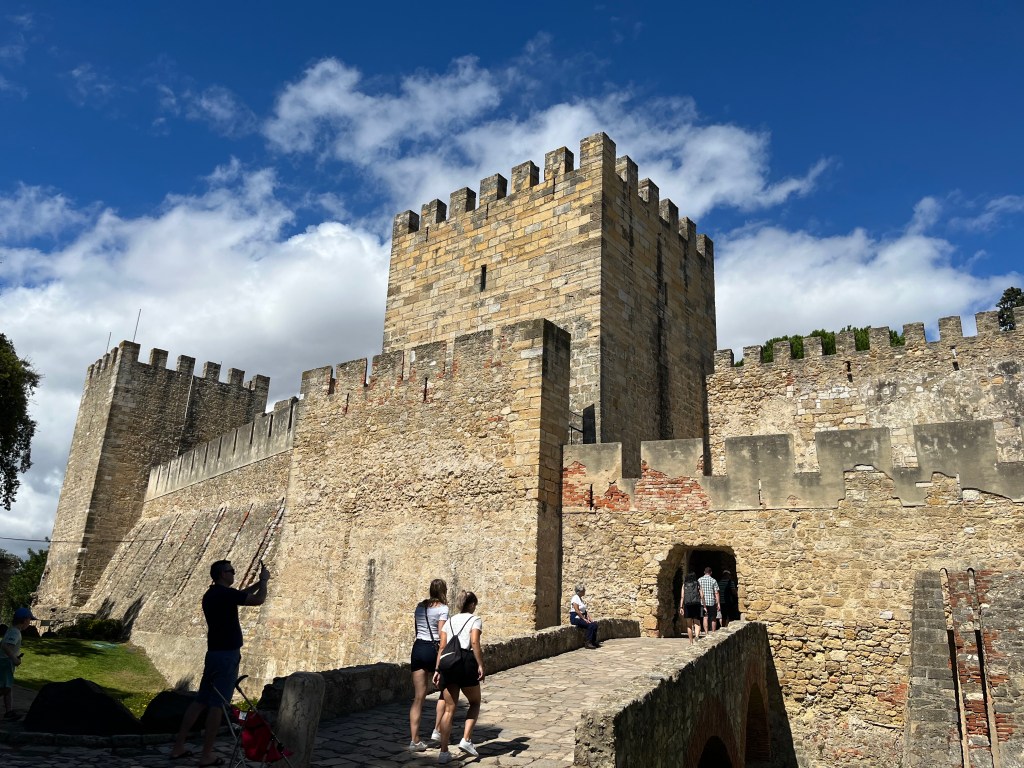
After the Pantheon, I headed uphill, not an uncommon direction in Lisbon, to the Castelo de Sao Jorge, which dates from the 13th century. The castle remains in pretty fair shape. It’s in the Alfama district, which dates from the Moorish times and means “hot springs” in Arabic. The views from the castle are magnificent.
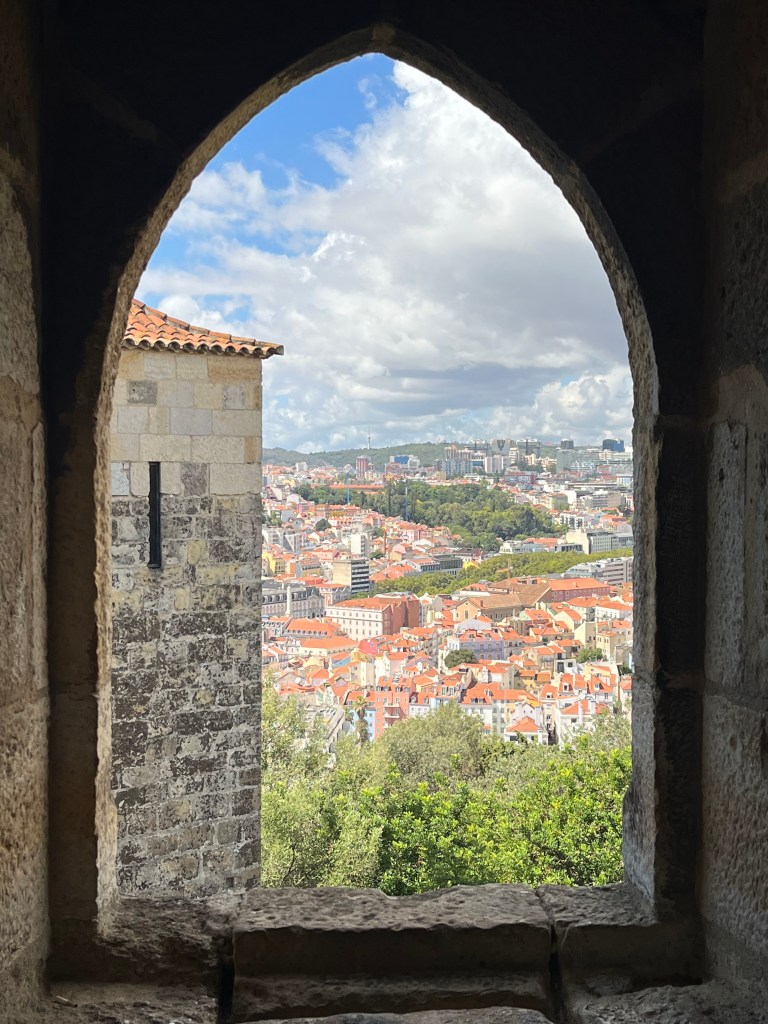
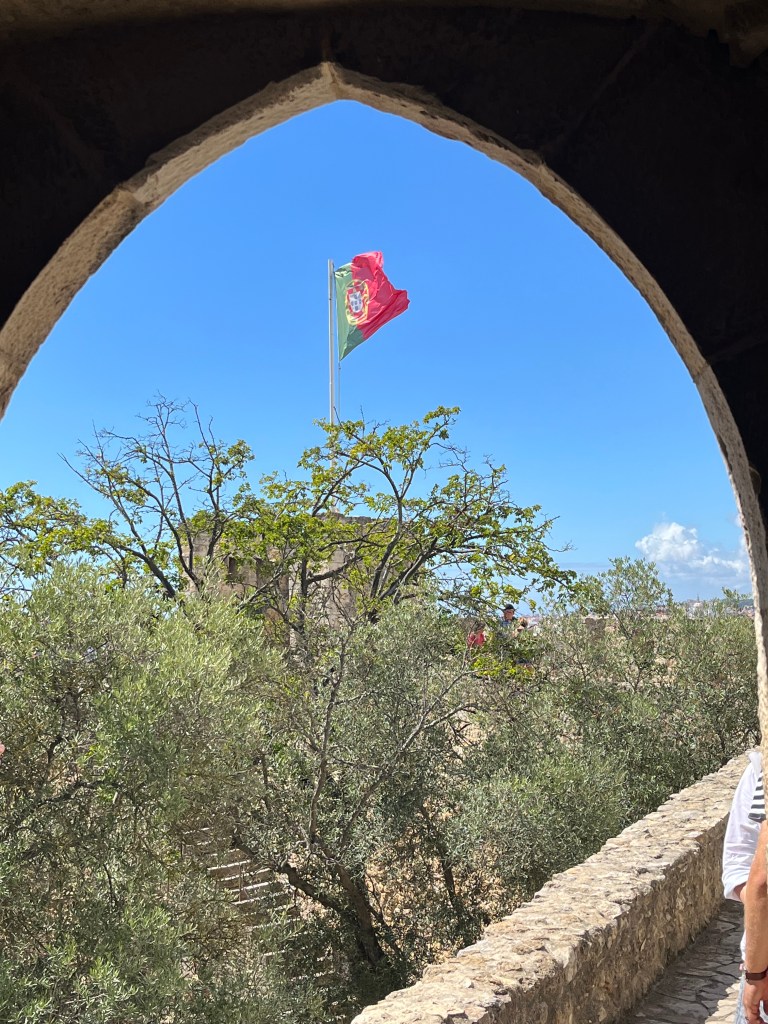
Also in the Alfama is the stately Mosteiro de Sao Vicente de Fora, one of the famous Portuguese monasteries. Built during the early imperial years, it has all the gold and gilt one might imagine.
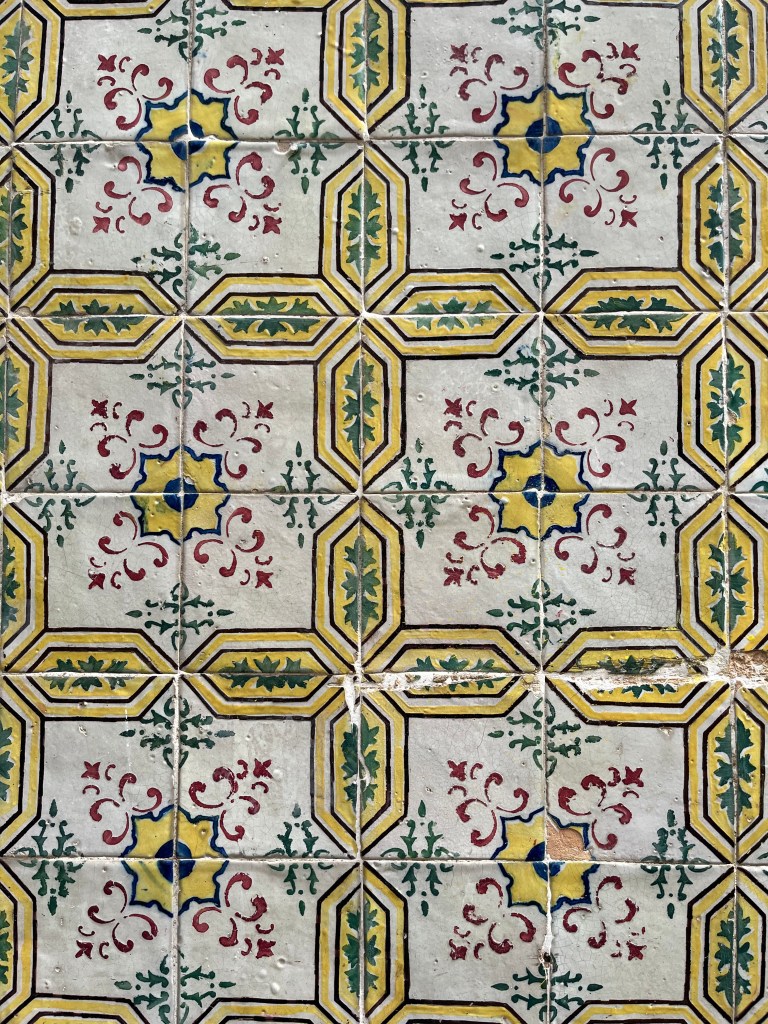
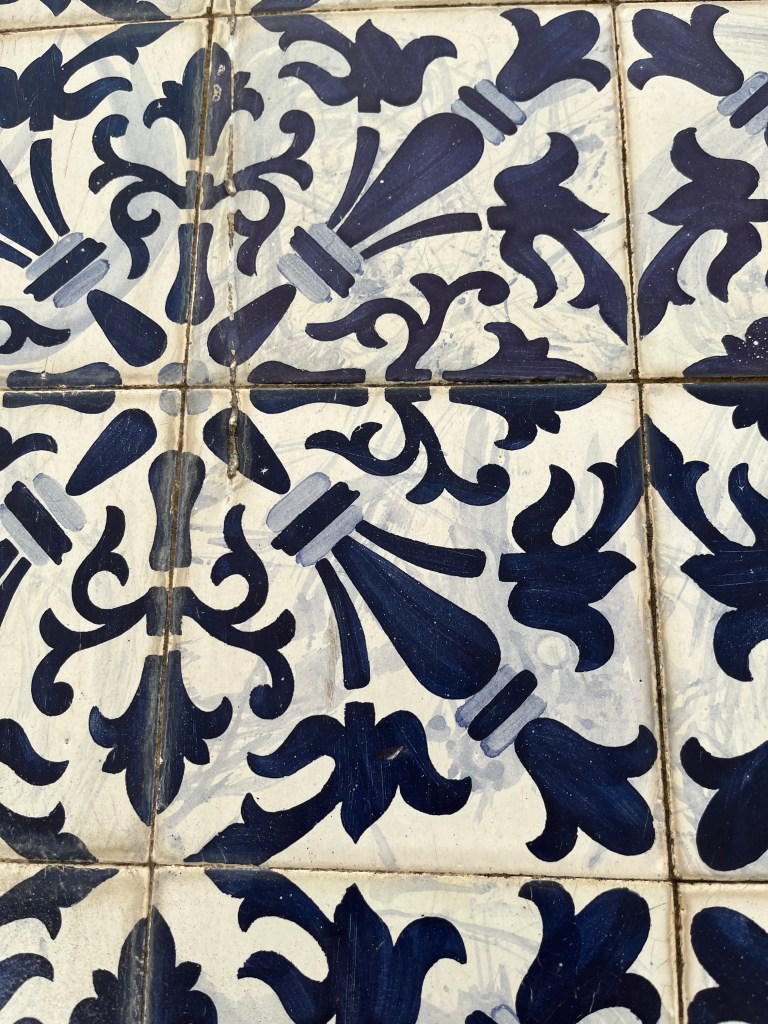
Lisbon is also famous for its tiles. I took some pictures from just one neighborhood and was amazed by the variety.


I’ve always been interested in foreign languages and Portuguese is an interesting one. One commonly assumes that it’s similar to Spanish; but, it’s quite different. The Portuguese will tell you that they understand Spaniards; but Spaniards don’t understand Portuguese. Many of the words are similar; for example, por favor and de nada. But others are not. Obrigado is thank you and Calle is Rua, pronounced Hu-a. In Portuguese, the Spanish “l” is replaced with “r”. Plato is prato. They also pronounce the “j” in English style: Jose is Joe-say. I’m learning more words as I go. I think that I’ll be able to handle simple Portuguese by the end of my trip.
From the Castelo, I walked a few kilometers to one of the famous miradouros, or viewpoints, called Graca. From there, the vista is westward, across the Baixa to Biarro Alto and Chiado, which are also higher up. I returned to the riverside down some significant steps through an immigrant quarter. Since it was an imperial power, there are quite a few residents from their African colonies of Angola, Mozambique and Guinea-Bissau. Nonetheless, it was perfectly safe.
The owner of the AirBnb suggested that I visit the Central Market on the riverside for dinner and I’m glad I followed her advice. It’s sponsored by TimeOut magazine and is a massive food hall with stalls from some of Lisbon’s famous chefs. I had some cod in the traditional “Bras” style and it was excellent. You sit at common tables. I’m sure native Lisboetas deride it as a tourist trap, but I’d recommend a visit.

My journey home was, of course, uphill. When I checked the Steps app, I saw that I’d walked 13.7 miles with 66 climbs. I crashed that night despite the jet lag.
-
The Long Journey
Although the BA flight to London was supposed to depart Nashville at 8:35 PM, it was delayed by two hours because they were waiting for a “VIP” to get through customs. A fellow traveler, Tyler Reeve (a country music singer), said it was a US Marshal. In any event, the special passenger decided to remain in Nashville and we finally left shortly before 11 PM. Dinner was served around 11:30. Fortunately, I was able to grab a few hours sleep on the nice business class fold-down bed. Once we landed at HTR, I saw that I’d received a text from BA confirming my seats on a later flight, so I decamped at the BA business lounge while waiting to board my flight to Lisbon. The BA staff were really great. Aside from the late departure, it was a pleasant flight.
I’d been a bit concerned about HTR, since they have an intrusive security clearance program; however, the line that I was in didn’t require opening bags or placing liquids in plastic bags. I was through security in less than ten minutes.
The flight to Lisbon went well. All I had to do at the airport was swipe my passport and I was out. I’m glad I opted for carry-on.
I grabbed an Uber to my Airbnb and met my host, Maria, at the front door. It was a steep climb up five flights of stairs to the apartment. An obese or elderly person would’ve had a hell of a time.
Maria was great. The apartment was on the top floor with sweeping views. Great bed and bathroom. I grabbed a light dinner at a little outdoor bistro next door and then took a nice walk up the hill to the viewpoint. Lots of tourists walking around at the late hour. After ascending the stairs to my place I took a shower and finally hit the sack. I closed the windows and turned the AC on and slept over nine hours. Very quiet.


-
Hello World!
Welcome to WordPress! This is your first post. Edit or delete it to take the first step in your blogging journey.
-
Subscribe
Subscribed
Have a WordPress.com account? Log in now.

